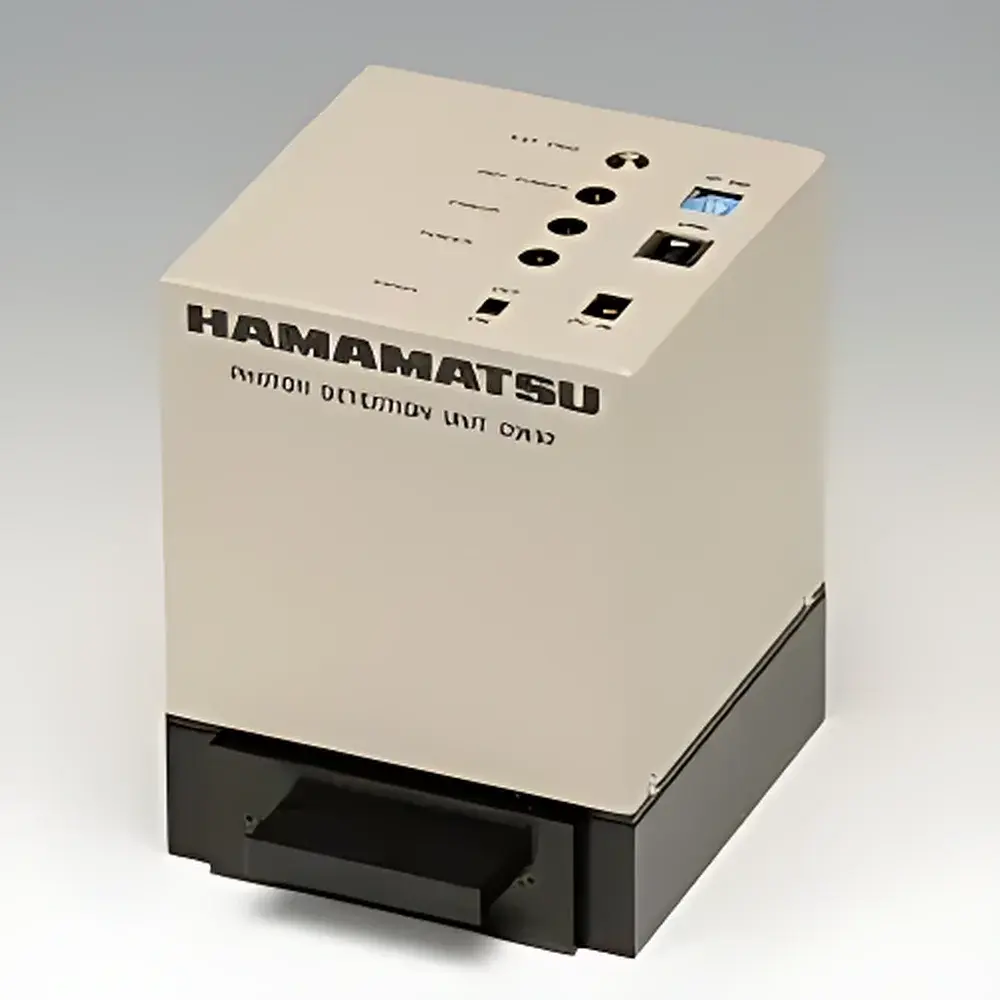
Hamamatsu C9692 Photon Counting Module
| Brand | Hamamatsu |
|---|---|
| Origin | Japan |
| Manufacturer Type | Original Equipment Manufacturer (OEM) |
| Product Origin | Imported |
| Model | C9692 |
| Pricing | Upon Request |
Overview
The Hamamatsu C9692 Photon Counting Module is a compact, self-contained detection system engineered for quantitative measurement of ultra-low-light signals at the single-photon level. It integrates a high-gain, low-noise photomultiplier tube (PMT), optimized high-voltage power supply, pulse processing electronics, and digital counting circuitry into a single shielded housing. The module operates on the principle of photon-electron conversion followed by time-resolved pulse discrimination and digital accumulation—enabling direct photon flux quantification without external amplification or analog-to-digital conversion stages. Designed for laboratory and industrial environments where signal integrity, timing fidelity, and minimal setup complexity are critical, the C9692 delivers high reproducibility in applications requiring sub-picoampere current resolution and nanosecond-scale temporal response.
Key Features
- Integrated photon-counting architecture with built-in PMT, HV supply, and TTL-compatible digital output
- Optimized for spectral sensitivity in the 185–650 nm range, with peak quantum efficiency exceeding 35% at 400 nm
- Dark count rate ≤ 100 counts per second (cps) at ambient temperature (25 °C), enabling high signal-to-noise ratio in low-flux regimes
- Dead time < 35 ns, supporting maximum count rates up to 5 × 10⁶ cps with linear response maintained to ≥95% of full scale
- USB 2.0 interface with vendor-provided SDK (C/C++, Python, LabVIEW) for real-time data streaming and configuration control
- Compact aluminum housing (85 × 60 × 35 mm) with EMI/RFI shielding compliant with IEC 61326-1 for electromagnetic compatibility in shared lab environments
Sample Compatibility & Compliance
The C9692 module is compatible with standard optical interfaces including SMA-905 fiber coupling (optional adapter available) and free-space input via integrated quartz window. It supports integration into fluorescence lifetime spectrometers, time-correlated single-photon counting (TCSPC) systems, luminescence decay analyzers, and quantum optics test benches. From a regulatory perspective, the module conforms to ISO/IEC 17025 requirements for measurement traceability when used with NIST-traceable calibration sources. Its electrical safety design complies with IEC 61010-1 for measurement, control, and laboratory equipment. While not certified as a medical device, it meets essential performance criteria referenced in ASTM E2889–13 (Standard Practice for Calibration of Single-Photon Detectors) and supports GLP-compliant data acquisition workflows when paired with audit-trail-enabled software.
Software & Data Management
Hamamatsu provides the “Photon Counting Utility” software suite for Windows-based configuration, real-time histogramming, and export of timestamped count data in CSV and HDF5 formats. The SDK supports deterministic acquisition modes—including fixed-duration counting, gated counting synchronized to external triggers (TTL/CMOS), and continuous streaming with user-defined binning intervals. All acquired datasets include embedded metadata (timestamp, integration time, HV setting, temperature reading from onboard sensor). When deployed in regulated environments, the software architecture permits integration with third-party LIMS platforms and supports 21 CFR Part 11 compliance through optional digital signature modules and configurable user access levels.
Applications
- Fluorescence correlation spectroscopy (FCS) and fluorescence lifetime imaging (FLIM) in biophysics and cell biology
- Quantum key distribution (QKD) receiver validation and single-photon source characterization
- Low-level chemiluminescence and bioluminescence assays in pharmaceutical QC laboratories
- Raman spectroscopy signal enhancement in standoff detection and process analytical technology (PAT)
- Calibration transfer standards for radiometric and photometric reference instruments
- Time-of-flight (ToF) measurements in lidar prototyping and ultrafast laser diagnostics
FAQ
What is the recommended operating temperature range for stable photon counting performance?
The C9692 is specified for continuous operation between 15 °C and 35 °C; active cooling is not required, but ambient temperature stability within ±1 °C is advised for long-term dark count consistency.
Can the module be triggered externally for time-gated measurements?
Yes—it accepts TTL/CMOS-compatible trigger inputs with programmable delay (0–10 ms, 10 ns resolution) and gate width (10 ns–10 s), enabling synchronization with pulsed lasers or modulated light sources.
Is NIST-traceable calibration available for this module?
Hamamatsu offers optional factory calibration using primary-standard photodiodes traceable to NIST SRM 2270, delivered with uncertainty budgets and calibration certificates compliant with ISO/IEC 17025.
Does the module support multi-channel coincidence detection?
No—the C9692 is a single-channel counting module; however, multiple units can be synchronized via common clock and trigger lines for parallel acquisition in custom-built coincidence logic setups.
What maintenance is required during routine use?
No periodic maintenance is required; the sealed PMT and solid-state electronics ensure >50,000 hours MTBF. Users should avoid exposure to ambient light above 10⁻⁴ lux during operation and store the module in its protective case when not in use.