
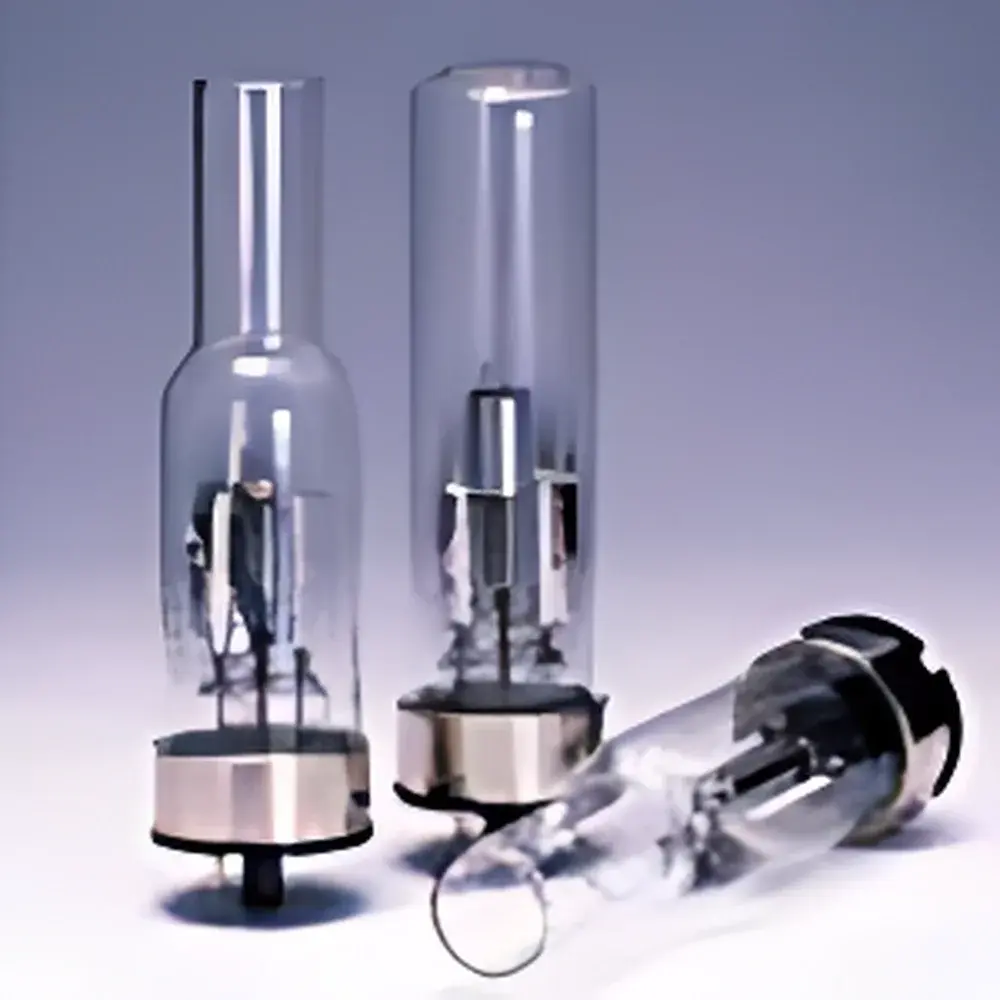
Hammatsu Hollow Cathode Lamp (HCL) for Atomic Absorption Spectroscopy
| Origin | Japan |
|---|---|
| Manufacturer Type | Authorized Distributor |
| Import Status | Imported |
| Model | HCL Series |
| Pricing | Available Upon Request |
Overview
The Hamamatsu Hollow Cathode Lamp (HCL) is a precision-designed, low-pressure gas discharge lamp engineered specifically for atomic absorption spectroscopy (AAS). Operating on the principle of cathodic sputtering and resonant line emission, the HCL generates narrow, element-specific spectral lines by vaporizing and exciting target metal atoms within a sealed quartz envelope filled with inert neon or argon gas. When a high-voltage DC current is applied across the hollow cathode (fabricated from the analyte element or its alloy) and anode, ions bombard the cathode surface, ejecting atoms into the gas phase; these atoms are then excited and emit characteristic radiation at wavelengths defined by their electronic transitions. This mechanism ensures high spectral purity, excellent intensity stability, and minimal self-absorption—critical requirements for quantitative trace metal analysis in compliance with ASTM E1947, ISO 11885, and USP .
Key Features
- Element-specific spectral output with linewidths typically < 0.002 nm (FWHM), optimized for AAS monochromator resolution
- 66 single-element lamp variants available, covering essential metals including Ag, Al, As, Ca, Cd, Co, Cr, Cu, Fe, K, Mg, Mn, Na, Ni, Pb, Se, Zn, and rare earths such as La and Yb
- 7 multi-element lamp configurations (e.g., Ca–Mg–Zn, Fe–Mn–Cu–Zn, Na–K–Li), enabling rapid sequential analysis without lamp replacement
- High-purity cathode construction using ≥99.99% elemental targets; sintered or machined geometries ensure consistent sputtering efficiency and extended operational lifetime (>5,000 mA·h typical)
- Hermetically sealed quartz envelope with integrated getter to maintain stable internal gas pressure over time
- Standard 1/4″–28 UNF threaded base compatible with all major AAS instrument mounts (PerkinElmer, Agilent, Shimadzu, Thermo Fisher)
Sample Compatibility & Compliance
HCLs are used exclusively as primary line sources in flame AAS (FAAS) and graphite furnace AAS (GFAAS) systems. Their emission profiles are fully compatible with deuterium or continuum-source background correction methods. Each lamp undergoes factory calibration against NIST-traceable reference spectra and is supplied with individual spectral verification reports. The lamps meet IEC 61000-6-3 (EMC emissions) and IEC 61000-6-2 (immunity) standards. For regulated environments, lamp usage logs—including operating hours, current settings, and spectral validation dates—can be integrated into GLP/GMP-compliant audit trails when paired with compliant AAS software platforms.
Software & Data Management
While HCLs are hardware components without embedded firmware, their operational parameters are managed via the host AAS instrument’s control software. Modern AAS platforms (e.g., Agilent AA 240FS, PerkinElmer PinAAcle series) support automated lamp identification through encoded EEPROM chips (optional on select Hamamatsu models), enabling instrument recognition, recommended current presets, and usage tracking. All spectral data generated during lamp qualification—including peak intensity, asymmetry index, and baseline noise—are exportable in CSV or XML formats for inclusion in laboratory information management systems (LIMS) and FDA 21 CFR Part 11–compliant electronic records.
Applications
- Regulatory environmental testing: quantification of heavy metals (Pb, Cd, As, Hg) in drinking water per EPA Method 200.9 and ISO 17294-2
- Pharmaceutical quality control: elemental impurity screening in active pharmaceutical ingredients (APIs) per ICH Q3D guidelines
- Food safety analysis: detection of nutritional minerals (Ca, Fe, Zn) and contaminants (Al, Sn) in infant formula and dietary supplements (AOAC 984.27, ISO 11171)
- Geological and metallurgical assay: determination of trace elements in ores, slags, and alloys using matrix-matched calibration
- Academic research: fundamental studies of atomic line broadening, self-absorption effects, and sputtering dynamics under controlled discharge conditions
FAQ
What is the recommended operating current for Hamamatsu HCLs?
Optimal current varies by element and lamp design; typical ranges are 5–25 mA for most single-element lamps. Exceeding maximum rated current accelerates cathode erosion and shortens lamp life.
How often should spectral verification be performed?
Initial verification upon installation is mandatory; subsequent checks are advised every 100 hours of operation or prior to critical analyses, per ISO/IEC 17025 clause 5.9.2.
Can multi-element lamps replace single-element lamps without loss of sensitivity?
Multi-element lamps offer convenience but may exhibit reduced intensity per element and increased spectral interference risk; single-element lamps remain preferred for regulatory-grade quantitation.
Are Hamamatsu HCLs compatible with Zeeman-effect background correction systems?
Yes—provided the lamp’s spectral profile meets the system’s modulation bandwidth and intensity stability specifications (typically ±0.5% RMS over 30 minutes).
Do these lamps require warm-up time before measurement?
A stabilization period of 15–30 minutes at operating current is required to achieve thermal equilibrium and spectral reproducibility, as specified in ASTM E1553.




