
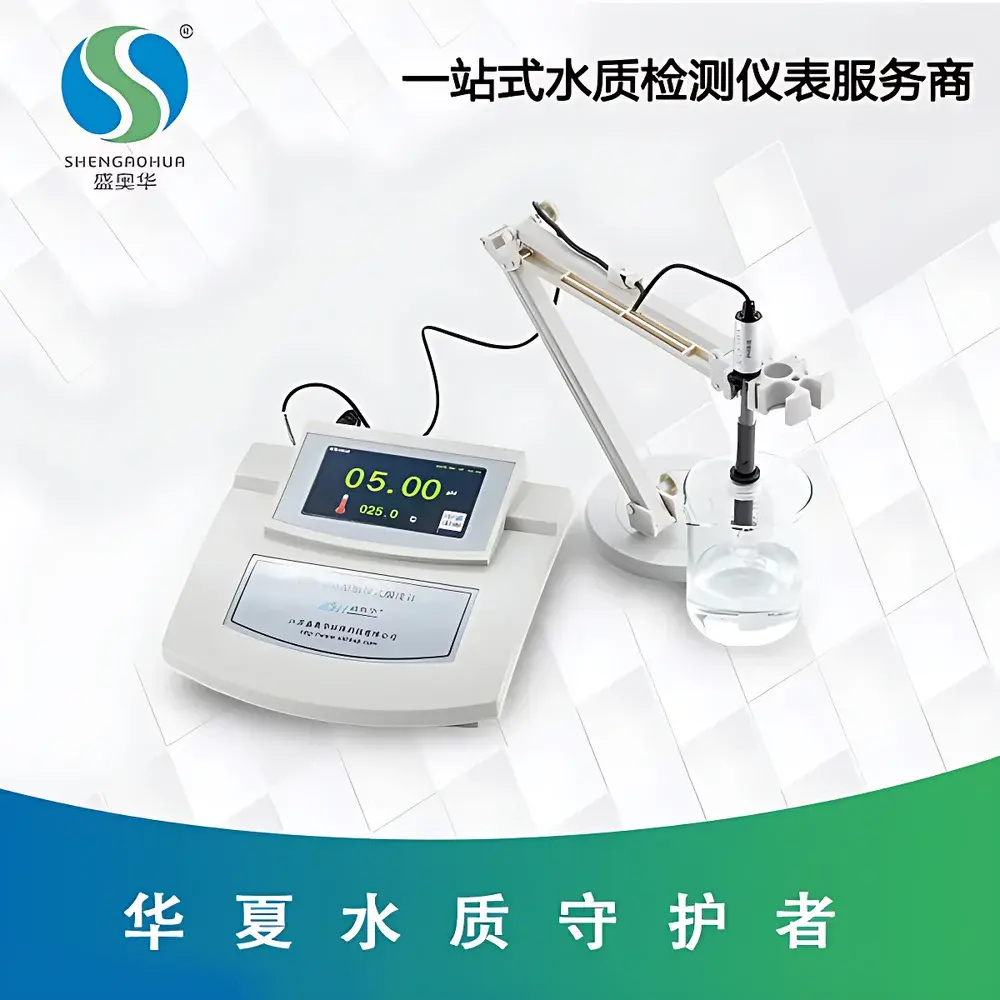
Shengaohua PHS-300 Touchscreen Benchtop pH Meter
| Brand | Shengaohua |
|---|---|
| Origin | Jiangsu, China |
| Manufacturer Type | Direct Manufacturer |
| Instrument Type | Benchtop |
| Model | PHS-300 |
| Measurement Parameters | Dual (pH and mV) |
| pH Accuracy | ±0.01 |
| pH Range | −2.00 to 16.00 |
| mV Range | −1000 to +1000 mV |
| pH Resolution | 0.01 |
| mV Resolution | 1 mV |
| Temperature Compensation | Automatic (0.0–60.0 °C) |
| Temperature Sensor | PT1000 |
| Calibration | Auto-buffer recognition, 3-point calibration |
| Standard Buffer Compatibility | NIST-traceable (Chinese national standard version) |
| Instrument Class | 0.01-level |
Overview
The Shengaohua PHS-300 is a high-precision, touchscreen-enabled benchtop pH meter engineered for routine and quality-critical electrochemical measurements in regulated and research laboratory environments. Based on potentiometric measurement principles, the instrument determines hydrogen ion activity via a glass electrode–reference electrode pair, converting the resulting potential difference (in mV) into calibrated pH values using the Nernst equation. Its dual-parameter capability supports both direct pH quantification and redox potential (ORP) analysis in millivolt mode—essential for process validation, environmental monitoring, and formulation development. Designed to meet ISO/IEC 17025-aligned operational rigor, the PHS-300 delivers consistent 0.01-level accuracy across its extended pH range (−2.00 to 16.00), enabling reliable characterization of strongly acidic or alkaline samples common in pharmaceutical effluent testing, caustic cleaning validation, and advanced material synthesis.
Key Features
- Capacitive full-color touchscreen interface with intuitive icon-driven navigation—eliminates mechanical button wear and improves glove-compatible operation in QC labs.
- Auto-buffer recognition algorithm that identifies standard pH 4.01, 7.00, and 10.01 (NIST-traceable Chinese national standard buffers) during calibration—reducing operator error and ensuring traceable calibration records.
- Integrated PT1000 temperature sensor with automatic temperature compensation (ATC) across 0.0–60.0 °C—minimizing thermal drift without manual input or external probes.
- Benchtop architecture with robust ABS housing, EMI-shielded analog front-end, and galvanically isolated power supply—designed for stable performance in industrial lab settings with variable electrical noise.
- Real-time stability indicator and endpoint detection logic—automatically locks readings once drift falls below ±0.01 pH per minute (±1 digit), satisfying GLP documentation requirements for measurement repeatability.
Sample Compatibility & Compliance
The PHS-300 accommodates standard 12-mm diameter combination pH electrodes (BNC connector) and is compatible with double-junction, gel-filled, and refillable reference systems—supporting aqueous, low-ionic-strength, high-salinity, and mildly organic solvent-containing samples. It complies with GB/T 20780–2006 (Chinese national standard for laboratory pH meters) and aligns with metrological requirements referenced in ASTM D1293 (Standard Test Method for pH of Water) and ISO 10523 (Water quality — Determination of pH). While not certified to IEC 61000-4 electromagnetic immunity standards out-of-box, its design incorporates filtering and grounding provisions recommended for Class II laboratory equipment under IEC 61326-1. The instrument supports audit-ready calibration logging when paired with optional RS232/USB data export.
Software & Data Management
Data output is supported via RS232 serial port (standard) and USB virtual COM port (optional firmware upgrade), enabling seamless integration with LIMS or Excel-based QA workflows. Raw mV and pH values—including timestamp, temperature, electrode ID (if encoded), and calibration status—are transmitted as ASCII text with configurable delimiter and carriage-return format. Though the device lacks onboard data storage or FDA 21 CFR Part 11-compliant electronic signatures, its deterministic output protocol allows third-party software (e.g., LabArchives, Empower, or custom Python scripts) to enforce ALCOA+ principles—ensuring Attributable, Legible, Contemporaneous, Original, Accurate, and Complete recordkeeping. Audit trails for calibration events can be reconstructed from timestamped serial logs.
Applications
- Environmental monitoring: Wastewater pH profiling at municipal treatment plants per EPA Method 150.1; surface water compliance checks aligned with EU Water Framework Directive parameters.
- Pharmaceutical manufacturing: In-process control of buffer preparation, cleaning verification (CIP cycle endpoint detection), and stability-indicating assays per USP .
- Food & beverage QA: Fermentation monitoring in dairy and brewing applications; titratable acidity correlation in fruit juice and wine production.
- Academic research: Electrolyte behavior studies, corrosion inhibitor evaluation, and polymer hydrolysis kinetics where wide-range pH tracking is required.
- Industrial process support: Alkaline degreasing bath control in metal finishing; pulp & paper stock pH optimization; textile dye-bath consistency assurance.
FAQ
Does the PHS-300 support automatic calibration with non-NIST buffers?
No—the auto-buffer recognition function is preconfigured only for Chinese national standard buffers traceable to NIST SRMs (pH 4.01, 7.00, 10.01). Manual calibration is required for other buffer formulations.
Can the instrument store calibration history internally?
No—calibration metadata (date, buffer IDs, slope/mV offset) must be captured externally via serial output or manually logged.
Is the PT1000 temperature probe replaceable by the user?
Yes—the integrated PT1000 sensor is field-replaceable using M4 mounting and standard 4-wire connection; replacement parts are available under Shengaohua service part number T-PT1000-R.
What is the warm-up time required before first-use measurement?
Stabilization is achieved within 15 minutes after power-on under ambient conditions (20–25 °C); full metrological readiness (per GB/T 20780) is attained after 30 minutes.
Does the PHS-300 meet IP rating requirements for wet-lab use?
It carries no formal IP rating; however, its sealed front-panel construction resists incidental splashes—consistent with typical benchtop analytical instrument practice under IEC 61010-1 safety guidelines.
Related Products






