
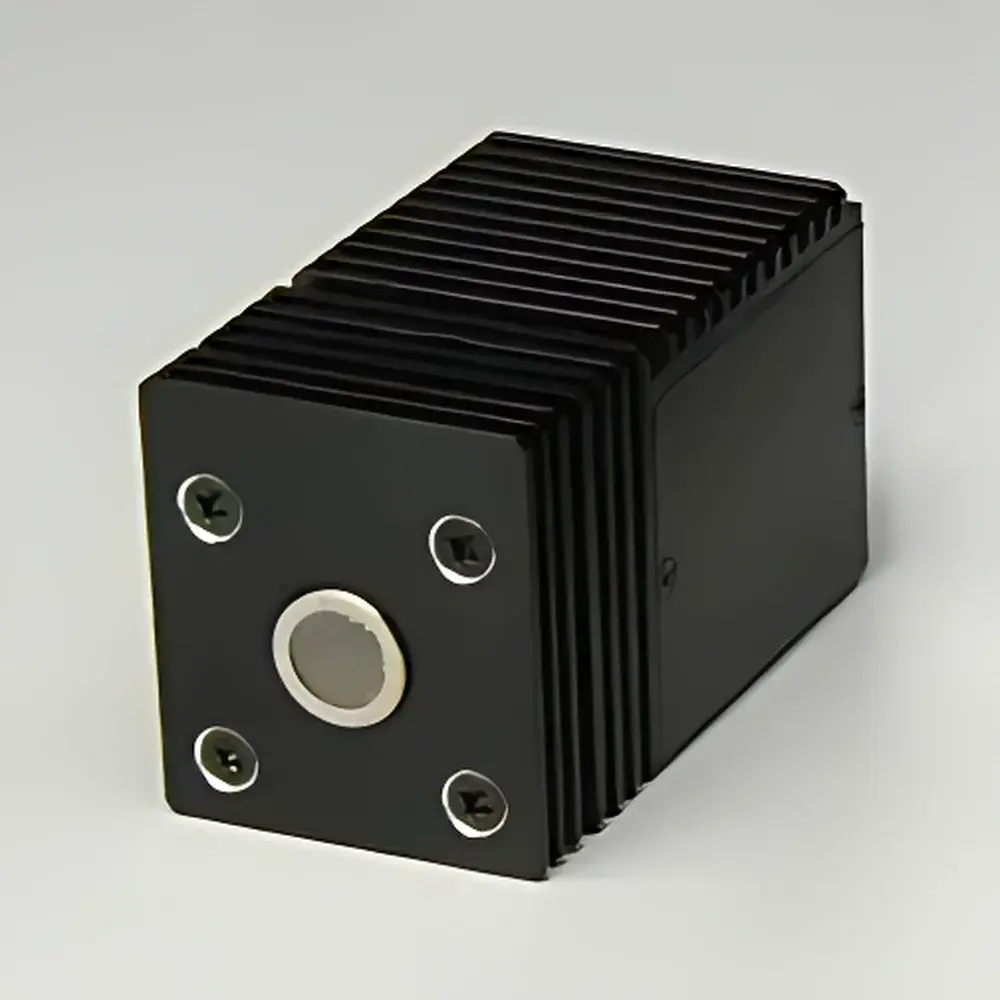
Hamamatsu Microchannel Plate (MCP) F1094-01
| Brand | Hamamatsu |
|---|---|
| Origin | Japan |
| Manufacturer Type | Original Equipment Manufacturer (OEM) |
| Import Status | Imported |
| Model | F1094-01 |
| Pricing | Available Upon Request |
Overview
The Hamamatsu Microchannel Plate (MCP) F1094-01 is a high-gain, low-noise electron multiplier component engineered for integration into time-of-flight (TOF), quadrupole, and magnetic sector mass spectrometers. Designed using lead glass with a precisely controlled pore geometry, the F1094-01 operates on the principle of secondary electron emission under applied axial voltage gradients—enabling single-electron detection with sub-nanosecond temporal response and high spatial resolution. Its robust architecture supports vacuum environments down to 1 × 10⁻⁷ Pa, making it suitable for ultra-high-vacuum (UHV) mass analyzer chambers. As an OEM-grade detector element, the F1094-01 is not a standalone instrument but a critical signal amplification stage in ion detection systems where gain stability, pulse height distribution uniformity, and long-term operational reliability are essential.
Key Features
- High open-area ratio (>65%) optimized for ion transmission efficiency in TOF-MS and imaging mass spectrometry configurations
- Standard 25 mm active diameter with 12 µm pore size and 15 µm pitch, ensuring balanced gain and spatial resolution
- Resistance to ion feedback and saturation effects due to optimized bias angle (8°) and channel aspect ratio
- Low intrinsic background noise (<0.1 events/sec/cm² at room temperature), minimizing false-positive detection in trace-level analysis
- Hermetically sealed ceramic-metal (Kovar) package compatible with standard UHV flange mounting (CF-35 or ISO-KF25 interfaces)
- Pre-aged and tested for gain consistency; supplied with individual calibration data sheet including measured gain vs. voltage curves at 25°C and 1 × 10⁻⁶ Pa
Sample Compatibility & Compliance
The F1094-01 is compatible with positively charged ions across the mass range of 1–10,000 Da and exhibits linear response up to ~10⁶ ions/pulse under pulsed operation. It is routinely deployed in MALDI-TOF, SIMS, and laser desorption ionization (LDI) platforms where high dynamic range and picosecond-level timing jitter are required. The device complies with IEC 61340-5-1 for electrostatic discharge (ESD) handling protocols during installation and meets RoHS Directive 2011/65/EU for hazardous substance restrictions. While not certified as a medical device, its manufacturing process adheres to ISO 9001:2015 quality management standards, and batch traceability supports GLP-compliant instrument qualification documentation.
Software & Data Management
As a passive detector component, the F1094-01 does not include embedded firmware or onboard software. Its performance is fully characterized and controlled via external high-voltage power supplies (e.g., Hamamatsu C11204 series) and synchronized with digitizers or time-to-digital converters (TDCs) through standard NIM or LVDS trigger outputs. Gain optimization and lifetime monitoring are performed using vendor-agnostic acquisition software such as SpecView, LabVIEW-based DAQ modules, or open-source tools like PyMCA or TOFDAQ. All calibration datasets—including gain drift over 1,000-hour accelerated aging tests—are provided in ASCII format with metadata compliant with ASTM E1317-22 (Standard Practice for Calibration of Mass Spectrometers) for audit-ready record retention.
Applications
- Ion signal amplification in reflectron and linear-mode TOF mass spectrometers
- Position-sensitive detection in time-resolved secondary ion mass spectrometry (TR-SIMS)
- Fast-gated detection for laser-induced breakdown spectroscopy (LIBS) coupled with mass analysis
- Multi-anode array readout support in high-throughput imaging MS platforms
- Replacement or upgrade component for legacy VG, Thermo Fisher, and Shimadzu mass spectrometer detector assemblies
- Research-grade development of hybrid detectors integrating MCP stacks with delay-line anodes or CMOS pixel sensors
FAQ
Is the F1094-01 compatible with high-vacuum differential pumping stages?
Yes—it is rated for continuous operation at pressures between 1 × 10⁻⁶ Pa and 1 × 10⁻⁷ Pa, and its outgassing rate is below 1 × 10⁻¹¹ Pa·m³/s per cm² as verified by residual gas analysis.
Can this MCP be operated in chevron or Z-stack configuration?
The F1094-01 is supplied as a single plate; however, its mechanical and electrical specifications conform to industry-standard stacking protocols for dual-plate (chevron) configurations when paired with matching Hamamatsu MCPs such as the F1095 series.
Does Hamamatsu provide lifetime testing data under sustained ion flux?
Yes—each production lot undergoes accelerated lifetime validation at 10⁴ ions/cm²/s for 500 hours; full test reports including gain decay profiles and dark count evolution are available upon request with purchase.
What is the recommended high-voltage supply ripple specification?
For optimal pulse height distribution, input voltage ripple must be maintained below ±0.01% RMS at 1 kHz bandwidth; Hamamatsu recommends using low-noise, isolated HV supplies with active regulation and EMI filtering.
Is the F1094-01 suitable for use in space-qualified instrumentation?
While not formally space-qualified, the F1094-01 has been incorporated into ESA-funded prototype payloads for planetary surface analysis; radiation tolerance data (10 krad(Si) total ionizing dose) and thermal cycling performance (−40°C to +70°C, 100 cycles) are documented in application note HAM-MCP-AN-2023-04.






