
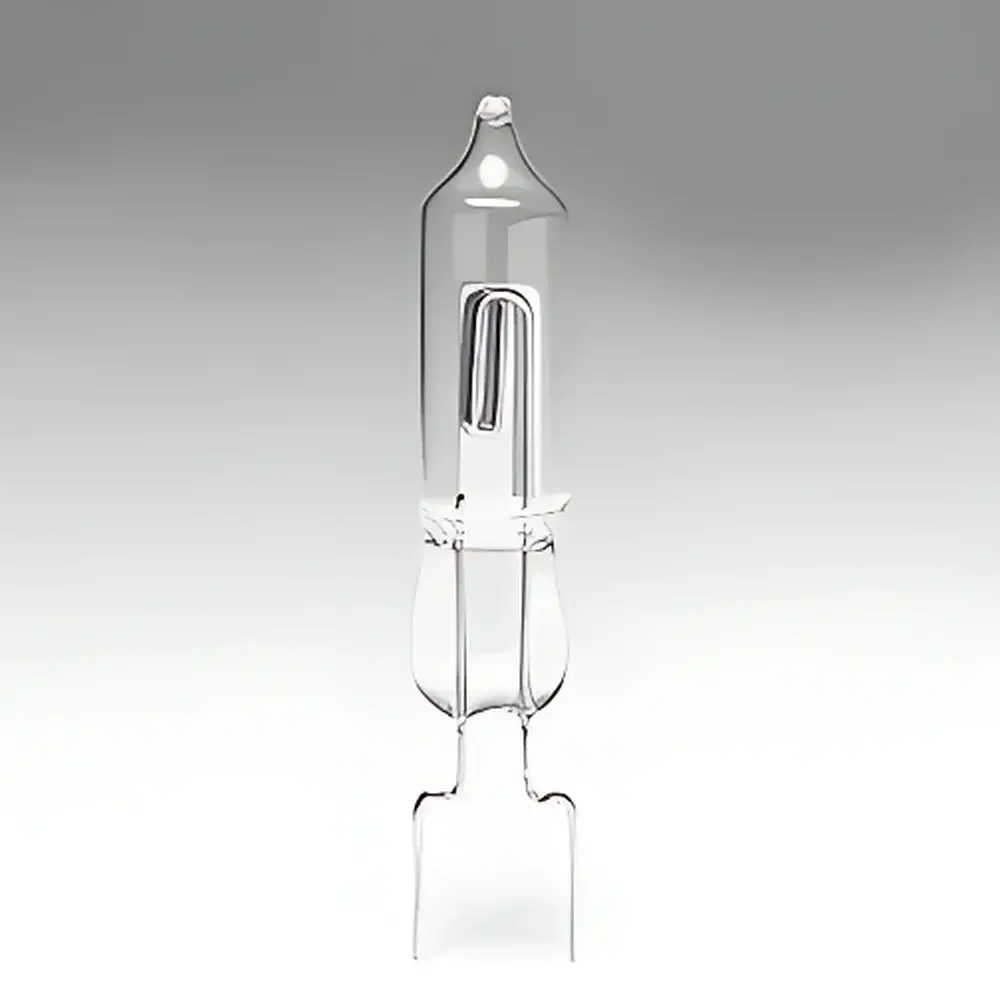
Hamamatsu R2868 UVTRON Flame Detector
| Brand | Hamamatsu |
|---|---|
| Origin | Japan |
| Manufacturer | Hamamatsu Photonics K.K. |
| Type | UV Gas Discharge Tube Sensor |
| Spectral Range | 185–260 nm |
| Cathode Material | Nickel (Ni) |
| Operating Voltage (Recommended) | 325 ± 25 V DC |
| Average Discharge Current (Recommended) | 0.3 mA |
| Minimum Arc-Extinguishing Time | 2 ms |
| Typical Sensitivity | 5000 counts/min |
| Maximum Background Count Rate | 10 counts/min |
| Average Lifetime | 10,000 h |
| Weight | ~1.5 g |
| Operating Temperature Range | −0.3 °C to +50 °C |
| Starting Discharge Voltage | 280 V DC |
| Sustaining Discharge Voltage | 240 V DC |
| Max. Peak Current | 30 mA |
| Max. Average Discharge Current | 1 mA |
| Max. Supply Voltage | 400 V DC |
Overview
The Hamamatsu R2868 UVTRON is a specialized ultraviolet (UV) flame detection sensor based on gas discharge tube technology. It operates on the principle of photoelectric emission from a nickel cathode under UV irradiation, followed by Townsend avalanche multiplication in a low-pressure inert gas fill—enabling single-photon-level detection without external amplification. Unlike photodiodes or PMTs, the UVTRON functions as a self-quenching, binary ON/OFF pulse generator: each incident UV photon within its narrow spectral band triggers a discrete, standardized current pulse (~10⁷ electrons per event), eliminating analog gain drift and enabling robust digital signal processing. Its cut-on at 185 nm and sharp cut-off at 260 nm provide intrinsic solar-blind operation—rejecting >99.99% of ambient visible and near-UV radiation—including daylight, incandescent, and LED sources—making it uniquely suited for outdoor or unshielded industrial environments where false alarms from non-flame UV sources must be eliminated.
Key Features
- Solar-blind spectral response (185–260 nm), certified per IEC 61508 and UL 268 Annex H for flame detection reliability
- Self-powered pulse output: no bias circuitry or active amplification required; compatible with standard TTL/CMOS logic interfaces
- High intrinsic signal-to-noise ratio: typical dark count rate <10 min⁻¹ ensures negligible false triggers under ambient conditions
- Rugged hermetically sealed glass envelope with nickel cathode and argon–neon fill, rated for continuous operation up to 10,000 hours MTBF
- Fast temporal response: minimum arc-extinguishing time of 2 ms supports detection of transient flame flicker (e.g., hydrocarbon diffusion flames at 10–20 Hz modulation)
- Wide operating temperature range (−0.3 °C to +50 °C) with stable discharge voltage characteristics across thermal gradients
- Low mass (~1.5 g) and compact cylindrical form factor (Ø8.5 × 24 mm) enables integration into space-constrained burner management systems and portable fire surveillance units
Sample Compatibility & Compliance
The R2868 is optimized for detecting UV emissions from hydrocarbon-based flames (e.g., methane, propane, gasoline, diesel), which emit strongly between 190–230 nm due to excited OH* and CH* radicals. It does not respond to blackbody radiation, IR signatures, or CO₂ absorption bands—thus eliminating cross-sensitivity to hot surfaces or steam. The device complies with EN 54-10:2017 (Fire detection and fire alarm systems – Part 10: Flame detectors – Requirements, test methods and performance criteria) and meets functional safety requirements per IEC 61508 SIL 2 when integrated into certified control architectures. Its UV-selective response satisfies NFPA 72 Chapter 17 and UL 268 §17.6 for Class A flame detectors in commercial and industrial settings.
Software & Data Management
As a passive pulse-output transducer, the R2868 interfaces directly with microcontroller-based flame monitoring units or PLC input modules equipped with high-speed counter channels. Hamamatsu provides reference schematics for quenching circuit design and pulse conditioning (e.g., RC differentiation, Schmitt-trigger shaping) to ensure noise-immune signal acquisition. When deployed in networked fire safety systems, pulse trains are timestamped and logged with audit-trail metadata (per ISO/IEC 17025 and FDA 21 CFR Part 11 compliant platforms) to support traceability during GLP/GMP audits. No proprietary software is required; raw pulse data integrates seamlessly with SCADA, BMS, or custom Python/Matlab analysis pipelines for flame stability trending, ignition verification, and combustion efficiency correlation.
Applications
- Industrial burner management systems (BMS) for boilers, furnaces, and thermal oxidizers—ensuring safe ignition sequence verification and flame failure shutdown (FFS)
- Fixed-position fire detection in high-ceiling warehouses, aircraft hangars, and power substations where smoke detection is ineffective
- Mobile and drone-mounted arson surveillance systems requiring low-power, solar-blind UV discrimination
- Corona and partial discharge monitoring on high-voltage transmission lines and switchgear enclosures
- Research-grade flame spectroscopy setups requiring gated UV trigger signals synchronized with high-speed imaging or laser diagnostics
- Explosive atmosphere monitoring in petrochemical refineries and LNG terminals per ATEX Directive 2014/34/EU Category 1G
FAQ
What distinguishes the R2868 from silicon carbide (SiC) or GaN UV photodiodes?
The R2868 leverages gas discharge gain rather than semiconductor junction physics—delivering inherent pulse uniformity, zero dark current drift, and immunity to temperature-induced responsivity shifts common in solid-state UV sensors.
Can the R2868 detect hydrogen or alcohol flames?
Yes—hydrogen flames emit weakly in the UV-C band but remain detectable above threshold; ethanol and methanol flames produce stronger OH* bands within the 185–260 nm window and are reliably sensed.
Is external cooling required for continuous operation?
No—its glass-metal seal and low average power dissipation (<100 mW) enable passive thermal management across the full specified temperature range.
How is calibration maintained over lifetime?
Calibration is inherently stable due to fixed gas composition and electrode geometry; periodic functional verification using a traceable deuterium lamp (NIST SRM 2032) is recommended every 24 months per ISO/IEC 17025.
Does the R2868 require a high-voltage power supply?
Yes—a regulated DC source delivering 325 ± 25 V is required; Hamamatsu recommends using a current-limited supply with fast overcurrent protection to preserve tube longevity.



