
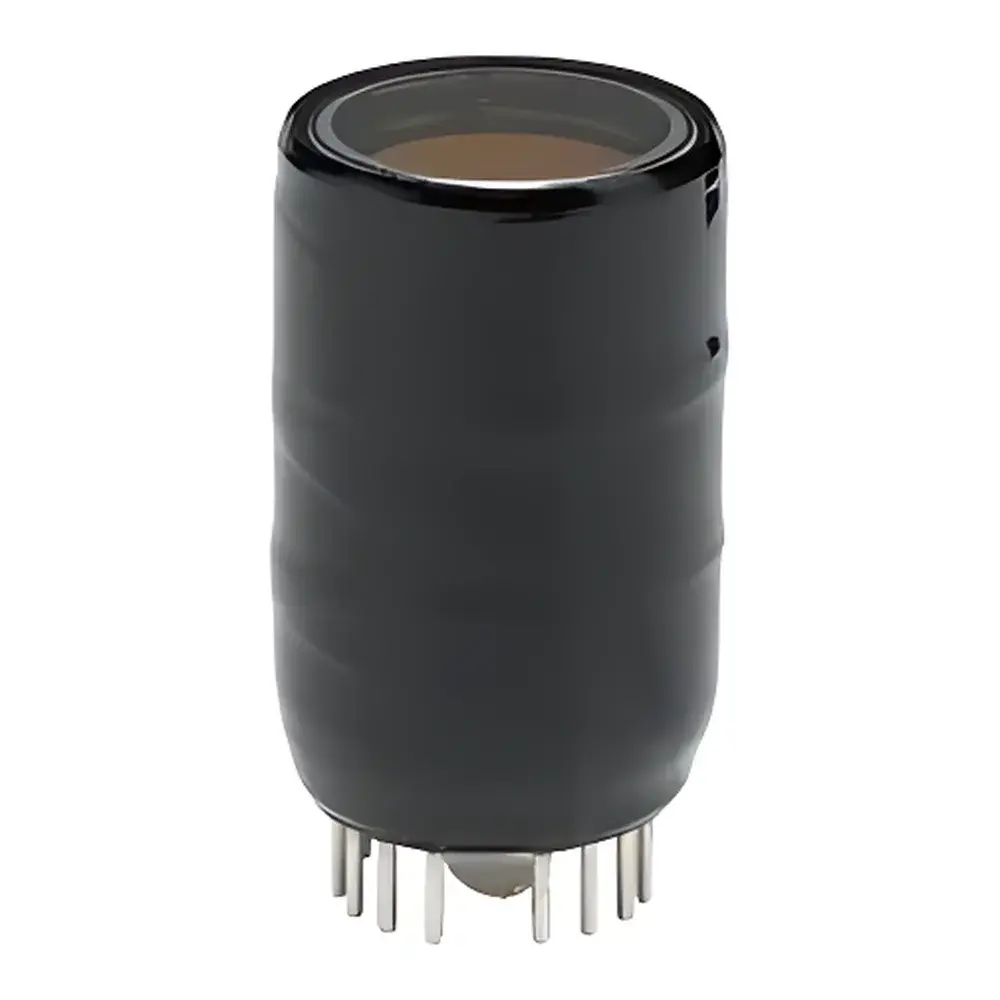
Hamamatsu Anti-Magnetic Photomultiplier Tube (PMT) R5R7
| Brand | Hamamatsu |
|---|---|
| Origin | Japan |
| Manufacturer Type | OEM Manufacturer |
| Import Status | Imported |
| Model | R5R7 |
| Pricing | Upon Request |
Overview
The Hamamatsu Anti-Magnetic Photomultiplier Tube (PMT) R5R7 is a high-performance, vacuum-based photon detection device engineered for operation in environments with elevated magnetic field interference—such as MRI-adjacent spectroscopy setups, particle physics experiments, or magnetically shielded optical measurement systems. Unlike standard PMTs, the R5R7 incorporates a specialized magnetic shielding architecture, including mu-metal encapsulation and optimized electron optics, to suppress Lorentz-force-induced trajectory distortion of photoelectrons within the dynode chain. This ensures stable gain, linear response, and high quantum efficiency (>22% at 420 nm) under static magnetic fields up to ±10 Gauss—without requiring external active compensation. Its core operating principle relies on the photoelectric effect at the photocathode followed by secondary electron multiplication across a discrete-dynode cascade, delivering single-photon sensitivity with sub-nanosecond rise time and low dark current (<5 nA at −800 V). Designed for integration into OEM spectroscopic instrumentation, the R5R7 complies with IEC 60529 (IP00) for internal vacuum integrity and meets RoHS 2011/65/EU material restrictions.
Key Features
- Anti-magnetic construction with integrated mu-metal shielding for reliable performance in magnetic fields ≤10 G
- High quantum efficiency bialkali (Sb-Rb-Cs) photocathode with peak spectral response at 420 nm
- 25 mm effective photocathode diameter enabling optimal light collection in compact optical benches
- 10-stage linear-focused dynode structure ensuring stable gain (typ. 1 × 10⁶ at −1000 V) and pulse linearity over 6 decades
- Low thermionic noise: dark current <5 nA at rated bias voltage (−800 V), tested per JIS C 5502
- Hermetically sealed borosilicate glass envelope with UV-transmissive window (200–650 nm range)
- Compatible with standard PMT socket interfaces (e.g., E2031-01 series) and regulated high-voltage power supplies (±0.01% stability)
Sample Compatibility & Compliance
The R5R7 is optimized for low-light detection in fluorescence, chemiluminescence, and scintillation applications where magnetic perturbation compromises signal fidelity. It supports direct coupling to fiber-optic light guides (NA ≤0.22), monochromator exit slits (≥0.5 mm width), and scintillation crystals (e.g., NaI(Tl), LYSO). The device conforms to ISO/IEC 17025:2017 requirements for calibration traceability when used in accredited analytical laboratories. For regulated environments—including clinical chemistry analyzers and environmental emission monitors—the R5R7 supports audit-ready documentation packages aligned with FDA 21 CFR Part 11 (when paired with compliant data acquisition firmware) and meets essential safety requirements under IEC 61010-1:2010 for measurement/control laboratory equipment.
Software & Data Management
While the R5R7 itself is an analog detector, its output is fully compatible with industry-standard digitization platforms such as National Instruments PXIe-5171R oscilloscopes, Keysight Infiniium MSO-X 3054T, and Hamamatsu’s own C13672 digital photon counter modules. When integrated into spectroscopy systems, raw pulse-height spectra and count-rate time-series data can be processed using open-format protocols (IEEE 488.2 GPIB, USB-TMC, or Ethernet TCP/IP) and imported into MATLAB, Python (via PyVISA), or LabVIEW for advanced statistical analysis—including photon counting histogramming, lifetime decay fitting (e.g., multi-exponential convolution), and coincidence timing resolution assessment. Firmware-level timestamping (≤1 ns resolution) enables synchronization with external triggers in time-correlated single-photon counting (TCSPC) configurations.
Applications
- UV-Vis and fluorescence spectrophotometers deployed near MRI or NMR magnets
- Time-resolved luminescence detection in pharmaceutical QC labs (e.g., USP <1058> compliance verification)
- Scintillation-based radiation monitoring in nuclear medicine imaging subsystems
- Plasma diagnostics in semiconductor etch chambers, where magnetic field gradients exceed 5 G/cm
- Single-molecule fluorescence correlation spectroscopy (FCS) under controlled magnetic conditions
- OEM integration into portable environmental analyzers for airborne particulate or VOC detection via laser-induced fluorescence
FAQ
What magnetic field strength can the R5R7 tolerate without gain drift?
The R5R7 maintains gain stability within ±3% under static magnetic fields up to ±10 Gauss, verified per Hamamatsu Test Report HMT-PMTR5R7-MAG-2023.
Is the R5R7 suitable for ultra-low-light applications requiring photon counting?
Yes—it delivers single-photon resolution with pulse amplitude discrimination capability when operated with appropriate amplification and thresholding electronics.
Does Hamamatsu provide calibration certificates with NIST-traceable responsivity data?
Yes—traceable spectral responsivity (A/W) and cathode uniformity maps are available upon request under Hamamatsu Calibration Service Option CAL-R5R7-STD.
Can the R5R7 be operated in continuous high-count-rate mode (>10⁶ cps)?
It supports sustained count rates up to 5 × 10⁶ counts per second with ≤10% pulse pile-up distortion when biased at −1000 V and cooled to −10°C.
What is the recommended high-voltage supply stability for optimal linearity?
Voltage regulation better than ±0.01% RMS over 8 hours is required to maintain gain variation below 0.5% across dynamic range.





