
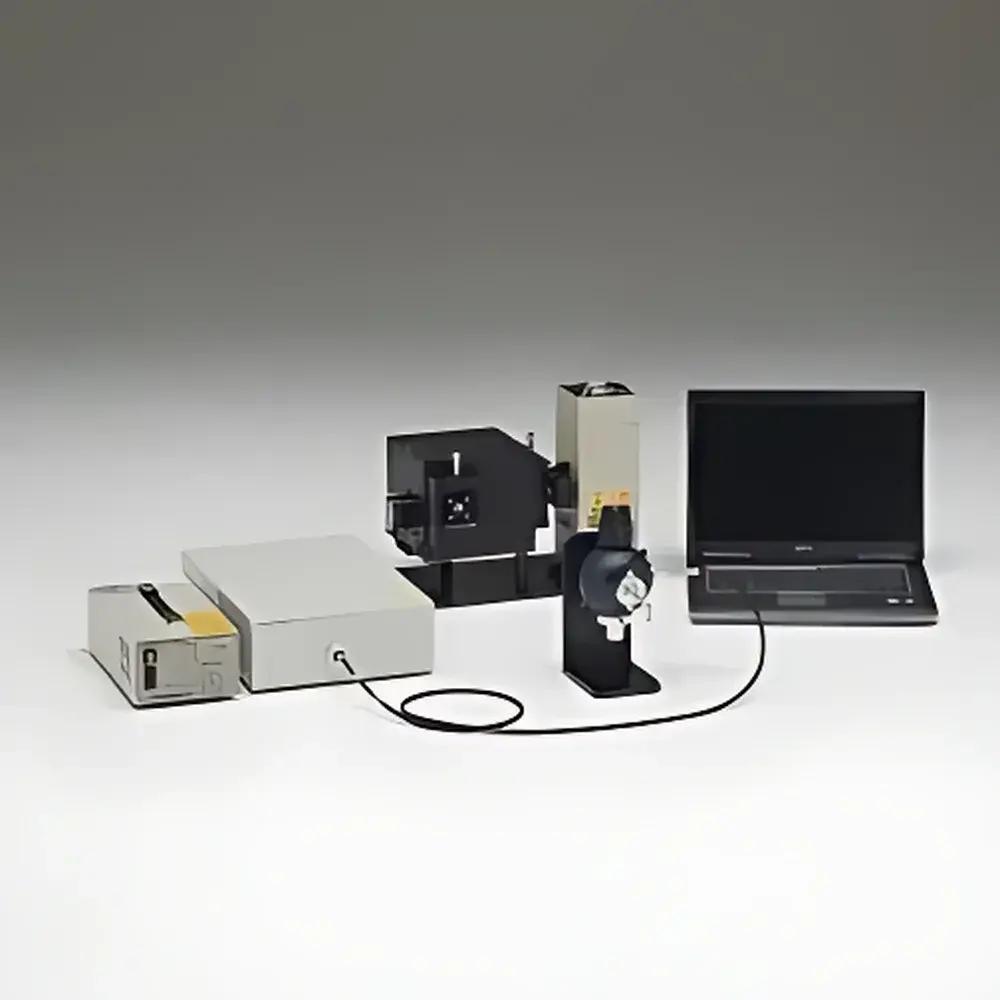
Hamamatsu C9920-02 Absolute Quantum Yield Measurement System
| Brand | Hamamatsu |
|---|---|
| Origin | Japan |
| Manufacturer Type | Original Equipment Manufacturer (OEM) |
| Product Category | Imported Instrument |
| Model | C9920-02 |
| Measurement Mode | DC |
| Detection Method | Photoluminescence (PL) |
| Optical Integration | Nitrogen-purged integrating sphere |
| Spectral Detection | CCD-based full-spectrum synchronous acquisition |
| Sample Formats | Thin films, powders, liquid solutions in cuvettes |
| Compliance | ISO 11664-1:2019 (CIE colorimetry), ASTM E2758-18 (quantum yield measurement of luminescent materials) |
Overview
The Hamamatsu C9920-02 Absolute Quantum Yield Measurement System is a precision optical instrumentation platform engineered for the quantitative determination of absolute photoluminescence quantum yield (PLQY) across solid-state, colloidal, and solution-phase luminescent materials. It operates on the fundamental principle of comparative photometric integration: excitation photons are delivered via a tunable monochromator-coupled light source, while emitted photons are collected omnidirectionally within a nitrogen-purged integrating sphere to eliminate angular dependence and minimize atmospheric quenching effects—particularly critical for oxygen-sensitive emitters such as organic phosphors and perovskite nanocrystals. The system’s core architecture integrates a stabilized DC excitation source, a high-fidelity monochromator with 98% BaSO₄ spectral reflectance coating, and a back-illuminated, thermoelectrically cooled CCD spectrometer capable of simultaneous 200–1100 nm spectral acquisition at 0.3 nm pixel resolution. This configuration ensures traceable, reproducible PLQY values referenced to NIST-traceable standards, supporting both research-grade material screening and regulatory-compliant characterization workflows.
Key Features
- DC-mode excitation source with intensity stabilization (<±0.5% drift over 1 hour), enabling long-integration measurements without pulse-induced thermal artifacts
- Nitrogen-purged integrating sphere environment maintains O₂ concentration <10 ppm, preserving intrinsic emission properties of air-sensitive samples
- Dual-sample holder design accommodates rigid thin films (up to 25 × 25 mm) and loose powders (with optional quartz sample cup); standard 1 cm path-length cuvettes supported for liquid-phase analysis
- Real-time spectral correction using built-in reference detector and calibrated sphere wall reflectance map, eliminating geometry-dependent bias
- Modular optical path with interchangeable gratings and slit widths to optimize signal-to-noise ratio for UV, visible, or NIR-emitting systems
- Rugged aluminum alloy chassis with vibration-damped optical bench, certified for operation in Class 1000 cleanroom environments
Sample Compatibility & Compliance
The C9920-02 supports heterogeneous sample forms without requiring dilution, matrix embedding, or surface functionalization. Thin-film measurements comply with ISO 11664-1:2019 definitions of radiant and luminous quantities, while powder analysis adheres to ASTM E2758-18 guidelines for quantum yield reporting—including mandatory baseline correction, excitation wavelength verification, and integrated photon flux normalization. All hardware components meet IEC 61000-4 electromagnetic compatibility standards; the nitrogen purge subsystem conforms to ISO 8573-1:2010 Class 2 purity specifications. Full audit trails—including instrument configuration logs, calibration timestamps, and raw spectral files—are retained in accordance with GLP and FDA 21 CFR Part 11 requirements when operated with optional secure software licensing.
Software & Data Management
Quantaurus-QY Control Software (v4.3+) provides a validated, menu-driven interface for automated PLQY calculation, spectral deconvolution, and comparative analysis across multiple samples. It implements the rigorous two-measurement method (sample + blank) with automatic background subtraction, spectral responsivity correction, and integrated photon count conversion. Export formats include CSV (for MATLAB/Python post-processing), CIE 1931 xy chromaticity coordinates, and PDF reports compliant with internal QA templates. Data integrity is enforced through role-based user authentication, electronic signatures, and immutable metadata stamping (date/time, operator ID, instrument serial number). Optional cloud synchronization enables cross-laboratory benchmarking against Hamamatsu’s global reference database of certified quantum yield standards.
Applications
- Development and QC of OLED emissive layers, QLED quantum dot inks, and TADF small-molecule hosts
- Photocatalyst efficiency screening (e.g., TiO₂, g-C₃N₄) under bandgap-specific excitation
- Biological fluorophore validation—including GFP variants, lanthanide chelates, and NIR-II probes—for preclinical imaging studies
- Stability assessment of perovskite nanocrystals under controlled atmosphere and thermal ramping protocols
- Academic photophysics research requiring absolute radiometric quantification of non-radiative decay pathways
FAQ
What excitation wavelengths are supported?
The monochromator covers 240–900 nm with ±0.2 nm wavelength accuracy; discrete line sources (e.g., Hg/Xe lamps) may be coupled for narrowband excitation.
Can the system measure electroluminescent quantum efficiency (EQE)?
No—this system is optimized for photoluminescence only. EQE requires current-voltage-controlled device integration and is outside its operational scope.
Is nitrogen purging mandatory for all measurements?
It is strongly recommended for any material exhibiting oxygen-quenched luminescence (e.g., triplet emitters); inert gas flow rate and pressure are programmable via integrated mass flow controller.
How is calibration traceability established?
Factory calibration uses NIST-traceable tungsten halogen and deuterium standards; end-user recalibration kits include certified PLQY reference materials (e.g., quinine sulfate in 0.1 M H₂SO₄, PLQY = 0.546 ± 0.005 at 350 nm).
Does the system support time-resolved PLQY analysis?
No—the C9920-02 performs steady-state integration only. For lifetime-resolved quantum yield, Hamamatsu recommends coupling with the C11202-01 time-correlated single-photon counting module.




