
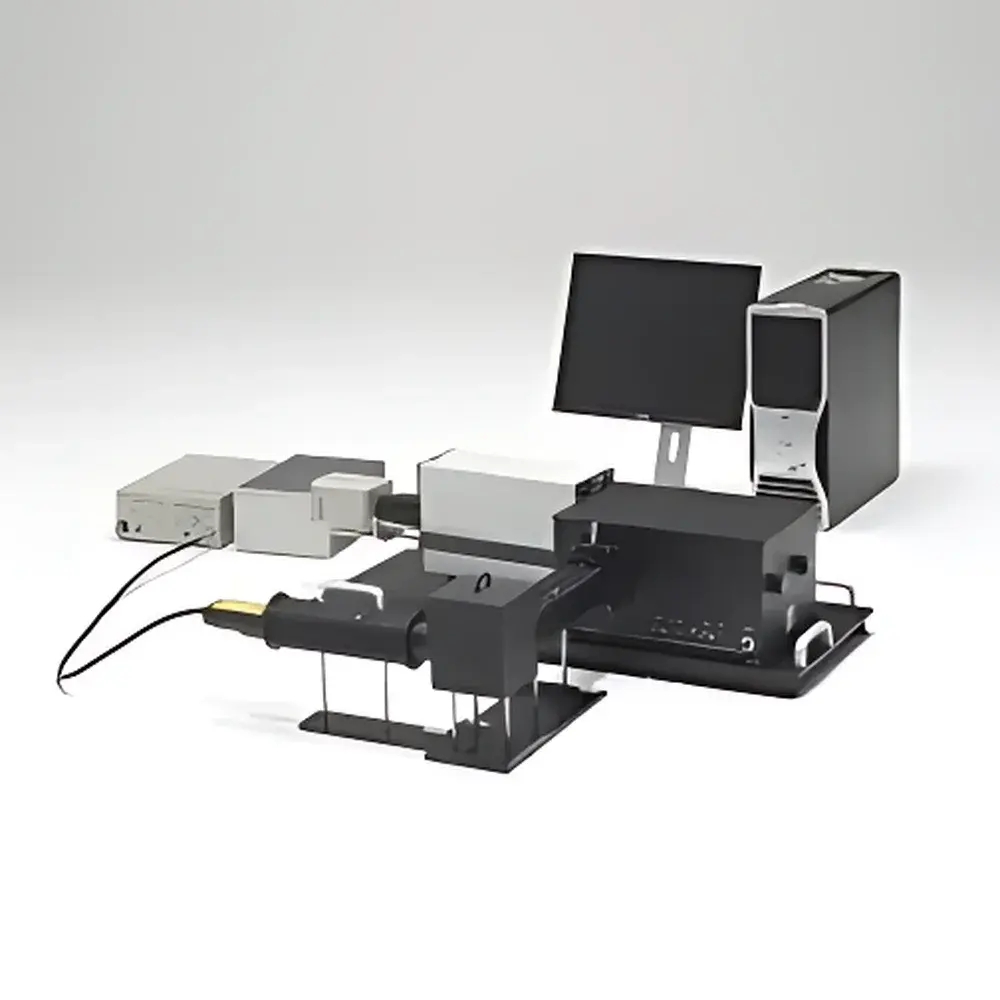
Hamamatsu C11200 Mode-Locked Ti:Sapphire Laser System
| Brand | Hamamatsu |
|---|---|
| Origin | Japan |
| Manufacturer Type | Original Equipment Manufacturer (OEM) |
| Import Status | Imported |
| Model | C11200 |
| Core Components | Solid-State Mode-Locked Laser Source, Streak Camera, Spectrograph, Delay Generator, and Integrated Control Software |
| Wavelength Range | 400–900 nm (Ti:Sapphire output, frequency-doubled to 200–450 nm optional) |
| Temporal Resolution (deconvolved) | 5 ps |
| Maximum Scan Repetition Rate | 20 MHz |
| Spectral Resolution | 0.18–5.4 nm (dependent on grating selection: 40–1200 gr/mm) |
| Spectral Coverage | 10–280 nm (with appropriate grating and detector configuration) |
| Time Base Range | 1 ns – 10 ms |
| Detector Architecture | Czerny-Turner spectrograph with aberration-corrected toroidal mirror, f = 338 mm, F/3.9 |
| Grating Capacity | Dual-grating turret (two gratings mounted simultaneously) |
| Dynamic Range | >100,000:1 (photon-counting mode) |
Overview
The Hamamatsu C11200 Mode-Locked Ti:Sapphire Laser System is a fully integrated, turnkey ultrafast fluorescence lifetime measurement platform engineered for time-resolved photophysics and photochemistry research. At its core lies a synchronously pumped, mode-locked titanium:sapphire oscillator delivering sub-100-fs pulses at repetition rates up to 20 MHz—enabling high-duty-cycle, high-signal-throughput transient detection. The system couples this excitation source with a high-bandwidth streak camera (200–850 nm or 300–900 nm spectral response options), a dual-grating Czerny-Turner spectrograph (f = 338 mm, F/3.9), and a precision electronic delay generator to achieve true two-dimensional (wavelength × time) photon detection with picosecond temporal fidelity. Unlike conventional TCSPC or gated ICCD approaches, the C11200 leverages optical streak imaging physics—where photoelectrons are spatially dispersed along a microchannel plate according to their arrival time—to record full transient spectra in a single laser shot. This architecture eliminates scanning artifacts, enables multi-wavelength decay acquisition without wavelength stepping, and supports photon-counting sensitivity down to the single-photon level.
Key Features
- Picosecond temporal resolution: 5 ps (deconvolved) and 15 ps (instrument response function, IRF), validated using standard ultrafast reference dyes and autocorrelation measurements.
- Simultaneous multi-wavelength detection: Full spectral decay traces acquired across 10–280 nm per laser pulse—no mechanical scanning required.
- Dual-grating spectrograph turret: Supports rapid interchange between low-dispersion (40 gr/mm) and high-resolution (1200 gr/mm) configurations; spectral resolution adjustable from 0.18 nm to 5.4 nm.
- Dynamic range exceeding 100,000:1 in photon-counting mode: Enables quantitative decomposition of multi-exponential decays spanning orders of magnitude in amplitude and lifetime.
- Configurable time base: Adjustable scan durations from 1 ns to 10 ms—covering fluorescence (ps–ns), phosphorescence (µs–ms), and delayed luminescence regimes within one instrument.
- UV–NIR spectral flexibility: Standard Ti:Sapphire fundamental (680–1080 nm) and second-harmonic (340–540 nm) outputs; optional external harmonic generators extend coverage to 200 nm.
- Real-time data visualization: Live display of time-resolved spectra, decay curves, and spectral slices during acquisition—facilitating on-the-fly parameter optimization.
Sample Compatibility & Compliance
The C11200 accommodates liquid solutions (cuvettes, flow cells), thin films (spin-coated, Langmuir–Blodgett, vacuum-deposited), single crystals, nanostructured surfaces, and optically transparent solid-state hosts (e.g., doped glasses, perovskite thin films). Sample chambers support ambient, inert-gas-purged, or cryogenic (77 K) environments via optional cold-finger integration. All optical paths comply with ISO 10110-7 (laser safety labeling) and IEC 60825-1:2014 (Class 4 laser product requirements). Data acquisition and analysis workflows adhere to GLP principles: audit-trail-enabled software logging, user-access-controlled parameter modification, and timestamped raw-data archiving (HDF5 format). While not FDA 21 CFR Part 11-certified out-of-the-box, the system supports third-party validation packages for regulated QC/QA laboratories requiring electronic signature and data integrity compliance.
Software & Data Management
Control and analysis are executed via Hamamatsu’s proprietary C11200 Acquisition & Analysis Suite—a Windows-based application built on .NET Framework with native support for 64-bit memory addressing. The interface provides synchronized control of streak camera sweep voltage, spectrograph grating position, delay generator timing, and laser repetition rate. Key modules include:
- Auto-Delay Calibration: Automatically optimizes temporal zero-point alignment between laser trigger and streak sweep onset—reducing setup time by >70% versus manual adjustment.
- Multi-Decay Deconvolution Engine: Implements non-linear least-squares fitting with variable-number exponential models (1–4 components); includes IRF convolution, weighting by Poisson noise statistics, and χ² convergence criteria.
- Tail-Fit Algorithm: Alternative fitting strategy for long-lived components (e.g., phosphorescence), bypassing full deconvolution while preserving amplitude accuracy.
- Spectral Slice Export: Exports time-resolved spectra as ASCII or HDF5 matrices compatible with MATLAB, Python (NumPy), and OriginLab for custom modeling.
- Batch Processing Pipeline: Scriptable workflow automation for sequential sample measurements, including auto-normalization, baseline correction, and report generation (PDF/CSV).
Applications
This system is routinely deployed in academic and industrial R&D labs for:
- Ultrafast exciton dissociation and charge-transfer kinetics in organic photovoltaic blends and perovskite heterojunctions.
- Triplet-state dynamics and intersystem crossing rates in thermally activated delayed fluorescence (TADF) emitters for OLED development.
- Surface-bound fluorophore behavior at solid–liquid interfaces—probing local viscosity, polarity, and binding kinetics via time-resolved anisotropy and spectral shifts.
- Energy transfer efficiency and donor–acceptor distance mapping in supramolecular assemblies (e.g., J-aggregates, DNA-templated dyes).
- Defect-state recombination lifetimes in wide-bandgap semiconductors (GaN, SiC) and quantum-confined nanostructures (CdSe/ZnS QDs, carbon nanotubes).
- Time-gated Raman rejection for background-suppressed fluorescence detection in biological tissue phantoms.
FAQ
What is the minimum measurable fluorescence lifetime with the C11200?
The system resolves lifetimes ≥5 ps (deconvolved) under optimal signal-to-noise conditions; the instrument response function (IRF) is typically 12–15 ps full-width-at-half-maximum (FWHM) depending on photocathode type and sweep speed.
Can the C11200 measure phosphorescence lifetimes in the millisecond range?
Yes—the adjustable time base extends to 10 ms, and the Tail-Fit algorithm is specifically optimized for accurate amplitude and lifetime extraction of µs–ms components without IRF convolution artifacts.
Is external laser synchronization supported?
Yes; the system accepts TTL or LVDS external trigger inputs (≤20 MHz) and can operate in master–slave or slave–master timing modes for integration with amplified laser systems or pump–probe setups.
Does the software support batch processing of multiple samples?
Yes—the Acquisition & Analysis Suite includes a scriptable batch processor with conditional logic, automated file naming, and export templates for LIMS integration.
Are calibration standards provided with the system?
Hamamatsu supplies NIST-traceable fluorescent lifetime standards (e.g., Rhodamine 6G in ethanol, Fluorescein in 0.1 M NaOH) and IRF characterization tools (autocorrelator module optional) for routine performance verification.





