
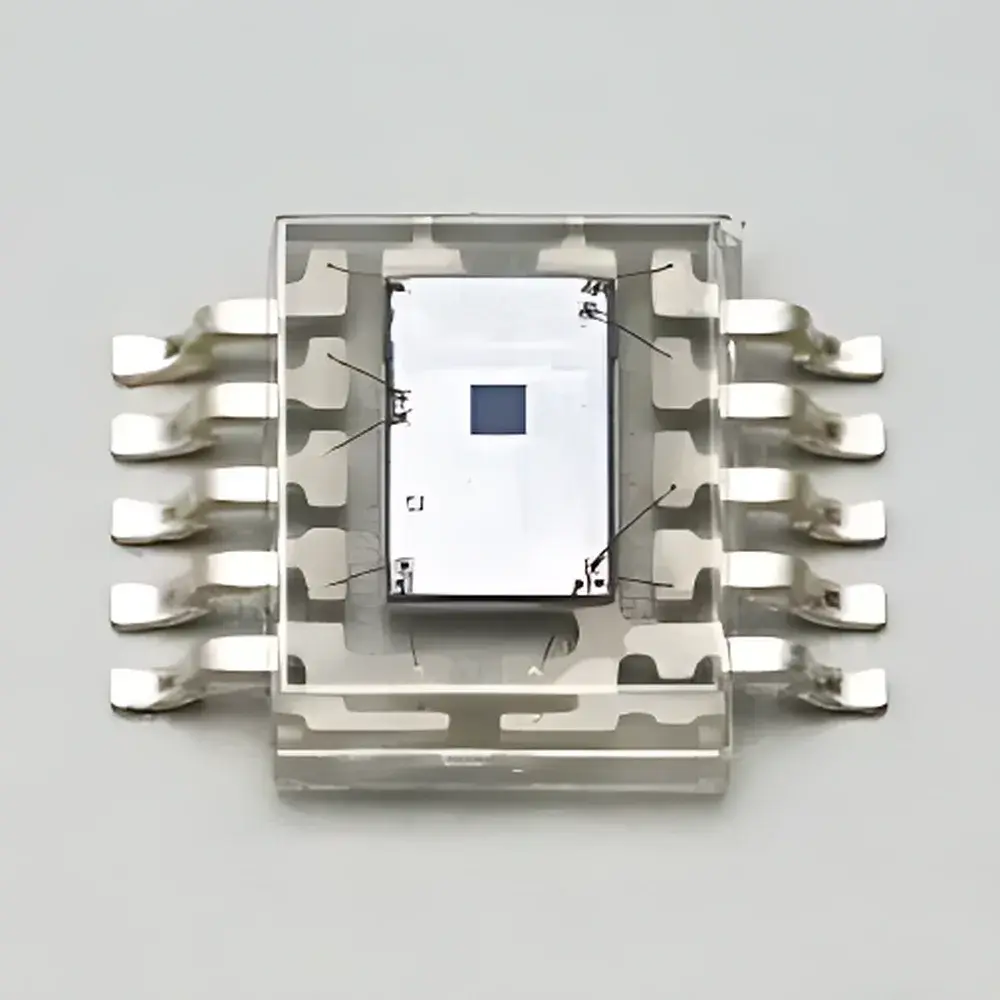
Hamamatsu S6841 Optical Switch IC
| Brand | Hamamatsu |
|---|---|
| Origin | Japan |
| Manufacturer Type | Original Equipment Manufacturer (OEM) |
| Import Status | Imported |
| Model | S6841 |
| Component Category | Optical Component |
| Package | Surface-Mount Plastic (4.5 × 5.5 mm) |
| Output Type | Digital |
| Supply Voltage | 4.5–5.5 V |
| Spectral Response Range | 380–1120 nm |
| Threshold Illuminance | 0.05 µW/mm² |
| Maximum Permissible Ambient Illuminance | 5000 lx |
| Key Feature | High Sensitivity |
Overview
The Hamamatsu S6841 Optical Switch IC is a monolithic photointegrated circuit engineered for robust, high-reliability optical sensing in industrial automation and laboratory-grade optical switching applications. Based on a silicon photodiode coupled with integrated signal conditioning and digital threshold comparison circuitry, the device operates on the principle of photoelectric detection—converting incident optical flux within the 380–1120 nm spectral band into a clean, logic-level digital output. Its design targets transmission-mode and reflective-mode optical interrupters, where precise detection of object presence, position, or motion is required without mechanical contact. The S6841’s extended near-infrared response enables compatibility with common infrared LEDs (e.g., 850 nm or 940 nm emitters), while its low 0.05 µW/mm² threshold ensures reliable operation under weak-signal conditions typical in miniaturized or long-path optical gate configurations.
Key Features
- Compact surface-mount plastic package (4.5 × 5.5 mm) optimized for automated PCB assembly and space-constrained optomechanical integration
- Digital TTL/CMOS-compatible output with built-in hysteresis for noise-immune switching behavior
- Integrated short-circuit protection safeguarding against inadvertent output-stage overload during system integration
- Dual-status indicator terminals supporting real-time monitoring of operational state (“ON”) and margin status (“MARGIN”) for predictive diagnostics
- Configurable synchronous or asynchronous mode selection via external control pin, enabling synchronization with external clocked systems (e.g., PLC scan cycles or encoder-triggered acquisition)
- Stable performance across industrial temperature range (–20 °C to +70 °C), verified per JEDEC J-STD-020 moisture sensitivity level (MSL) 3 handling guidelines
Sample Compatibility & Compliance
The S6841 is designed for use with standard GaAs, InGaAs, or AlGaAs-based light-emitting diodes operating in pulsed or DC mode. It complies with IEC 61000-4-2 (ESD immunity ±4 kV contact discharge) and IEC 61000-4-4 (electrical fast transient burst immunity). While not certified as a standalone safety component, the device supports functional safety architectures compliant with IEC 61508 SIL 2 when implemented within validated system-level redundancy schemes. Its optical response curve conforms to CIE 1931 photopic luminosity function weighting only in broad approximation; users requiring photometric traceability must apply calibrated correction factors based on source spectral distribution. No RoHS exemptions apply—the device meets EU Directive 2011/65/EU Annex II substance restrictions.
Software & Data Management
As a passive analog-front-end + digital comparator IC, the S6841 does not incorporate embedded firmware or programmable registers. However, it interfaces seamlessly with industry-standard microcontroller units (MCUs) and programmable logic controllers (PLCs) via standard digital I/O lines. When deployed in systems subject to FDA 21 CFR Part 11 or ISO 13485 requirements, its deterministic response time (< 15 µs typical propagation delay from light-on to valid logic transition) supports audit-trail-capable event logging when paired with timestamped GPIO capture peripherals. Design documentation—including SPICE models, IBIS files, and thermal derating curves—is available under Hamamatsu’s Engineering Support Portal (login required) and conforms to IPC-7351B land pattern standards.
Applications
- Non-contact position sensing in CNC tool changers and robotic end-effector verification
- Object counting and jam detection in high-speed packaging conveyors
- Lab-scale optical chopper synchronization for lock-in amplifier-based spectroscopy setups
- Beam-break security interlocks in Class 1 laser enclosures per IEC 60825-1
- Low-power battery-operated presence detectors in portable analytical instrumentation
- Multi-channel optical encoder feedback in compact rotary stage control systems
FAQ
What is the recommended LED drive current for optimal S6841 performance in transmission mode?
For stable margin above threshold under worst-case alignment tolerances, Hamamatsu recommends driving matched 850 nm LEDs at 20–50 mA peak current with 10% duty cycle (100 µs pulse width) to maintain junction temperature below 65 °C.
Can the S6841 be used in environments exceeding 5000 lx ambient illumination?
No—exceeding the specified 5000 lx maximum permissible ambient illuminance may cause false triggering due to internal photodiode saturation; for higher ambient scenarios, consider the S8119 variant (10,000 lx rating) or implement mechanical shielding/baffle optimization.
Is the S6841 compatible with 3.3 V logic systems?
The device requires 4.5–5.5 V supply and outputs 5 V logic levels; interfacing with 3.3 V MCUs necessitates level translation via discrete MOSFET or dedicated bidirectional translator ICs (e.g., TXS0102).
Does Hamamatsu provide evaluation boards for the S6841?
Yes—reference design kit EK-S6841 includes PCB-mounted S6841, adjustable IR LED driver, potentiometer-tuned threshold calibration, and test points for oscilloscope validation of rise/fall times and noise margins.
How is long-term stability affected by UV exposure in optical path windows?
Prolonged UV exposure (>365 nm) degrades standard acrylic or polycarbonate lenses; Hamamatsu recommends fused silica or UV-stabilized COP (cyclic olefin polymer) windows when operating continuously under broadband illumination sources.





