
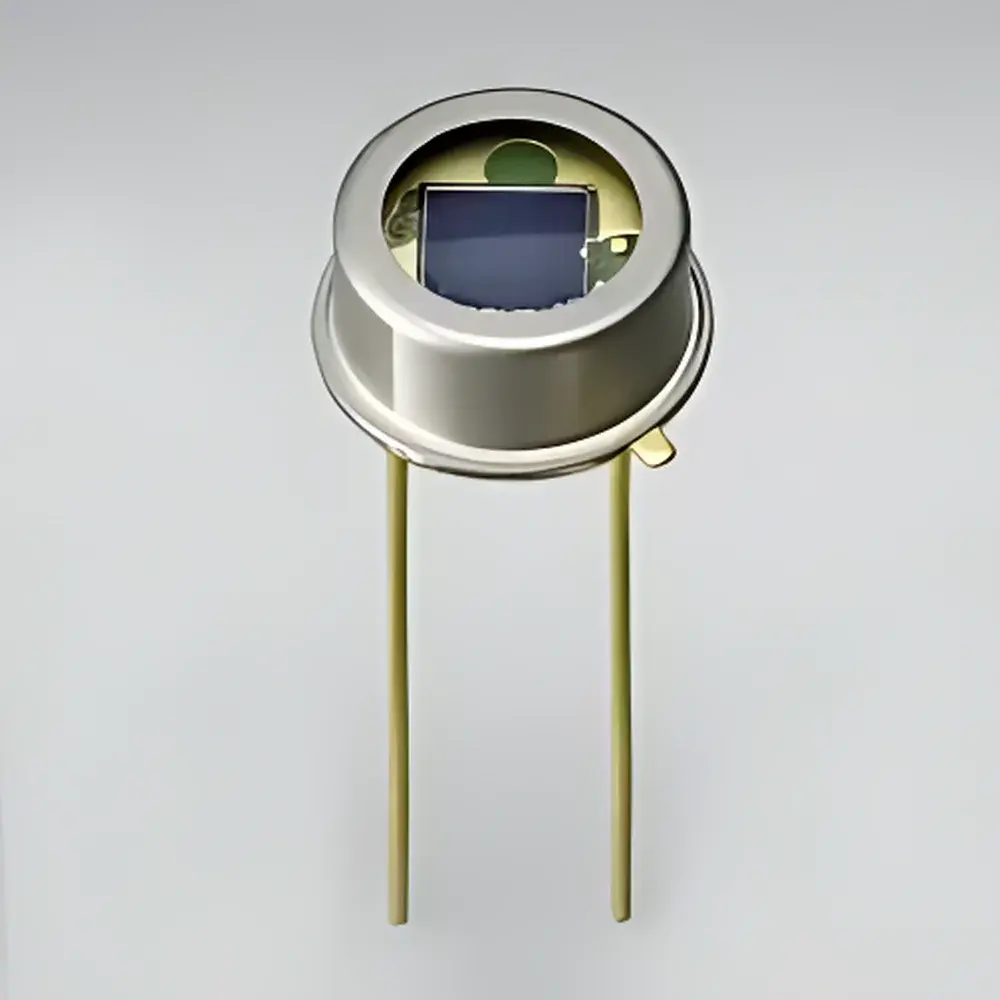
Hamamatsu Silicon Photodiode S1336-44BK
| Brand | Hamamatsu |
|---|---|
| Origin | Japan |
| Manufacturer Type | Original Equipment Manufacturer (OEM) |
| Product Category | Imported Optical Component |
| Model | S1336-44BK |
| Component Type | Silicon Photodiode |
| Active Area | 3.6 × 3.6 mm² |
| Spectral Range | 320–1100 nm |
| Peak Responsivity Wavelength (Typ.) | 960 nm |
| Responsivity (Typ. at 960 nm) | 0.5 A/W |
| Dark Current (Max. at VR = 10 mV) | 50 pA |
| Junction Capacitance (Typ. at VR = 0 V, f = 10 kHz) | 150 pF |
| Rise Time (Typ. at VR = 0 V) | 0.5 μs |
| Maximum Reverse Voltage | 5 V |
| Package | TO-5 Metal Can |
| Cooling | Non-cooled |
| Operating Temperature | –40 to +85 °C (Storage: –40 to +100 °C) |
Overview
The Hamamatsu S1336-44BK is a high-performance, non-cooled silicon photodiode engineered for precision radiometric and photometric measurements across the ultraviolet (UV) to near-infrared (NIR) spectrum (320–1100 nm). Designed with a large active area of 3.6 × 3.6 mm² and housed in a hermetically sealed TO-5 metal package, this photodiode delivers stable, low-noise performance under ambient laboratory and industrial conditions. Its spectral response peaks at 960 nm with a typical responsivity of 0.5 A/W—optimized for applications requiring high quantum efficiency in the NIR region while maintaining usable sensitivity down to 320 nm. The device operates in photovoltaic or photoconductive mode and is characterized by low junction capacitance (150 pF), fast temporal response (0.5 μs rise time), and exceptionally low dark current (≤50 pA at 10 mV reverse bias), enabling high signal-to-noise ratio detection in low-light scenarios such as spectroscopy, laser power monitoring, and optical encoder feedback systems.
Key Features
- Wide spectral coverage from 320 nm (UV-A) to 1100 nm (NIR), supporting multi-band optical system integration
- High responsivity (0.5 A/W at 960 nm) with excellent linearity over five decades of incident optical power
- Low dark current (≤50 pA) ensures minimal thermal noise, critical for DC-coupled and low-frequency measurement circuits
- Low junction capacitance (150 pF at 0 V bias) supports high-speed signal acquisition and minimizes RC time constant limitations
- Robust TO-5 metal-can package provides electromagnetic shielding, mechanical stability, and long-term hermetic reliability
- No active cooling required—designed for stable operation across –40 °C to +85 °C ambient temperature range
- Compliant with JEDEC J-STD-020 moisture sensitivity level (MSL) 1, suitable for standard surface-mount or through-hole assembly processes
Sample Compatibility & Compliance
The S1336-44BK is compatible with standard optical bench configurations, fiber-coupled setups (via SMA or FC adapters using custom mounting fixtures), and collimated beam alignment systems. Its flat, uncoated silicon surface allows direct integration with UV-grade fused silica windows or AR-coated optics without spectral distortion. The device meets RoHS Directive 2011/65/EU and REACH Regulation (EC) No. 1907/2006 requirements. While not intrinsically certified for hazardous locations, it is routinely deployed in ISO/IEC 17025-accredited calibration laboratories for reference-grade irradiance and luminous flux transfer standards. Its electrical and thermal specifications are validated per Hamamatsu’s internal test protocol HMPD-TS-2023, aligned with IEC 60747-5-2 (discrete semiconductor devices — optoelectronic devices).
Software & Data Management
As a passive transducer, the S1336-44BK requires external signal conditioning—including low-noise transimpedance amplification, analog filtering, and ADC digitization—for quantitative optical power measurement. It is fully compatible with industry-standard data acquisition platforms including National Instruments DAQmx, Keysight U2300A series, and Thorlabs PM100D-compatible meter interfaces. When integrated into traceable calibration workflows, its responsivity curve (provided in NIST-traceable calibration reports available upon request) can be imported into MATLAB, Python (SciPy/NumPy), or LabVIEW environments for spectral correction and uncertainty propagation analysis. Full compliance with FDA 21 CFR Part 11 is achievable when used within validated instrument control software that implements electronic signatures, audit trails, and data integrity controls.
Applications
- UV-NIR spectrophotometer detector arrays (as single-element reference or secondary channel)
- Laser diode output monitoring in telecom and medical laser systems (808 nm, 940 nm, 980 nm bands)
- Integrating sphere-based total luminous flux measurement per CIE S 025/E:2015
- Optical encoder position sensing in high-reliability motion control systems
- Calibration transfer standards in national metrology institutes (NMIs) and third-party calibration labs
- Environmental sensor modules for solar irradiance (UV index, PAR) and water quality monitoring (turbidity, absorbance)
FAQ
What is the maximum permissible reverse voltage for continuous operation?
The absolute maximum reverse voltage is 5 V. Exceeding this may cause irreversible junction breakdown.
Can this photodiode be used in photovoltaic mode without bias?
Yes—it exhibits negligible offset and excellent linearity in zero-bias configuration, making it suitable for low-drift energy measurement applications.
Is the spectral responsivity data NIST-traceable?
Calibration certificates with NIST-traceable spectral responsivity data (320–1100 nm, 5 nm step) are available as an optional service (order code: CAL-S1336-44BK-NIST).
Does the TO-5 package include a built-in window?
No—the TO-5 metal can has an open aperture; users must integrate an appropriate optical window (e.g., UV-fused silica or broadband AR-coated glass) based on application-specific transmission requirements.
How does temperature affect dark current performance?
Dark current approximately doubles per 10 °C rise above 25 °C; operation below 40 °C is recommended for sub-pA-level stability in ultra-low-light applications.




