
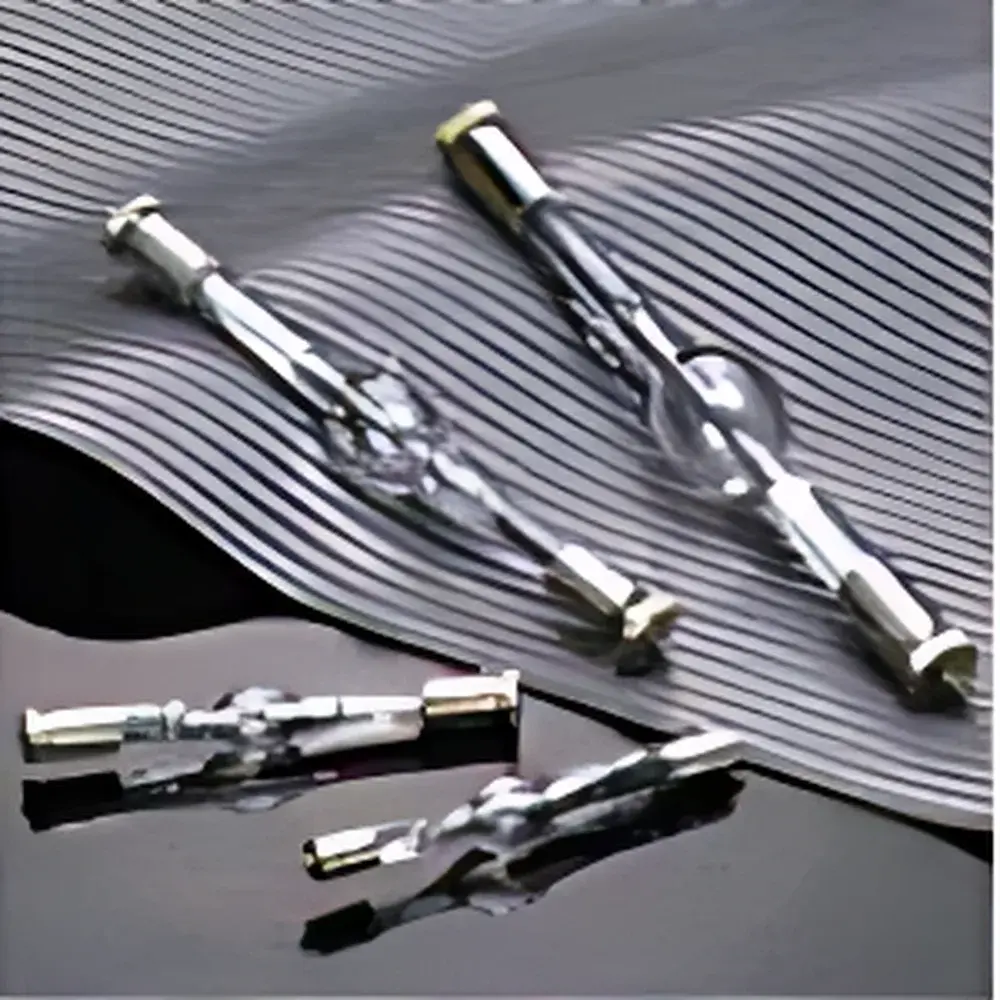
Hamamatsu L2173 DC Xenon Lamp Module
| Origin | Japan |
|---|---|
| Manufacturer Type | Authorized Distributor |
| Origin Category | Imported |
| Model | L2173 |
| Power Rating | 35 W |
| Spectral Range | 185–2000 nm (Fused Silica Window) |
| Operating Current | 3.5 ± 0.2 A DC |
| Operating Voltage | 11 V DC |
| Arc Length | 1.5 mm |
| Lamp Lifetime | ≥ 2,000 hours (typical, under recommended cooling and drive conditions) |
Overview
The Hamamatsu L2173 is a high-stability, direct-current (DC) powered xenon lamp module engineered for precision optical instrumentation requiring broadband spectral continuity from deep ultraviolet (UV) through visible to near-infrared (NIR). Unlike pulsed or AC-driven sources, the L2173 employs a thermionically enhanced cathode design and precisely controlled DC arc discharge to deliver exceptional radiometric stability (< ±0.5% RMS intensity drift over 8 hours), minimal spatial drift of the arc image, and reproducible spectral output across its full 185–2000 nm range. Its fused silica envelope enables transmission down to 185 nm—critical for UV-Vis spectrophotometry, fluorescence excitation, and photochemical reaction monitoring. The lamp operates at a nominal 35 W power level with a compact 1.5 mm arc length, facilitating efficient coupling into monochromators, fiber-optic light guides, and microspectrometer illumination pathways.
Key Features
- Stable DC arc operation with low noise and high temporal reproducibility—optimized for lock-in detection and time-resolved measurements
- Fused silica window with certified UV transmission (≥85% at 190 nm, ≥92% at 300 nm) enabling reliable deep-UV applications
- Engineered cathode geometry and gas fill composition reduce electrode sputtering and extend operational lifetime beyond 2,000 hours under proper thermal management
- Integrated lamp housing with precise mechanical alignment features (M32 × 0.75 thread, reference plane tolerance ±5 µm) ensures repeatable optical positioning in OEM systems
- Compliant with IEC 62471:2006 Photobiological Safety standards for lamp classification (Risk Group 2 for UV exposure under typical enclosure conditions)
- RoHS-compliant construction and halogen-free internal materials support laboratory environmental compliance protocols
Sample Compatibility & Compliance
The L2173 is designed for integration into analytical platforms where spectral fidelity and long-term calibration stability are mandatory—including UV-Vis-NIR spectrophotometers (ASTM E275, ISO 9001-compliant calibration workflows), fluorescence microplate readers (USP ), and photostability test chambers (ICH Q1B). Its continuous spectrum eliminates line-emission artifacts common in mercury or deuterium lamps, making it suitable for absorbance ratio validation (e.g., NIST-traceable SRM 930e filter verification). All Hamamatsu xenon lamps undergo individual spectral characterization and are supplied with factory-measured relative spectral irradiance data (2 nm resolution, NIST-traceable calibration). The module meets CE marking requirements for electromagnetic compatibility (EN 61326-1) and safety (EN 61010-1), and supports GLP/GMP audit readiness via documented lot traceability and certificate of conformance.
Software & Data Management
While the L2173 is a hardware light source without embedded firmware, Hamamatsu provides comprehensive digital support for system integrators and end users. Each unit ships with a unique serial-numbered spectral calibration report in CSV and XML formats, compatible with MATLAB, Python (NumPy/Pandas), and LabVIEW-based data acquisition environments. Hamamatsu’s free Light Source Manager software (v3.2+) enables spectral interpolation, irradiance normalization, and lifetime tracking when paired with optional photodiode monitoring modules (e.g., C12701 series). For regulated environments, the lamp’s traceable calibration data satisfies FDA 21 CFR Part 11 requirements when stored within validated electronic lab notebooks (ELNs) or LIMS platforms with appropriate audit trail configuration.
Applications
- Primary and secondary standard illumination in double-beam UV-Vis spectrophotometers per ASTM E387 and ISO/IEC 17025 accreditation criteria
- Excitation source for steady-state and time-resolved fluorescence spectroscopy—particularly where broad-band excitation or multi-wavelength scanning is required
- Reference light source in hyperspectral imaging calibration rigs (e.g., push-broom scanners, Fourier-transform imaging spectrometers)
- Illumination for accelerated weathering test chambers (ASTM G154, ISO 4892-3) due to stable UV-B/C output and low ozone generation
- OEM integration into automated clinical analyzers, environmental water quality sensors (e.g., COD, TOC), and semiconductor wafer inspection tools
FAQ
What is the recommended operating orientation for the L2173?
The lamp is rated for horizontal operation only (arc axis parallel to ground), with ±2° tilt tolerance. Vertical or inverted mounting accelerates cathode wear and reduces lifetime by up to 40%.
Does the L2173 require external ballasting or current regulation?
Yes—it must be driven by a constant-current DC power supply with ripple ≤0.1% and fast transient response (<10 µs) to maintain arc stability; Hamamatsu recommends the C10720 series controllers.
Can the L2173 be used in ozone-sensitive environments?
No—the fused silica envelope transmits below 200 nm, generating ozone below 240 nm. For ozone-free operation, select the L2193 variant with synthetic quartz (240–2000 nm cutoff).
How is spectral recalibration performed after extended use?
Hamamatsu offers certified recalibration services (traceable to NIST SRM 2036) every 1,000 operating hours or annually—whichever occurs first—to maintain measurement uncertainty budgets below ±1.2% (k=2) in the UV region.
Is thermal management mandatory?
Yes—continuous forced-air cooling (≥1.5 m/s airflow across housing) is required to maintain junction temperature 3×.




