
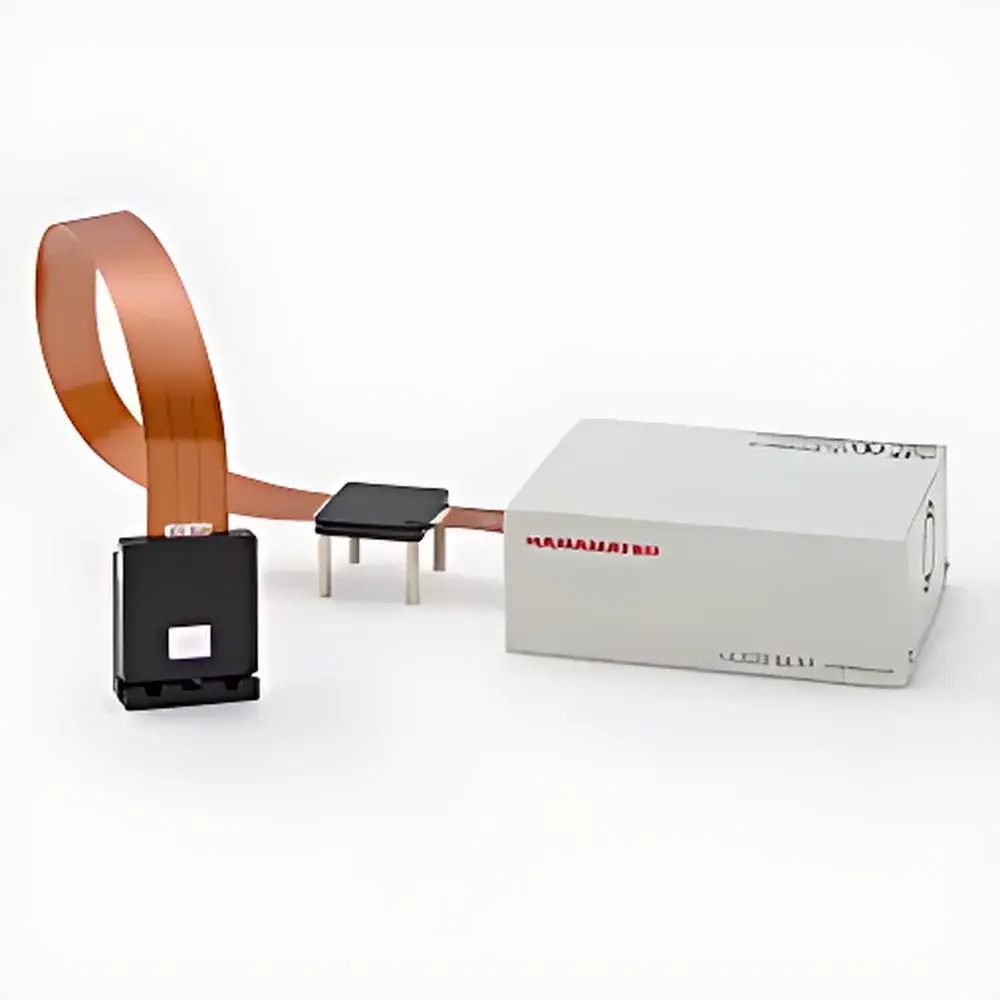
Hamamatsu LCOS-SLM X15213-13 Reflective Pure-Phase Spatial Light Modulator
| Brand | Hamamatsu |
|---|---|
| Origin | Japan |
| Manufacturer Type | Original Equipment Manufacturer (OEM) |
| Import Status | Imported |
| Model | X15213-13 |
| Pricing | Upon Request |
| Pixel Pitch | 12.5 µm |
| Active Area | 15.9 × 12.8 mm |
| Resolution | 1272 × 1024 pixels (SXGA) |
| Fill Factor | 96% |
| Input Interface | DVI-D + USB-B (USB 2.0 High-Speed) |
| DVI Frame Rate | 60 Hz |
| Gray Levels | 256 (8-bit) |
| Rise Time | 10 ms |
| Fall Time | 25 ms |
| Operating Wavelength Range | 530–635 nm |
| Optical Efficiency | 97% (measured at λ = 532 nm) |
| Maximum Spatial Frequency | 40 lp/mm |
| Modulation Type | Reflective, Pure-Phase |
Overview
The Hamamatsu X15213-13 is a high-performance reflective pure-phase spatial light modulator (SLM) based on liquid crystal on silicon (LCoS) technology. Engineered for precision wavefront control in advanced optical systems, it operates across the visible spectrum from 530 nm to 635 nm—optimized for common laser wavelengths including 532 nm and 635 nm. Unlike transmissive SLMs, its reflective architecture enables compact integration into folded-beam optical paths while minimizing thermal load on the active layer. The device implements voltage-controlled nematic liquid crystal alignment directly on a silicon backplane, enabling sub-wavelength phase modulation with high fidelity and repeatability. Its monolithic LCoS chip is calibrated to compensate for intrinsic wavefront distortions—including pixelation-induced diffraction artifacts, LC birefringence nonlinearity, and static aberrations—through integrated firmware correction routines accessible via host PC.
Key Features
- Reflective pure-phase modulation architecture with >97% optical efficiency at 532 nm
- High fill factor (96%) and fine pixel pitch (12.5 µm) enabling high spatial resolution up to 40 line pairs per millimeter
- SXGA-native resolution (1272 × 1024 active pixels) over a 15.9 × 12.8 mm active area
- Dual-interface control: DVI-D for real-time phase pattern streaming at 60 Hz frame rate; USB-B (USB 2.0 HS) for firmware updates, calibration data loading, and low-latency parameter configuration
- 8-bit grayscale input support (256 phase levels) ensuring linearized phase response across full dynamic range
- Rise/fall times of 10 ms / 25 ms—suitable for quasi-static holographic applications, adaptive optics feedback loops, and iterative beam shaping protocols
- Robust thermal design supporting continuous-wave illumination at power densities typical of laboratory-grade diode and DPSS lasers
Sample Compatibility & Compliance
The X15213-13 is designed for integration into ISO-standard optical breadboards and modular laser systems compliant with IEC 60825-1 (laser safety) and EN 61326-1 (electromagnetic compatibility for laboratory equipment). Its sealed LCoS package meets JEDEC J-STD-020 moisture sensitivity level (MSL) 3 specifications, ensuring long-term reliability under controlled lab environments (23 °C, 50% RH). While not certified for medical or industrial process-critical use, the device supports traceable calibration workflows compatible with GLP-aligned laboratories. Phase response linearity and stability are validated per Hamamatsu’s internal test protocol HSLM-T-004, which includes temporal drift monitoring (<0.02π RMS over 2 hours) and wavelength-dependent retardance mapping across the specified band.
Software & Data Management
Hamamatsu provides the proprietary SLM Control Studio software suite (Windows 10/11, 64-bit), enabling direct DVI-driven phase pattern generation, real-time gamma correction, and hardware-accelerated Fourier hologram computation. The application supports import of complex field distributions (e.g., .mat, .tif, .fits), batch sequence scripting (Python API included), and synchronized triggering via TTL input/output ports. All calibration datasets—including pixel-wise phase-response lookup tables (LUTs), flat-field correction maps, and chromatic dispersion compensation profiles—are stored in vendor-defined binary formats with SHA-256 checksum integrity verification. Audit trails for pattern uploads, parameter changes, and system diagnostics comply with FDA 21 CFR Part 11 requirements when deployed with optional electronic signature modules and network-attached logging servers.
Applications
- Dynamic holography and computer-generated hologram (CGH) projection
- Adaptive optics wavefront correction in microscopy (e.g., multiphoton, confocal, and light-sheet systems)
- Optical trapping and holographic optical tweezers (HOT) with multi-point manipulation capability
- Beam shaping for ultrafast laser pulse front tilt, vortex generation, and Bessel beam synthesis
- Quantum optics experiments requiring high-fidelity spatial mode control (e.g., OAM state preparation, entanglement encoding)
- Interferometric metrology and null testing using programmable reference wavefronts
FAQ
Is the X15213-13 compatible with third-party SLM control software?
Yes—via DVI video signal injection, it accepts standard RGB888 or YUV444 video streams; however, only Hamamatsu’s native software fully exploits phase-linearity correction, USB-based calibration, and temporal synchronization features.
What is the maximum average optical power density the device can withstand?
The LCoS chip is rated for continuous-wave illumination up to 5 W/cm² at 532 nm under collimated, uniform illumination conditions with adequate heat sinking; derating is required above 600 nm due to increased absorption in the dielectric stack.
Does the unit include factory calibration data?
Yes—each shipped unit includes a unique calibration certificate with measured phase-response curves, pixel defect map, and flat-field correction matrix, delivered as encrypted .slmcal files readable by SLM Control Studio.
Can multiple X15213-13 units be synchronized?
Hardware-level synchronization is supported via external TTL trigger input (BNC), enabling sub-millisecond inter-unit timing alignment for multi-SLM interferometry or large-aperture tiling configurations.
Is there an SDK available for custom application development?
A C++/Python SDK with comprehensive documentation, sample code, and DLL/DYLIB/SO libraries is provided under NDA upon request for qualified academic and commercial integrators.





