
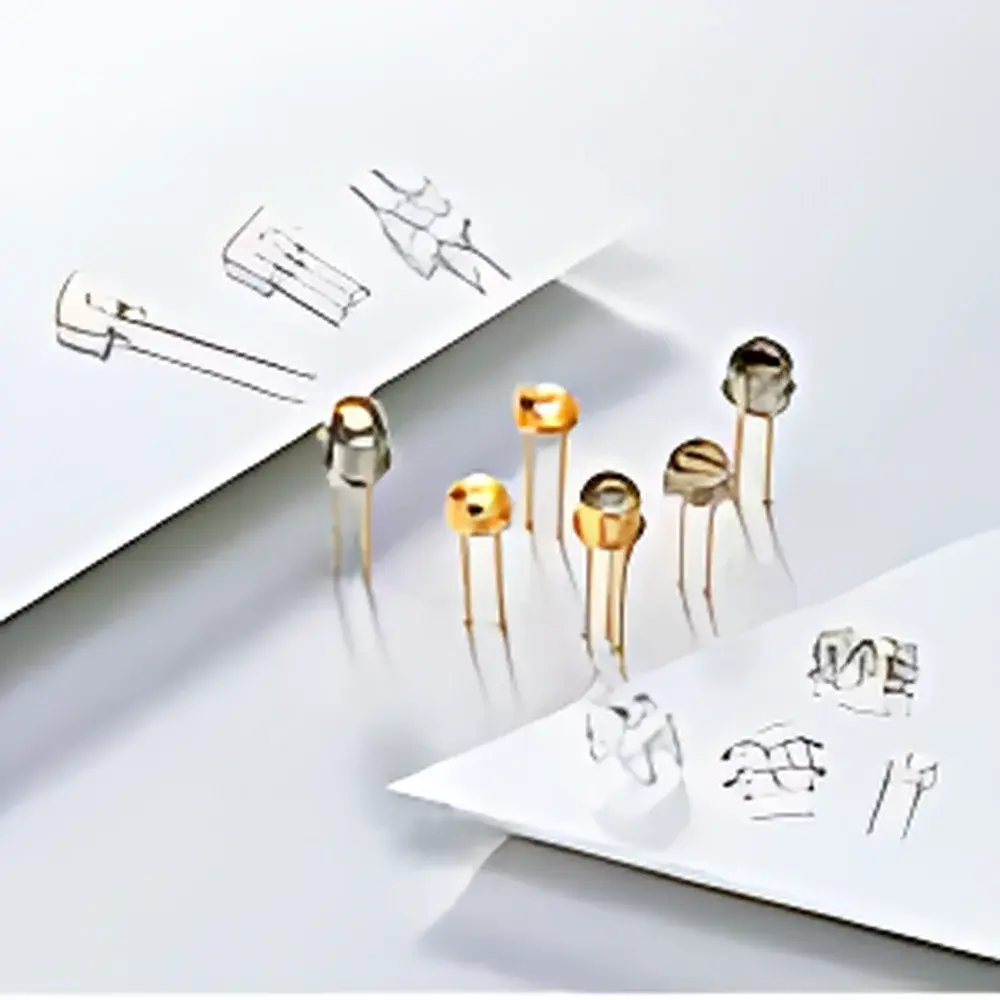
Hamamatsu L10596 High-Speed Near-Infrared LED Device
| Origin | Japan |
|---|---|
| Manufacturer Type | Authorized Distributor |
| Origin Category | Imported |
| Model | L10596 |
| Price | Upon Request |
Overview
The Hamamatsu L10596 is a high-reliability, high-speed near-infrared (NIR) light-emitting diode engineered for precision optoelectronic applications requiring stable spectral output, rapid modulation response, and long-term operational stability. Based on gallium arsenide (GaAs) semiconductor technology, this device operates on the principle of electroluminescence—converting electrical current directly into coherent, narrow-band NIR radiation at a peak wavelength of 870 nm. Unlike laser diodes, the L10596 emits incoherent, Lambertian radiation with low spatial coherence, making it inherently immune to speckle noise and optical feedback instability—critical advantages in free-space optical (FSO) links, encoder systems, and industrial sensing environments. Its TO-46 metal-can package ensures excellent thermal dissipation and mechanical robustness under continuous-wave (CW) or pulsed operation, supporting integration into automated test equipment, embedded control modules, and ISO/IEC 17025-compliant calibration setups.
Key Features
- Peak emission wavelength: 870 nm — optimized for silicon photodetector responsivity and atmospheric transmission windows
- High modulation bandwidth: 15 MHz cutoff frequency — enables high-speed digital encoding, pulse-position modulation (PPM), and time-of-flight (ToF) signal generation
- Radiant power output: 3 mW (typ.) under standard forward current (IF = 50 mA) — sufficient for short-to-medium range detection without lensing
- Hermetically sealed TO-46 metal package — provides superior moisture resistance (IP54 equivalent), ESD protection (HBM > 2 kV), and thermal stability across –40 °C to +85 °C operating range
- Low forward voltage drop (VF ≈ 1.4 V @ IF = 50 mA) — minimizes power consumption and self-heating in battery-powered or high-density array configurations
- Compliant with RoHS Directive 2011/65/EU and REACH Regulation (EC) No. 1907/2006 — suitable for deployment in EU-regulated instrumentation and medical auxiliary systems
Sample Compatibility & Compliance
The L10596 is designed for direct integration with industry-standard photodiode receivers (e.g., Hamamatsu S120VC, OSI Optoelectronics PIN-10DP), transimpedance amplifiers, and FPGA-based timing controllers. Its spectral profile aligns with common optical filter bands used in humidity sensing (e.g., water vapor absorption at 1450 nm requires paired devices like L10660), FSO channel allocation (ITU-T G.694.2), and industrial encoder resolution standards (e.g., EN 61800-5-2 for drive system safety). The device meets IEC 62471:2006 photobiological safety requirements for Class 1 LED sources and supports traceable calibration per ISO/IEC 17025 when used with NIST-traceable radiometric measurement systems.
Software & Data Management
While the L10596 is a passive emitter requiring external driver circuitry, Hamamatsu provides comprehensive application notes (e.g., “AN-LED-003: Driving High-Speed NIR LEDs for Encoder Applications”) and SPICE-compatible behavioral models for LTspice and PSpice simulation. Integration with LabVIEW™, MATLAB® Instrument Control Toolbox, and Python-based PyVISA frameworks is supported via compatible constant-current drivers (e.g., Hamamatsu C11202 series). All technical documentation—including spectral radiant intensity maps, thermal resistance curves (Rth = 120 K/W), and aging data (L70 > 50,000 h @ Tj = 60 °C)—is accessible through Hamamatsu’s secure distributor portal, enabling full audit trail compliance for GLP/GMP environments.
Applications
- Optical encoders and rotary position sensors — leveraging high-frequency modulation for sub-microradian angular resolution
- Industrial humidity and moisture analyzers — as part of dual-wavelength differential absorption systems (e.g., paired with 1450 nm emitters)
- Free-space optical communication links — supporting up to 15 Mbps unidirectional data transmission over distances up to 20 m in indoor environments
- Proximity and presence detection in automotive ADAS subsystems — meeting AEC-Q102 stress test requirements when mounted on qualified PCB assemblies
- Time-of-flight (ToF) distance measurement modules — integrated with fast-gating SiPMs or APDs for <1 cm ranging accuracy
- Machine vision illumination for NIR-reflective contrast enhancement in food sorting, pharmaceutical blister inspection, and textile defect detection
FAQ
What is the maximum allowable forward current for continuous operation?
The absolute maximum DC forward current is 100 mA; however, Hamamatsu recommends ≤ 60 mA for extended lifetime and thermal stability.
Can the L10596 be driven with pulsed current to achieve higher peak power?
Yes — with duty cycle ≤ 10% and pulse width ≤ 100 ns, peak currents up to 500 mA are permissible, provided average power remains within 60 mW.
Is there a recommended constant-current driver IC compatible with this device?
The Texas Instruments DRV593 and Analog Devices ADN8834 are validated for use with TO-46 NIR LEDs; Hamamatsu also offers the C11202-01 evaluation board.
Does the L10596 require electrostatic discharge (ESD) protection during handling?
Yes — always use grounded wrist straps and anti-static mats; the device is rated Class 2 per ANSI/ESDA/JEDEC JS-001.
How does temperature affect its radiant output and spectral shift?
Radiant power decreases by ~0.5%/°C above 25 °C; peak wavelength red-shifts at ~0.3 nm/°C — compensation algorithms are included in Hamamatsu’s encoder reference firmware.



