
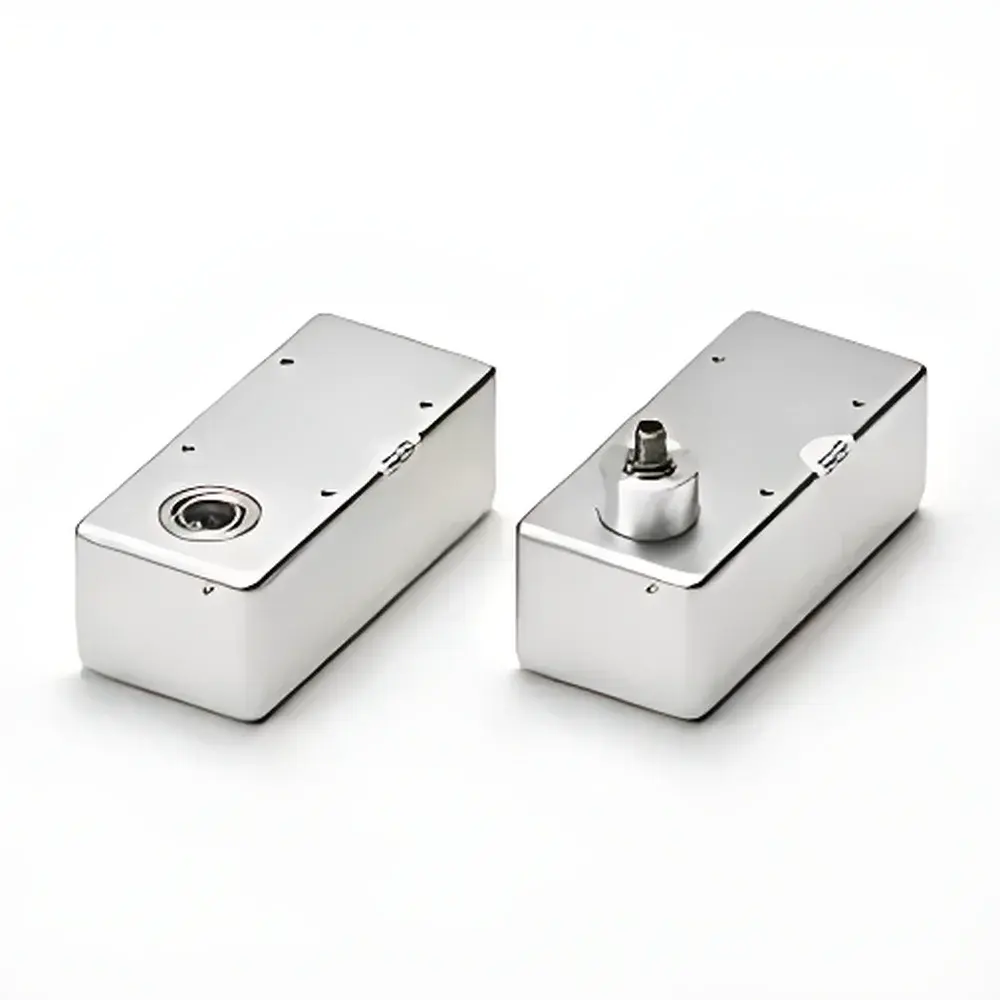
Hamamatsu L9456 5W Pulsed Xenon Lamp Module with Integrated Power Supply and Trigger Interface
| Brand | Hamamatsu |
|---|---|
| Origin | Japan |
| Manufacturer | Hamamatsu Photonics K.K. |
| Product Type | Pulsed Xenon Light Source |
| Model | L9456 |
| Arc Length | 3.0 mm |
| Spectral Range (Quartz Window) | 160–2000 nm |
| Spectral Range (UV-Grade Glass Window) | 185–2000 nm |
| Spectral Range (Borosilicate Glass Window) | 280–2000 nm |
| Max. Repetition Rate | 252 Hz (configurable) |
| Max. Average Input Power | 5.0 W |
| Light Output Stability (CV, typical) | 0.3% |
| Guaranteed Lifetime | 5 × 10⁸ flashes |
| Operating Temperature | 0–+40 °C |
| Compliance | IEC/EN 61326-1 (EMC), IEC/EN 62471 (Photobiological Safety, Risk Group 3), RoHS (IEC/EN 63000) |
Overview
The Hamamatsu L9456 is a compact, self-contained 5W pulsed xenon lamp module engineered for precision optical instrumentation requiring stable, broadband ultraviolet-to-near-infrared illumination. Based on high-efficiency flashlamp technology, it operates via capacitor discharge across a 3.0 mm arc gap, generating short-duration, high-intensity light pulses with minimal thermal load. Unlike continuous-wave sources, the L9456 delivers peak spectral irradiance without sustained heating—making it ideal for applications where photodegradation, sample heating, or detector saturation must be minimized. Its integrated power supply and trigger interface eliminate external driver complexity, enabling direct integration into OEM analytical platforms such as UV-Vis spectrophotometers, flow cytometers, HPLC detectors, and portable environmental sensors. The module’s spectral output spans 160–2000 nm when equipped with synthetic fused silica windows—covering deep UV (including 190 nm absorption bands critical for nucleic acid quantification) through visible and into the NIR region—ensuring compatibility with silicon, InGaAs, and other common photodetectors.
Key Features
- Integrated design: Combines lamp head, high-voltage power supply, and TTL-compatible trigger circuitry in a single mechanically robust housing (dimensions: 45 × 30 × 25 mm).
- Three optical window options: Synthetic quartz (160–2000 nm), UV-grade glass (185–2000 nm), and borosilicate glass (280–2000 nm), each selected to optimize transmission for specific application bands.
- High pulse-to-pulse stability: Typical coefficient of variation (CV) of 0.3% under 126 Hz operation at 5 W average input—validated per ISO 9001 traceable test protocols using calibrated Hamamatsu S1336-8BQ photodiodes.
- Configurable electrical parameters: Main discharge voltage adjustable from 400–600 V (internal regulation) or 500–1000 V (external control); main discharge capacitance fixed at 0.2 µF for L9456 variants.
- No active cooling required: Designed for conduction-cooled operation up to +40 °C ambient; thermal management relies on aluminum housing and optimized PCB layout—no fans or heat sinks needed in standard deployment.
- EMC-compliant architecture: Meets IEC/EN 61326-1 emission limits (CISPR 11 Group 1, Class A) and immunity requirements (Table 2), ensuring reliable coexistence in laboratory and industrial instrument racks.
Sample Compatibility & Compliance
The L9456 supports diverse sample geometries and measurement modalities—including cuvette-based absorbance, fiber-coupled reflectance, and free-space transmittance—due to its collimated output beam profile and low divergence (<5° full angle). Its deep-UV capability enables detection of aromatic amino acids (Trp, Tyr), nucleic acids (260 nm), and organic pollutants (e.g., nitrobenzene at 255 nm) without ozone generation concerns typical of deuterium lamps. From a regulatory standpoint, the module conforms to IEC/EN 62471 Photobiological Safety standards and is classified as Risk Group 3—requiring appropriate enclosure interlocks in open-beam configurations per EN 61010-1. It satisfies RoHS Directive 2011/65/EU (IEC/EN 63000) and supports GLP/GMP-aligned validation through documented lifetime metrics: guaranteed 5 × 10⁸ flashes before 50% radiant flux decay (measured at 190–1100 nm band) or exceeding ±2.5% p-p output fluctuation.
Software & Data Management
While the L9456 operates as a hardware-level light source without embedded firmware, its analog control interface enables seamless synchronization with host instrument software stacks. The 5–10 V rectangular trigger signal (≥10 µs pulse width, 330 Ω input impedance) allows precise temporal alignment with CCD/CMOS exposure timing, lock-in amplifier reference signals, or chromatographic event markers. For systems requiring audit trails—such as clinical analyzers compliant with FDA 21 CFR Part 11—the module’s stable output eliminates need for real-time intensity correction algorithms, simplifying data integrity workflows. Hamamatsu provides comprehensive datasheets, aging curve datasets, and spectral irradiance calibration reports (NIST-traceable upon request), supporting IQ/OQ/PQ documentation for regulated environments.
Applications
- UV-Vis-NIR spectrophotometry: Reference-grade stability supports ASTM E275 and ISO 6223 compliance in benchtop and handheld analyzers.
- HPLC and UHPLC detectors: High repetition rate (up to 252 Hz) enables multi-wavelength scanning across elution peaks without duty-cycle loss.
- Flow cytometry and imaging cytometry: Sub-millisecond pulse width minimizes motion blur in high-speed cell sorting; broad spectrum accommodates >6-fluorochrome panels.
- Environmental monitoring: Used in portable gas analyzers (NO₂, SO₂, O₃) and turbidity sensors due to strong UV line emission and resistance to humidity-induced drift.
- In vitro diagnostics: Supports CLIA-waived assays for hemoglobin, bilirubin, and creatinine via fixed-wavelength photometry at 415, 450, and 520 nm.
- Material inspection: Enables fluorescence excitation of phosphors, gemstone identification (e.g., diamond vs. moissanite), and semiconductor wafer defect mapping.
FAQ
What is the recommended operating temperature range for long-term reliability?
The L9456 is rated for continuous operation between 0 °C and +40 °C. Exceeding +45 °C at the housing surface may accelerate electrode erosion; passive heatsinking or forced-air cooling is advised above this threshold.
Can the L9456 be synchronized with external data acquisition systems?
Yes—its TTL-compatible trigger input accepts 5–10 V rectangular pulses with ≥10 µs width and responds on the rising edge. Trigger jitter is <100 ns (RMS), enabling sub-microsecond timing alignment with DAQ cards or FPGA-based controllers.
How is spectral output validated across the UV-VIS-NIR range?
Hamamatsu characterizes each production batch using double-monochromator spectroradiometers calibrated against NIST SRM 1931c and 2032. Full spectral irradiance curves (1 nm resolution) are available in CSV format upon request.
Does the module support remote intensity modulation?
No—intensity is controlled solely by adjusting main discharge voltage and repetition rate via analog inputs. Digital dimming or PWM modulation is not supported; output linearity versus voltage is ±1.5% over the 400–600 V range.
What maintenance is required during its operational lifetime?
None beyond periodic visual inspection of the optical window for contamination. No consumables, recalibration, or lamp replacement are necessary until end-of-life (5 × 10⁸ flashes), after which output degradation exceeds specification limits.





