
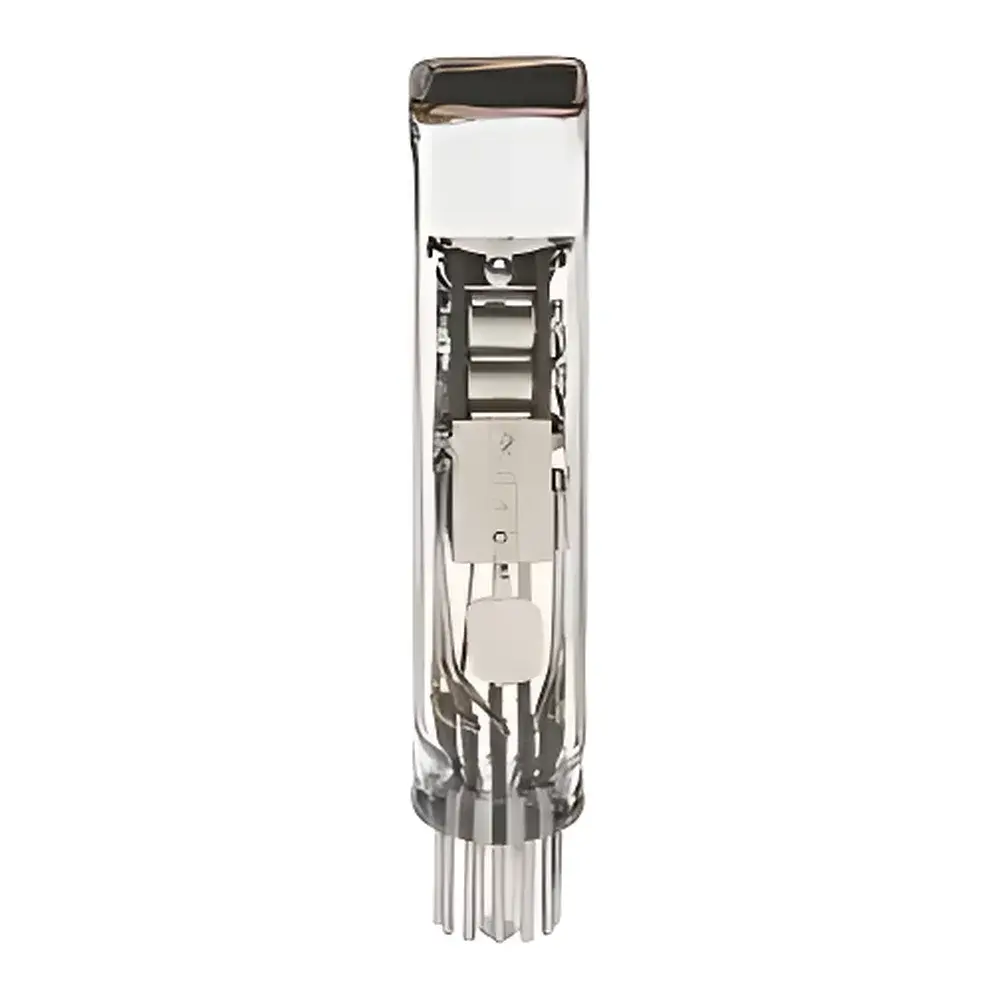
Hamamatsu Custom-Shape Photomultiplier Tube (PMT) R6 Series
| Brand | Hamamatsu |
|---|---|
| Origin | Japan |
| Manufacturer Type | Original Equipment Manufacturer (OEM) |
| Import Status | Imported |
| Model | R6 Series |
| Pricing | Available Upon Request |
Overview
The Hamamatsu R6 Series custom-shape photomultiplier tubes (PMTs) are engineered for demanding optical detection applications requiring non-standard geometries, high quantum efficiency, and exceptional signal-to-noise performance. Based on the fundamental principle of secondary electron multiplication via dynode chain amplification under vacuum, these PMTs convert incident photons—typically in the ultraviolet to visible spectral range—into measurable electrical current with gains exceeding 10⁶–10⁷. Unlike conventional cylindrical or side-on PMTs, the R6 Series features purpose-designed active area shapes—including square, rectangular, and truncated profiles—to optimize light collection efficiency in constrained optical paths, such as compact spectrometers, multi-channel detector arrays, and integrated analytical modules. Their bialkali (Sb-Rb-Cs) photocathodes deliver peak spectral sensitivity near 420 nm, aligning with common excitation sources (e.g., mercury lamps, nitrogen lasers) and fluorescence emission bands used across analytical chemistry and life science instrumentation.
Key Features
- Custom-shaped photosensitive areas (e.g., 24 × 24 mm, 9.8 × 9.8 mm) enabling tailored integration into space-limited optical benches and multi-element detector assemblies
- Bialkali photocathode with typical peak quantum efficiency >25% at 420 nm and low thermionic noise (<0.5 counts/sec at 25°C, typical)
- High gain stability over extended operation (>10⁶ gain reproducibility within ±3% after 1,000 hours at rated voltage)
- Vacuum-sealed borosilicate glass envelope with UV-transmissive window options (e.g., fused silica for <200 nm transmission)
- Robust dynode structure (linear-focused or box-and-grid configuration depending on model variant) supporting fast pulse response (rise time <2.5 ns, transit time spread <3.0 ns)
- Compliance with RoHS 2011/65/EU and REACH (EC) No. 1907/2006 directives for hazardous substance restrictions
Sample Compatibility & Compliance
The R6 Series PMTs are compatible with low-light samples requiring photon-counting or analog current-mode detection, including weak luminescence signals from chemiluminescent assays, scintillation events in liquid chromatography–radiometric detection, and Raman scattering in portable spectrometers. These devices meet critical requirements for analytical instrument manufacturers seeking components compliant with IEC 61000-4 electromagnetic compatibility standards and ISO/IEC 17025-accredited calibration traceability pathways. While not intrinsically certified for medical device use, individual R6 variants (e.g., R6234-01, R6237-01) are widely deployed in Class IIa and Class IIb in vitro diagnostic (IVD) systems under OEM responsibility per MDR (EU) 2017/745 Annex II documentation frameworks.
Software & Data Management
As passive analog detectors, R6-series PMTs interface directly with external high-voltage power supplies (e.g., C9201 series), preamplifiers, and digitization hardware. Hamamatsu provides comprehensive technical documentation—including pinout diagrams, voltage-divider network recommendations, dark current vs. temperature curves, and pulse height distribution data—for seamless integration into third-party data acquisition environments (e.g., National Instruments DAQmx, Keysight PathWave, or LabVIEW-based QC/QA platforms). All R6 models support audit-trail-capable HV control when paired with programmable power supplies compliant with FDA 21 CFR Part 11 requirements for electronic records and signatures in regulated laboratories.
Applications
- Spectroscopy: Used as primary detectors in benchtop and field-deployable UV-Vis and fluorescence spectrophotometers, particularly where spatial constraints prohibit standard PMT housings
- Nuclear & Radiological Measurement: Integral to scintillation counters for environmental gamma spectroscopy and low-level radioactivity monitoring (e.g., water, soil, air particulates)
- Life Sciences: Employed in flow cytometry optical engines, microplate readers, and autoradiography imagers requiring high dynamic range and sub-picoamp sensitivity
- Industrial Process Control: Integrated into laser-induced breakdown spectroscopy (LIBS) sensors for real-time elemental analysis in metallurgy and semiconductor fabrication lines
- Academic Research: Deployed in neutrino observatory prototypes, Cherenkov radiation detectors, and time-resolved fluorescence lifetime measurement setups
FAQ
What is the typical operating voltage range for R6-series PMTs?
Standard operation requires a stabilized high-voltage supply between –700 V and –1500 V DC, depending on gain requirements and dynode configuration. Voltage divider networks must be optimized per datasheet specifications.
Are R6 models available with alternative photocathode materials?
Yes—while bialkali (S-20) is standard, Hamamatsu offers optional multialkali (S-25), GaAs (S-25), and solar-blind Cs-Te (S-11) photocathodes upon request for specialized UV or NIR applications.
Can R6 PMTs be used in vacuum or controlled atmosphere enclosures?
These are sealed glass vacuum devices; no external vacuum pumping is required. However, prolonged exposure to high humidity or corrosive gases may degrade socket insulation—use recommended in dry N₂-purged or hermetically sealed instrument housings.
Is calibration data provided with each unit?
Each R6 PMT ships with individual test reports including dark current, gain vs. voltage, and spectral responsivity curves measured at Hamamatsu’s ISO/IEC 17025-accredited facility in Iwata, Japan.







