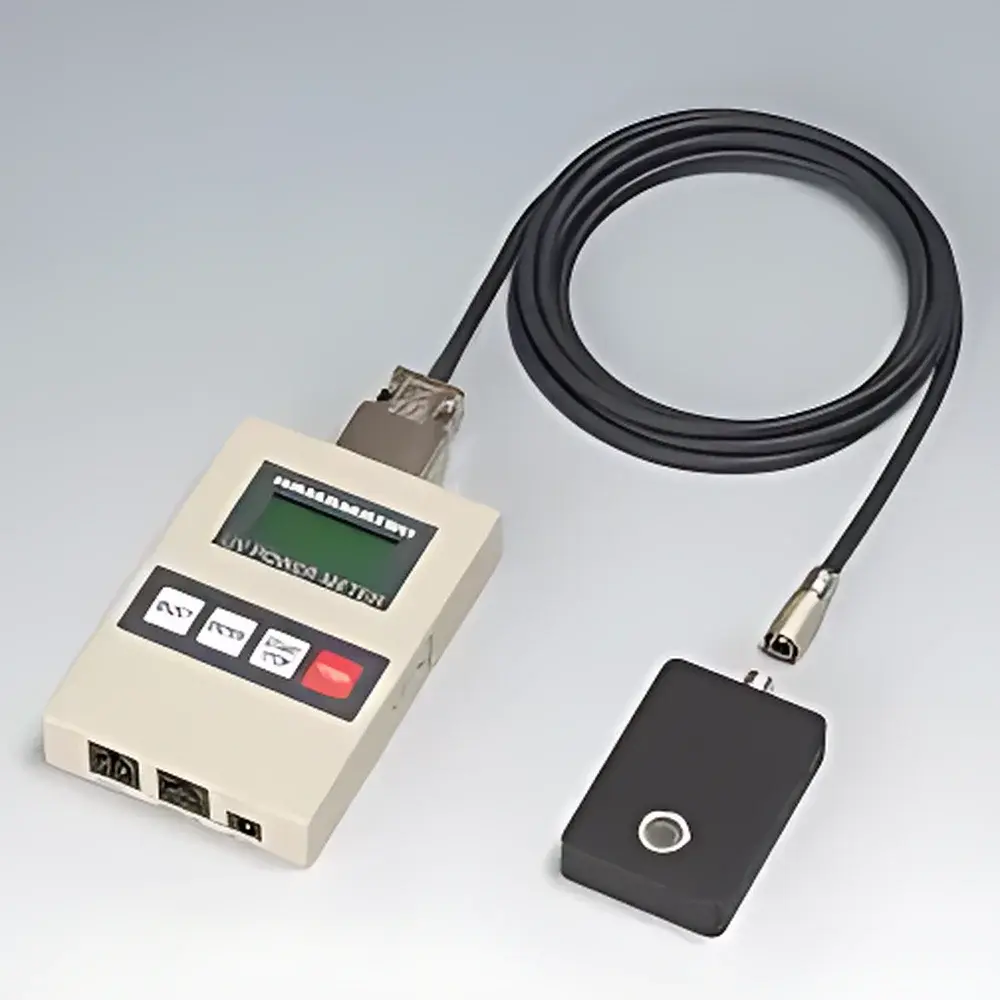
Hamamatsu C9536 UV Radiometer
| Brand | Hamamatsu |
|---|---|
| Origin | Japan |
| Manufacturer Type | Manufacturer |
| Origin Category | Imported |
| Model | C9536 |
| Price | Upon Request |
Overview
The Hamamatsu C9536 UV Radiometer is a precision-calibrated, modular radiometric measurement system engineered for absolute ultraviolet (UV) irradiance quantification in industrial and laboratory environments. It operates on the principle of direct photoelectric detection using a vacuum photodiode-based sensor (H9535 head), optimized for spectral responsivity in the deep and far-UV range without reliance on external optical filters. This eliminates wavelength-dependent drift caused by filter degradation and ensures long-term stability under continuous UV exposure—critical for process-critical applications such as UV curing, surface modification, and germicidal validation. The system comprises two core components: the H9535 detachable sensor head, featuring an integrated rechargeable battery and non-volatile memory for autonomous data logging, and the C9536 main controller unit, which performs real-time signal conditioning, calibration compensation, and digital output. Calibration is traceable to Japanese national standards (JIS Z 8000 series) and includes NIST-traceable reference data at six discrete wavelengths: 126 nm, 146 nm, 172 nm, 185 nm, 222 nm, and 254 nm—enabling accurate mW/cm² irradiance reporting across low-pressure mercury, excimer, and KrCl/VUV lamp spectra.
Key Features
- Direct UV irradiance measurement with vacuum photodiode sensor (H9535), eliminating need for interference filters and ensuring stable response in deep-UV (<200 nm)
- Modular architecture: detachable sensor head (14 mm profile) enables installation in confined or inaccessible locations—e.g., inside UV conveyor ovens, near lamp arrays, or within cleanroom ductwork
- Onboard data storage and battery operation (H9535 head) supports unattended, remote monitoring for up to 72 hours without external power
- Cosine-corrected angular response (±10° deviation from ideal cosθ) achieved without diffuser—maintaining accuracy even at oblique incidence angles typical in industrial UV chambers
- Dual communication interface: RS-232C for host PC integration and analog voltage output (0–5 V or 0–10 V) compatible with PLCs, chart recorders, and SCADA systems
- Factory-applied, wavelength-specific calibration coefficients embedded in firmware; supplied with ISO/IEC 17025-accredited calibration certificate per JIS Z 8000-2022
Sample Compatibility & Compliance
The C9536 system is validated for use with low-pressure mercury lamps (254 nm), KrCl excimer lamps (222 nm), Xe₂ excimers (172 nm), and deuterium arc sources (185 nm). Its sensor head exhibits negligible thermal drift (<0.05 %/°C) and radiation-induced aging (<0.3 % change after 10⁴ J/cm² cumulative exposure at 254 nm), satisfying long-duration process monitoring requirements. Compliance includes adherence to IEC 62471 (Photobiological Safety), JIS Z 8000-2022 (Radiometry—Calibration of UV Radiometers), and compatibility with GLP/GMP documentation workflows via audit-trail-capable software (see Software section). No recalibration is required under standard operating conditions for 12 months post-certification, per Hamamatsu’s maintenance protocol.
Software & Data Management
The C9536 supports ASCII-based serial command protocol over RS-232C, enabling seamless integration into custom LabVIEW, Python, or MATLAB control environments. Optional Hamamatsu Radiometer Control Software (v3.2+) provides time-stamped data logging, multi-channel synchronization (when used with multiple H9535 heads), and export to CSV, Excel, or XML formats compliant with FDA 21 CFR Part 11 requirements—including electronic signatures, user access logs, and immutable audit trails. All calibration metadata (wavelength, uncertainty, date, technician ID) is embedded in exported files, supporting ISO 9001 and ISO/IEC 17025 quality system audits.
Applications
- Real-time irradiance monitoring in UV-curing lines for coatings, adhesives, and inkjet inks—ensuring dose consistency per ISO 11997-2
- Validation and routine qualification of UV disinfection systems (e.g., 222 nm far-UV-C for airborne pathogen inactivation)
- Process control of UV ozone generation (185 nm) and surface oxidation treatments
- Characterization of excimer lamp uniformity and aging profiles in semiconductor photolithography support tools
- Verification of UV barrier efficacy in packaging materials and medical device sterilization packaging
FAQ
What wavelengths is the C9536 calibrated for, and how is traceability ensured?
The system is factory-calibrated at six discrete UV wavelengths (126, 146, 172, 185, 222, and 254 nm) using Hamamatsu’s primary standard reference detectors, with calibration traceable to the National Metrology Institute of Japan (NMIJ/AIST) and documented per ISO/IEC 17025.
Can the H9535 sensor head operate independently without the C9536 controller?
Yes—the H9535 head contains internal memory and a rechargeable battery, allowing standalone irradiance logging for up to 72 hours; however, real-time display, analog output, and advanced configuration require connection to the C9536 unit.
Is the cosine response verified per ISO/CIE standards?
Yes—angular responsivity was measured per CIE S 023/E:2013 and shows ≤±3% deviation from ideal cosθ law up to ±60° incidence angle, without auxiliary diffusers.
Does the system support GMP-compliant data integrity requirements?
When used with Hamamatsu’s optional Radiometer Control Software v3.2+, it fully supports 21 CFR Part 11 compliance—including role-based access control, electronic signatures, and immutable audit logs for all measurement and calibration events.