
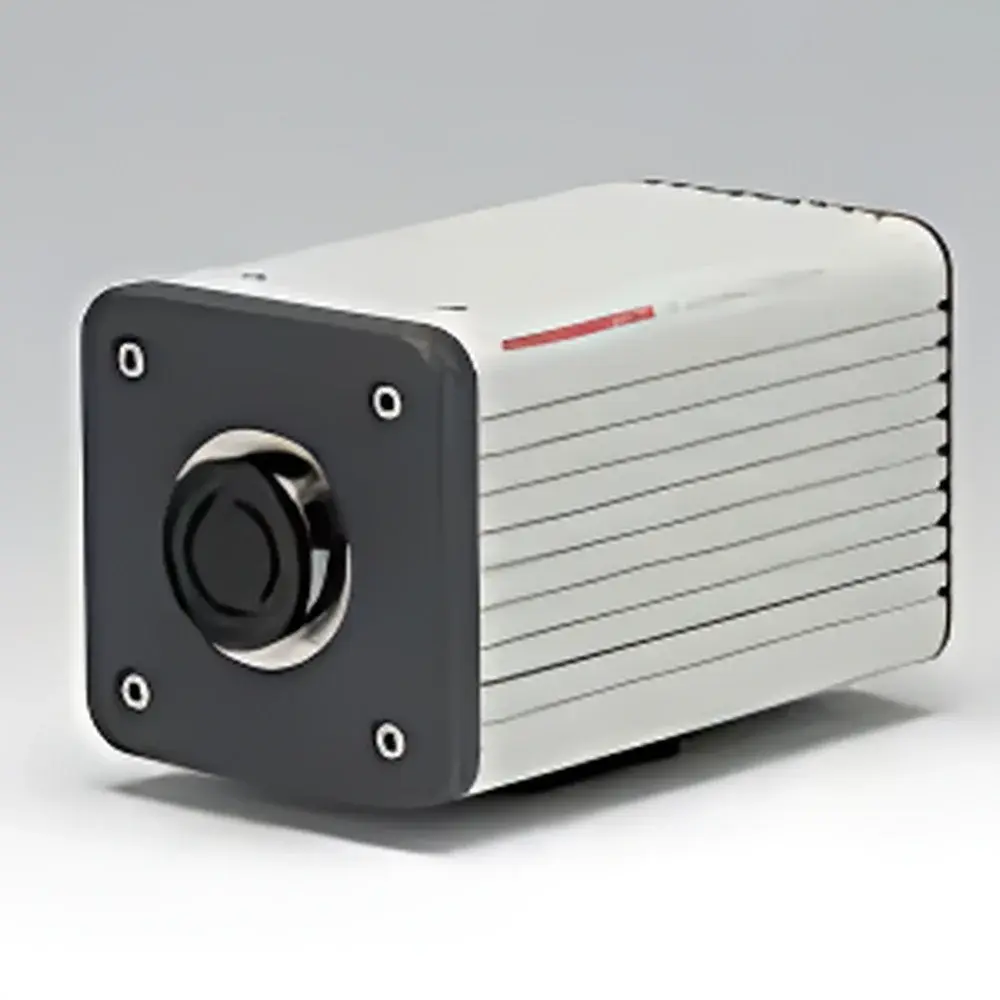
Hamamatsu C8000-30 Back-Illuminated CCD Camera
| Brand | Hamamatsu |
|---|---|
| Origin | Japan |
| Manufacturer Type | Original Equipment Manufacturer (OEM) |
| Import Status | Imported |
| Model | C8000-30 |
| Pricing | Upon Request |
Overview
The Hamamatsu C8000-30 is a high-performance back-illuminated frame-transfer CCD camera engineered for quantitative low-light imaging across ultraviolet (UV), visible (VIS), and near-infrared (NIR) spectral regions. Unlike conventional front-illuminated CCDs—where incident photons must pass through light-absorbing polysilicon gate electrodes before reaching the photosensitive depletion region—the C8000-30 employs a thinned, inverted silicon substrate (~10–15 µm thick) to enable direct photon absorption from the rear surface. This architecture eliminates parasitic absorption losses, particularly critical below 400 nm, resulting in quantum efficiency (QE) exceeding 60% at 200 nm and >90% at 650 nm. The device operates on the principle of charge-coupled transfer with full-frame readout capability, optimized for applications demanding high signal-to-noise ratio (SNR), temporal stability, and spectral fidelity—including semiconductor photomask inspection, UV fluorescence spectroscopy, NIR laser diode characterization, and time-resolved luminescence imaging.
Key Features
- Back-illuminated frame-transfer CCD architecture enabling high QE across 200–1100 nm
- Active pixel array of 640 × 480 pixels with 14 µm × 14 µm pixel pitch and 8.96 mm × 6.72 mm active area
- Full-well capacity of ~30,000 electrons per pixel, supporting wide dynamic range without saturation
- Readout noise of ≤150 e⁻ RMS at standard 31.4 fps operation, scalable via subarray binning
- Programmable recursive filtering (2–64 frames) for real-time noise suppression and signal averaging
- Dedicated background subtraction functionality for drift-compensated quantitative imaging
- CameraLink interface compliant with Base configuration, supporting deterministic trigger timing and high-throughput data streaming
- Natural convection cooling maintaining sensor temperature at +5 °C (ambient +20 °C), ensuring thermal stability without mechanical refrigeration
- 12-bit A/D conversion with 16-step analog gain control (×1 to ×5), preserving linearity across intensity scales
Sample Compatibility & Compliance
The C8000-30 is compatible with standard C-mount optical systems and integrates seamlessly into vacuum-compatible or inert-gas purged enclosures for UV-sensitive applications. Its spectral response profile meets requirements for ISO 15739:2013 (imaging system noise measurement) and supports traceable radiometric calibration when used with NIST-traceable reference sources. While not certified as a medical device, its performance characteristics align with GLP-compliant imaging workflows where auditability of exposure parameters, gain settings, and background correction logic is required. Firmware timestamps and non-volatile configuration storage support reproducible experimental conditions under ISO/IEC 17025-accredited laboratory environments.
Software & Data Management
The camera operates under Hamamatsu’s proprietary HCImage Live acquisition software, which provides full control over exposure duration (30.8 ms – 1 s), trigger mode selection (edge, level, start, or synchronous readout), and real-time image processing pipelines. All processed frames retain embedded metadata—including sensor temperature, gain index, exposure time, and applied recursive filter depth—enabling FAIR (Findable, Accessible, Interoperable, Reusable) data handling. Export formats include TIFF (16-bit unsigned), HDF5, and raw binary, facilitating integration with MATLAB, Python (via PyHamamatsu or NumPy), and LabVIEW-based automation frameworks. Audit trails for parameter changes are logged automatically, satisfying documentation requirements under FDA 21 CFR Part 11 for regulated analytical laboratories.
Applications
- Semiconductor photomask inspection and defect metrology in deep-UV lithography (193 nm / 248 nm)
- Time-resolved fluorescence lifetime imaging (FLIM) and phosphorescence decay analysis
- NIR laser beam profiling and M² characterization of 780–1064 nm diode sources
- Astronomical spectroscopy requiring high UV throughput and low dark current
- Plasma diagnostics in fusion research, especially VUV emission line monitoring
- Low-light microscopy including single-molecule localization and TIRF
- Industrial inline quality control of transparent coatings and thin-film interference patterns
FAQ
What is the primary advantage of back-illumination over front-illumination in CCD sensors?
Back-illumination removes the obstructive polysilicon gate layer from the optical path, enabling near-unity quantum efficiency in UV and improved responsivity across the entire 200–1100 nm range.
Can the C8000-30 operate in vacuum or controlled-atmosphere environments?
Yes—the hermetically sealed ceramic package and absence of internal cooling fans allow safe integration into dry nitrogen or vacuum chambers, provided external heat dissipation is managed.
Is CameraLink Base sufficient for real-time acquisition at maximum frame rate?
Yes—CameraLink Base (2-tap, 8-bit/channel) supports sustained 31.4 fps at full resolution; higher speeds (up to 101.8 fps) require subarray readout modes.
Does the camera support hardware triggering for synchronization with pulsed lasers?
Yes—four distinct trigger modes (edge, level, start, and synchronous readout) ensure precise temporal alignment with external events such as Q-switched laser pulses.
How is thermal stability maintained without active cooling?
Natural convection cooling combined with thermally optimized PCB layout ensures stable +5 °C sensor temperature under ambient conditions of +20 °C, minimizing dark current drift during extended acquisitions.




