
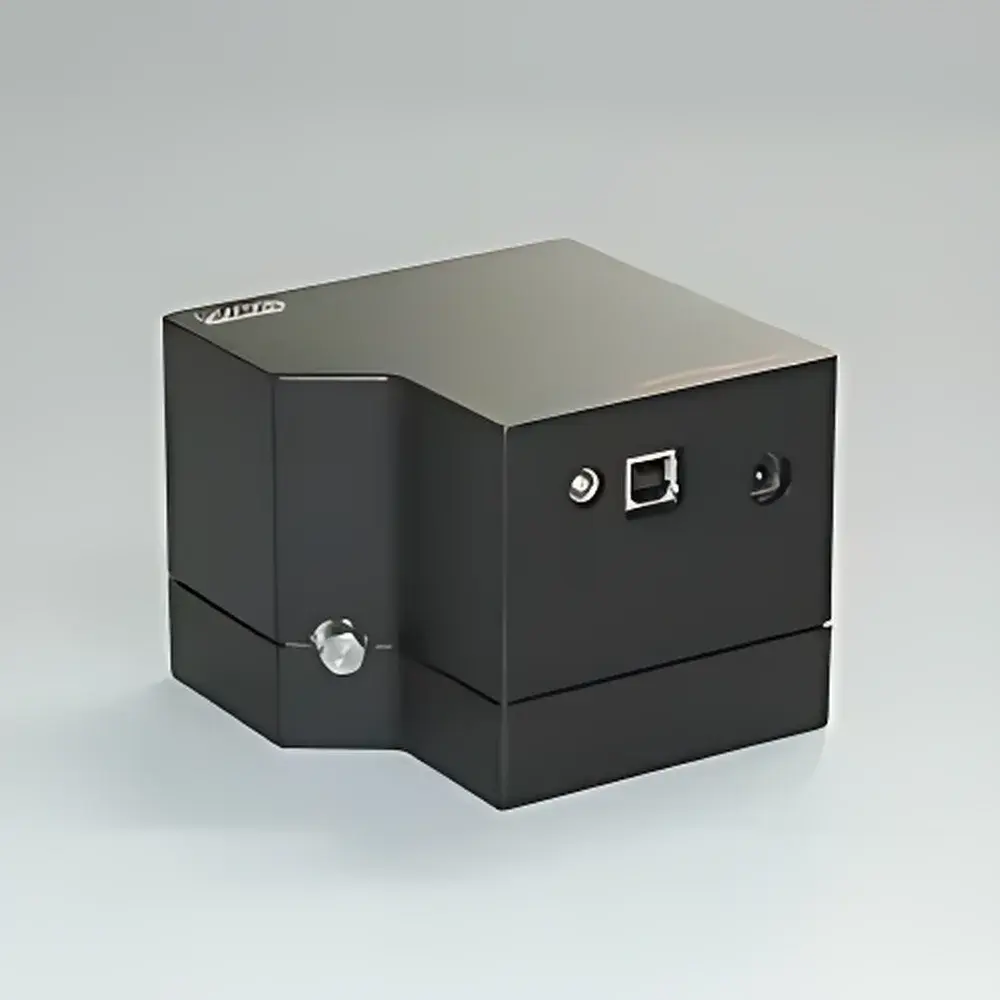
Hamamatsu TM Series Miniature Fiber Optic Spectrometer (320–1000 nm, Back-Illuminated CCD)
| Brand | Hamamatsu |
|---|---|
| Origin | Japan |
| Manufacturer Type | Original Equipment Manufacturer (OEM) |
| Import Status | Imported |
| Model Series | TM Series |
| Spectral Range | 320–1000 nm (Visible to Near-Infrared) |
| Detector Type | Back-Illuminated CCD |
| Spectral Resolution (FWHM, max) | 1 nm |
| A/D Conversion | 16-bit |
| Interface | USB 1.1 |
| Pixel Count | 2048 |
| Operating Temperature | 25 °C (typ.) |
| Cooling | Uncooled |
| Dynamic Range | >5000:1 (typ.) |
| Signal-to-Noise Ratio | >450:1 (at full well, 1 s integration) |
| Stray Light | <0.05% (600 nm, relative to peak) |
Overview
The Hamamatsu TM Series is a compact, integrated fiber optic spectrometer engineered for high-sensitivity spectral acquisition across the visible to near-infrared (VIS-NIR) range (320–1000 nm). Based on monochromator architecture with fixed grating and optimized optical path design, the TM Series employs a back-illuminated CCD linear image sensor—delivering quantum efficiency exceeding 90% at 600 nm and significantly enhanced photon detection capability compared to front-illuminated or CMOS-based alternatives. This architecture enables reliable measurement of low-light-intensity signals in demanding analytical environments, including fluorescence spectroscopy, LED characterization, colorimetry, and process monitoring where portability and signal fidelity are critical. Unlike modular benchtop systems, the TM Series integrates the optical bench, detector, analog front-end, and USB interface into a single robust aluminum housing (dimensions: ~70 × 50 × 25 mm), minimizing alignment sensitivity and enabling stable field-deployable operation without recalibration.
Key Features
- Back-illuminated CCD detector with 2048 active pixels and peak QE >90% at 600 nm—providing two orders of magnitude higher sensitivity than comparable CMOS spectrometers
- Fixed-grating monochromator design ensuring consistent spectral dispersion and long-term wavelength stability (±0.2 nm drift over 8 hours at constant ambient temperature)
- 16-bit analog-to-digital conversion supporting dynamic range >5000:1 (full-scale to RMS noise floor, 1 s integration)
- USB 1.1 interface with vendor-provided Windows-compatible DLL libraries—enabling seamless integration into custom LabVIEW, Python (PyUSB), or C++ applications
- No active cooling required; thermal drift compensated via onboard dark reference acquisition and real-time baseline correction algorithms
- Optimized optical coupling via SMA905 fiber connector (standard); compatible with multimode fibers (core diameters 50–400 µm) and standard collimating optics
Sample Compatibility & Compliance
The TM Series accepts light input exclusively through fiber-optic coupling, making it suitable for non-contact, remote, or in-situ measurements—including liquid cuvette transmission, reflectance from solid surfaces, gas-phase absorption cells, and embedded OEM sensing modules. Its uncooled operation and compact form factor comply with IEC 61000-6-3 (EMC emission limits) and IEC 61010-1 (safety requirements for electrical equipment for measurement). While not certified for hazardous locations, the device meets general-purpose laboratory and industrial environment specifications per ISO/IEC 17025 traceability guidelines when used with NIST-traceable calibration sources. It supports GLP-compliant data acquisition workflows when paired with validated third-party software that implements audit trail, electronic signature, and data integrity controls per FDA 21 CFR Part 11.
Software & Data Management
Hamamatsu provides free evaluation software (SpectraSmart™ Lite) for immediate operation—supporting real-time spectrum display, integration time adjustment (1 ms–65 s), dark/current subtraction, smoothing, peak identification, and export to CSV or ASCII formats. For integration into automated QA/QC systems, the fully documented DLL interface exposes low-level register access, trigger synchronization (TTL input/output), and memory-mapped buffer readout—facilitating deterministic timing control and high-throughput batch acquisition. All spectral data include embedded metadata: timestamp (system clock), integration time, detector temperature (monitored via on-chip thermistor), and serial-number-tagged calibration coefficients. Raw frame data retain full 16-bit depth prior to any on-board processing, preserving fidelity for post-acquisition deconvolution or multivariate analysis.
Applications
- LED and OLED spectral power distribution (SPD) measurement for color rendering index (CRI) and chromaticity coordinate (CIE 1931) calculation
- In-line pharmaceutical tablet coating thickness monitoring via NIR reflectance (700–1000 nm)
- Fluorescence lifetime-independent intensity mapping in bioassays using UV-excited visible emission
- Environmental water quality assessment via absorbance spectroscopy (e.g., nitrate, chlorophyll-a at 650–750 nm)
- OEM integration into handheld Raman probes, portable gas analyzers, and agricultural nutrient sensors
- Educational labs requiring affordable, USB-powered spectral instrumentation with reproducible calibration traceability
FAQ
Is the TM Series calibrated at the factory? What calibration standards are used?
Yes—each unit undergoes wavelength and radiometric calibration using NIST-traceable tungsten-halogen and mercury-argon line sources. Calibration files (.cal) are stored onboard and automatically loaded during initialization.
Can the TM Series operate in continuous acquisition mode with external triggering?
Yes—via TTL-compatible trigger input (rising-edge sensitive), enabling synchronization with pulsed light sources or motion stages. Maximum sustained frame rate is 10 Hz at full resolution (2048 pixels) and 16-bit depth.
What is the recommended integration time range for optimal SNR in low-light conditions?
For back-illuminated CCD operation, integration times between 100 ms and 5 s typically maximize SNR without significant dark current accumulation at ambient temperatures (20–30 °C).
Does the USB 1.1 interface limit data throughput in high-speed applications?
At full 2048-pixel resolution, USB 1.1 supports up to ~10 full-spectrum frames per second. For higher rates, binning (e.g., 2× or 4× pixel averaging) reduces data volume while preserving spectral shape fidelity.
Are firmware updates available, and how are they applied?
Firmware revisions are distributed via Hamamatsu’s official support portal and installed using the provided SpectraSmart™ utility—requiring no hardware modification or service center intervention.
Related Products



