
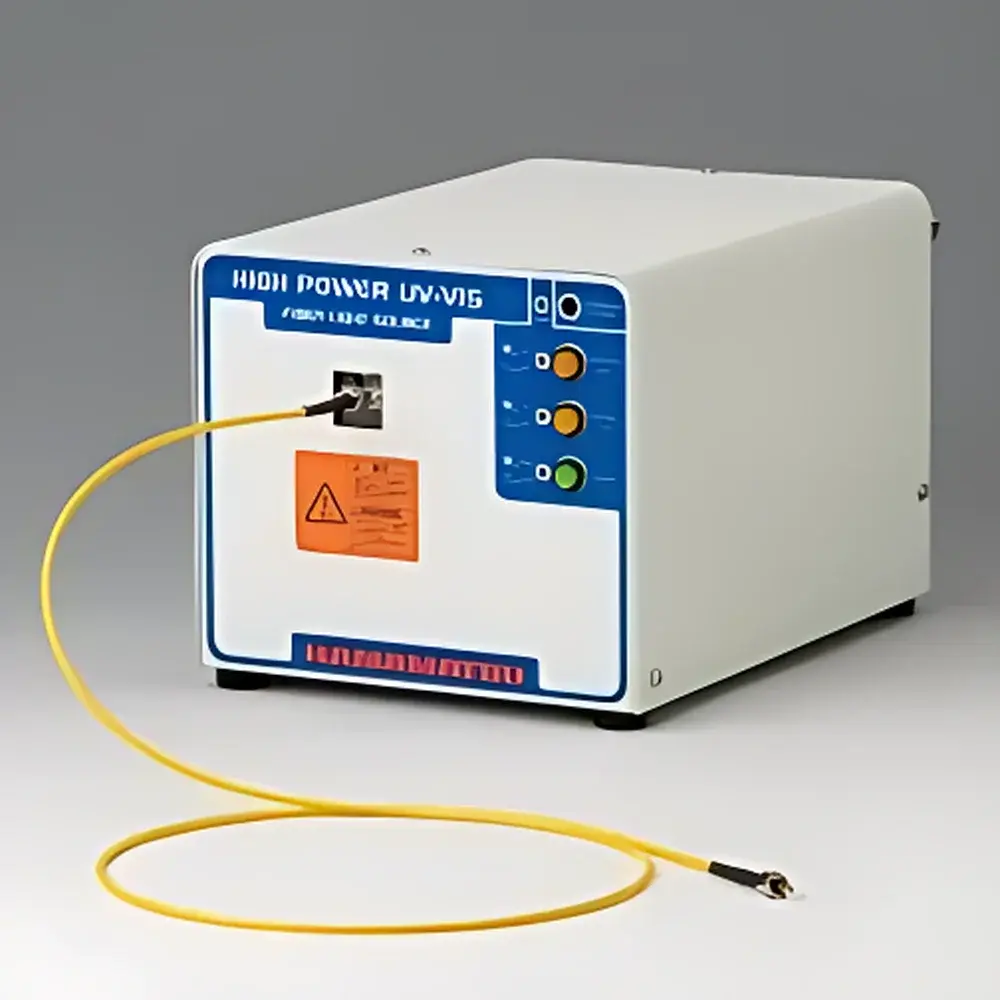
Hamamatsu L10290 UV-Vis Fiber-Coupled Light Source
| Brand | Hamamatsu |
|---|---|
| Origin | Japan |
| Manufacturer Type | Original Equipment Manufacturer (OEM) |
| Product Category | Imported Instrument |
| Model | L10290 |
| Light Source Type | Deuterium–Tungsten Halogen Dual Lamp |
| Illumination Mode | Internal Illumination Configuration |
| Output Wavelength Range | 200–1600 nm |
| Typical Output Stability | ±0.004 %p-p (equivalent to 2 × 10⁻⁵ A.U.) |
| Lamp Lifetime | ≥2000 h |
| Mechanical Shutter | Integrated |
| External Control Interface | TTL-compatible trigger input |
| Dimensions | 148 × 80 × 205 mm (W × H × D) |
| Weight | ~1.8 kg |
Overview
The Hamamatsu L10290 UV-Vis Fiber-Coupled Light Source is an engineered broadband illumination system designed for high-fidelity spectral applications requiring continuous coverage from deep ultraviolet (200 nm) through near-infrared (1600 nm). Unlike monochromatic or LED-based sources, the L10290 integrates two spectrally complementary arc lamps — a high-intensity deuterium lamp for stable UV emission and a tungsten-halogen lamp for robust visible-to-NIR output — within a single thermally stabilized, compact housing. This dual-lamp architecture eliminates spectral gaps and enables seamless, intensity-matched broadband delivery via optional optical fiber coupling (e.g., SMA905 or FC/PC connectors). The source operates on the principle of continuum radiation generation: deuterium discharge provides smooth, low-noise UV output (200–400 nm), while the halogen filament delivers high-color-temperature visible/NIR irradiance (350–1600 nm), with spectral overlap ensuring continuity across the full range. Its internal optical path is optimized for minimal etendue loss and high coupling efficiency into standard silica-based multimode fibers (core diameters 200–1000 µm).
Key Features
- Extended spectral coverage: 200–1600 nm in a single unit, eliminating the need for multiple lamp swaps or external wavelength-selective optics
- Doubled radiant flux output relative to prior-generation Hamamatsu broadband sources — verified under standardized fiber-coupling conditions (200 µm core, NA 0.22)
- Exceptional short-term stability: ≤0.004 %p-p intensity fluctuation (typical), measured over 1-hour intervals at constant ambient temperature (23 ± 1 °C), enabling high-SNR absorbance and transmittance measurements
- Integrated mechanical shutter with <10 ms actuation time and TTL-triggered operation for precise temporal control in kinetic or multiplexed experiments
- Compact form factor (148 × 80 × 205 mm) and low mass (~1.8 kg) support integration into portable spectrometers, field-deployable environmental sensors, and benchtop OEM modules
- Thermally managed lamp compartment with active airflow regulation ensures consistent thermal equilibrium, minimizing wavelength drift and intensity hysteresis during extended operation
Sample Compatibility & Compliance
The L10290 is compatible with standard quartz-tipped optical fibers (e.g., Ocean Insight, Avantes, or Thorlabs fiber bundles) and supports both free-space and fiber-coupled measurement geometries. It meets IEC 61000-6-3 (EMC emission limits) and IEC 61000-6-2 (immunity requirements) for laboratory instrumentation. While not classified as a medical device, its radiometric performance aligns with ASTM E275 (standard practices for describing and measuring performance of UV–Vis spectrophotometers) and ISO/IEC 17025 traceability frameworks when used with calibrated reference detectors. The unit complies with RoHS Directive 2011/65/EU and REACH Annex XVII restrictions on hazardous substances. No laser safety classification applies, as the source emits non-coherent, broadband thermal and discharge radiation.
Software & Data Management
The L10290 does not include embedded firmware or proprietary software; it functions as a hardware-level illumination engine controlled via external TTL logic signals (shutter open/close) and analog voltage inputs (optional intensity modulation, if configured with external attenuators). Integration with third-party platforms — including LabVIEW, Python (via National Instruments DAQ or serial relay controllers), MATLAB, or custom C++ instrument drivers — is achieved through standard digital I/O lines. For GLP/GMP-regulated environments, users may implement audit-trail logging of shutter activation timestamps and lamp-on duration using host-side software, satisfying FDA 21 CFR Part 11 requirements for electronic records when paired with appropriate system validation protocols.
Applications
- UV-Vis-NIR absorption and transmission spectroscopy in pharmaceutical QC labs (e.g., dissolution testing, excipient characterization per USP )
- In-line and at-line monitoring of thin-film thickness and refractive index in semiconductor manufacturing (using interference fringe analysis)
- Environmental water quality analysis: detection of nitrate, nitrite, and organic contaminants via multi-wavelength absorbance
- Microplate reader illumination for high-throughput ELISA and cell viability assays requiring broad-spectrum excitation consistency
- Calibration of spectroradiometers and hyperspectral imaging systems across the 200–1600 nm band
- Fiber-optic sensor interrogation in distributed sensing networks (e.g., FBG or LPG-based strain/temperature monitoring)
FAQ
What fiber types are recommended for optimal coupling efficiency?
Standard low-OH silica multimode fibers with core diameters of 400–600 µm and numerical aperture ≥0.22 are recommended. UV-grade fused silica fibers are required for reliable transmission below 220 nm.
Is the L10290 suitable for use in regulated GMP environments?
Yes — when integrated into validated instrument systems with documented calibration procedures, shutter event logging, and lamp usage tracking, it supports compliance with EU Annex 11 and FDA 21 CFR Part 11 data integrity requirements.
Can the deuterium and halogen lamps be operated independently?
No — the lamps are co-powered and thermally coupled within a shared optical cavity; simultaneous operation is mandatory to maintain spectral continuity and thermal equilibrium.
Does the unit include a built-in power supply?
Yes — the L10290 incorporates an internal switched-mode power supply compliant with universal AC input (100–240 VAC, 50/60 Hz); no external driver module is required.
How is lamp lifetime defined and validated?
Lifetime is specified as ≥2000 hours of continuous operation under nominal current and thermal conditions, based on Hamamatsu’s accelerated life testing per JIS C 5063 standards, with end-of-life defined as >20% decline in 254 nm (D₂) or 550 nm (W-Hal) output intensity.



