
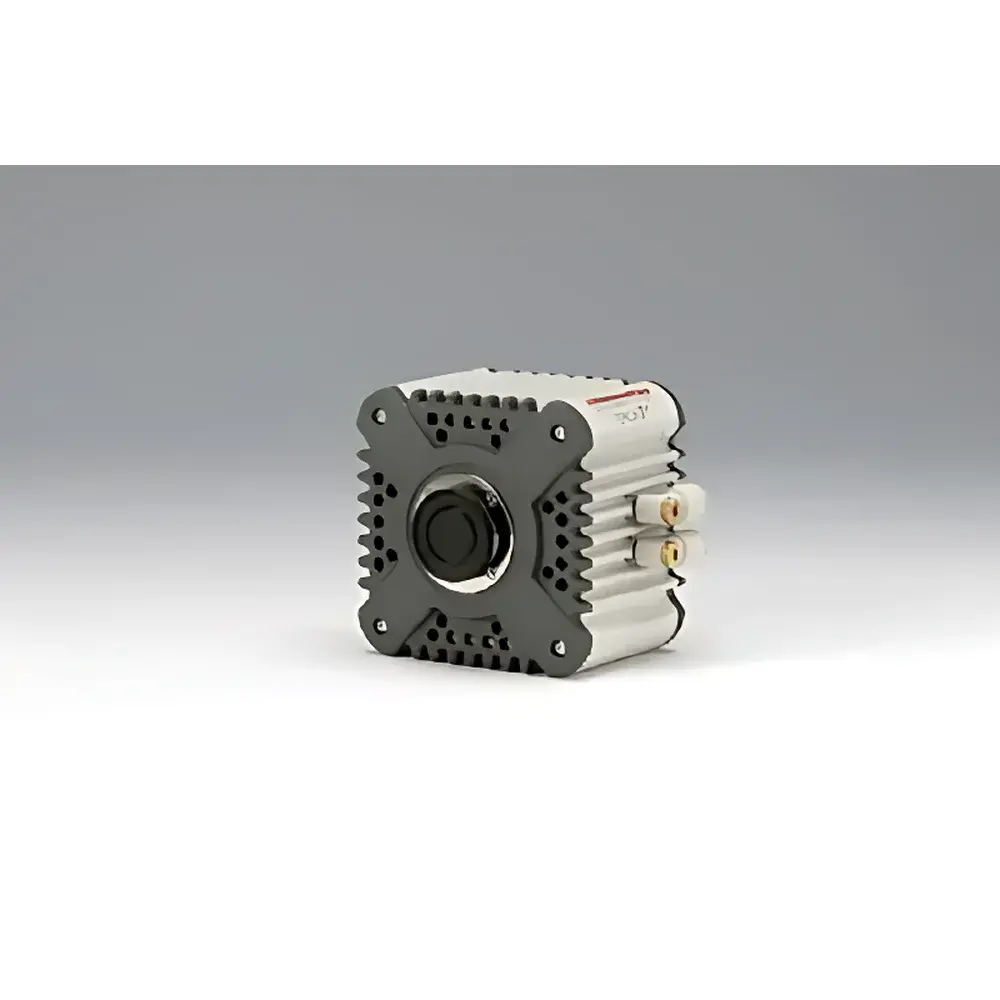
Hamamatsu ORCA-R2 C10600-10B Scientific CCD Camera
| Origin | Japan |
|---|---|
| Manufacturer Type | Authorized Distributor |
| Import Status | Imported |
| Model | C10600-10B |
| Price | Upon Request |
| Quantum Efficiency Peak | >70% |
| Spectral Response Range | 300–1100 nm |
| Cooling Method | Dual-mode (Air/Water) |
| Sensor Temperature | −35°C (Air-cooled) / −40°C (Water-cooled, at 20°C coolant temp) |
| Dark Current | 0.0005 e⁻/pixel/s @ −40°C |
| Pixel Count | 1344 × 1024 |
| Pixel Size | 6.45 × 6.45 µm |
| Active Area | 8.67 × 6.60 mm |
| Read Noise | 6 e⁻ (Normal mode) / 10 e⁻ (High-speed mode) |
| Full Well Capacity | 18,000 e⁻ (Normal) / 36,000 e⁻ (High Dynamic Range mode) |
| Dynamic Range | 3000:1 |
| Exposure Time | 10 µs – 4200 s |
| A/D Resolution | 12-bit or 16-bit selectable |
| Binning Modes | 2×2, 4×4, 8×8 |
| Subarray Imaging | Supported |
| Illumination Modes | Low-light / High-light |
| Analog Gain | Up to 10× |
| Analog Offset Adjustment | Supported |
| Trigger Modes | Edge, Level, Synchronous Readout, Start |
| Lens Mount | C-mount |
| Interface Standard | IEEE 1394b-2002 (FireWire 800) |
Overview
The Hamamatsu ORCA-R2 (model C10600-10B) is a high-performance, deep-cooled scientific CCD camera engineered for low-light quantitative imaging in demanding research environments. Based on a front-illuminated, vacuum-sealed CCD sensor with thermoelectric (Peltier) cooling and optional water-assisted thermal management, the ORCA-R2 achieves exceptional signal fidelity through ultra-low dark current (70% peak across 300–1100 nm). Its dual operational modes—Normal and High-Speed—enable flexible trade-offs between read noise (6 e⁻ vs. 10 e⁻), full-well capacity (18,000 e⁻ vs. 36,000 e⁻ in HDR mode), and frame rate, making it suitable for both photon-limited fluorescence acquisition and time-resolved dynamic studies. The camera’s architecture supports precise synchronization via multiple hardware trigger protocols and integrates seamlessly into automated microscopy platforms requiring deterministic timing control.
Key Features
- Deep thermoelectric cooling down to −40°C (water-cooled) or −35°C (air-cooled), ensuring stable sensor temperature independent of ambient conditions
- Vacuum-sealed optical window design eliminates condensation risk and maintains consistent QE across extended acquisitions
- 1344 × 1024 pixel resolution with 6.45 µm square pixels and 8.67 × 6.60 mm active area for optimal field-of-view and sampling density
- Selectably configurable A/D conversion: 12-bit for speed or 16-bit for enhanced dynamic range and quantization precision
- Programmable binning (2×2, 4×4, 8×8) and subarray readout to accelerate acquisition and reduce data volume without sacrificing region-of-interest fidelity
- Dual illumination optimization: dedicated low-light and high-light modes adjust gain, offset, and integration strategy to preserve linearity and minimize saturation artifacts
- IEEE 1394b-2002 (FireWire 800) interface provides deterministic latency, robust cable length tolerance (up to 10 m), and plug-and-play compatibility with major acquisition software frameworks
Sample Compatibility & Compliance
The ORCA-R2 is optimized for use with standard C-mount objective couplers and compatible with most inverted and upright research-grade microscopes. Its broad spectral response—from deep UV (300 nm) through visible to near-infrared (1100 nm)—supports diverse fluorophores including GFP, RFP, Cy5, IRDye 800CW, and quantum dot labels. The camera meets essential laboratory compliance requirements for reproducible quantitative imaging: its analog gain and offset calibration are traceable to factory-certified reference signals; exposure timing accuracy adheres to IEEE 1394b jitter specifications (<1 µs); and firmware supports audit-ready metadata embedding (timestamp, temperature, gain, binning, trigger source). While not FDA-cleared as a medical device, the system is routinely deployed in GLP-compliant preclinical imaging workflows and supports 21 CFR Part 11–compatible software integration when paired with validated acquisition platforms.
Software & Data Management
Hamamatsu provides the HCImage Live acquisition suite (Windows-based), offering real-time histogram analysis, multi-channel time-lapse sequencing, ROI-based intensity profiling, and TIFF/ND2 export with embedded EXIF-style metadata. The SDK (C/C++, MATLAB, Python) enables full low-level register access for custom synchronization logic, external shutter control, and hardware-triggered multi-camera coordination. All image data retain calibrated pixel values (e⁻/pixel) when raw mode is selected, supporting downstream photometric analysis in ImageJ/Fiji, MATLAB, or Python-based pipelines (e.g., using scikit-image or astropy). Frame buffering, ring memory management, and lossless compression options ensure sustained throughput during long-duration acquisitions (up to 4200 s exposure).
Applications
- Widefield and TIRF fluorescence microscopy of live-cell GFP/RFP expression dynamics
- Fluorescence in situ hybridization (FISH) with multiplexed near-IR probes
- Ratio-metric Ca²⁺ or pH imaging using dual-emission dyes (e.g., Fura-2, BCECF)
- Near-infrared differential interference contrast (NIR-DIC) combined with NIR fluorescence
- Time-lapse morphological tracking in developmental biology and neurobiology
- Confocal and spinning-disk co-localization studies requiring high SNR and spatial fidelity
- Low-dose X-ray scintillator readout for radiography and synchrotron beamline applications
- Fundamental semiconductor defect analysis via photoluminescence mapping under cryogenic conditions
FAQ
What cooling method is required to achieve −40°C sensor temperature?
Water cooling is mandatory; the system requires a recirculating chiller maintaining inlet water at 20°C ± 1°C. Air cooling alone achieves −35°C.
Is the ORCA-R2 compatible with USB 3.0 or GigE Vision interfaces?
No—it uses IEEE 1394b-2002 (FireWire 800) exclusively. Adapters or bridge devices are not supported for scientific operation due to timing and bandwidth constraints.
Can I perform real-time background subtraction during acquisition?
Yes—HCImage Live supports hardware-synchronized dark-frame acquisition and on-the-fly pixel-wise subtraction, preserving temporal resolution and avoiding post-processing latency.
Does the camera support rolling or global shutter operation?
It employs a true global shutter with mechanical or electronic reset, eliminating motion-induced skew in fast-moving samples.
How is calibration data stored and accessed?
Gain, offset, and temperature calibration coefficients are embedded in the camera’s non-volatile memory and automatically applied during image acquisition; raw uncorrected frames are also available via SDK control.





