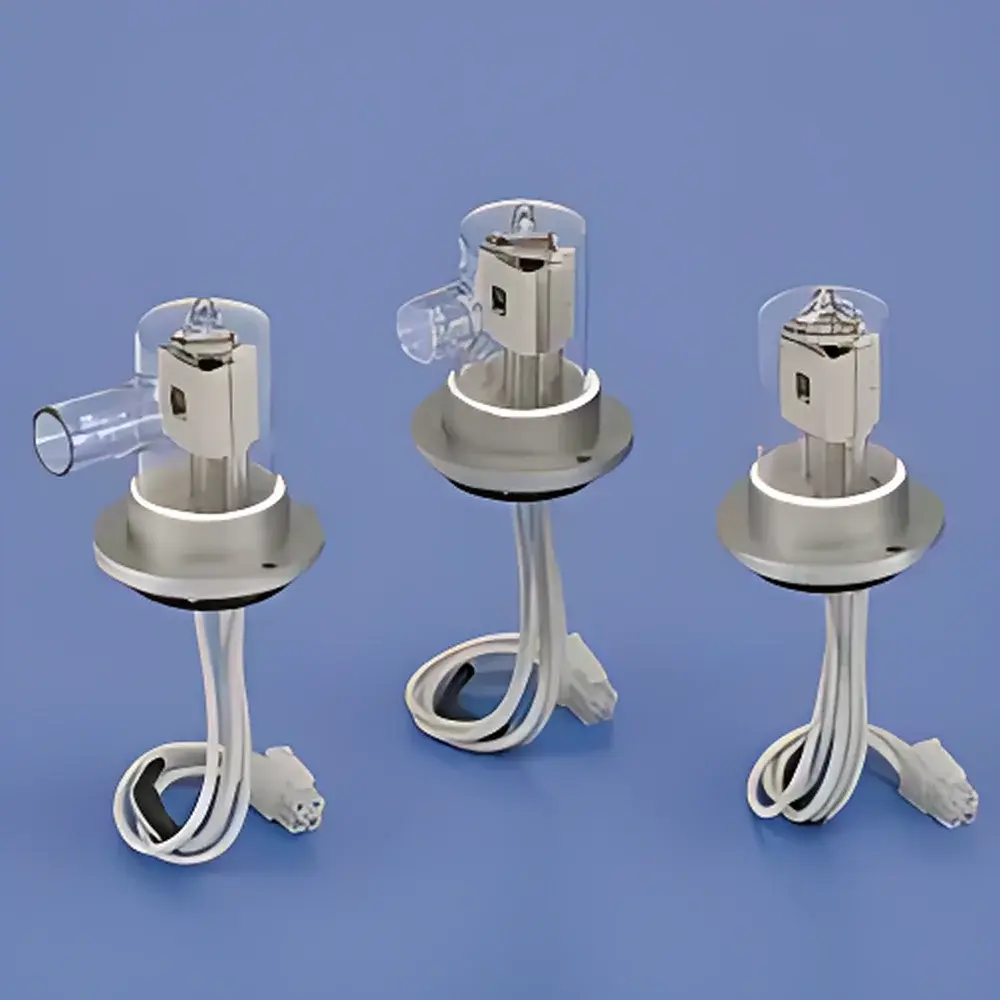
Hamamatsu X2D2 Deuterium Lamp
| Brand | Hamamatsu |
|---|---|
| Origin | Japan |
| Manufacturer Type | Original Equipment Manufacturer (OEM) |
| Product Origin | Imported |
| Model | X2D2 |
| Light Source Type | Continuous-wave Deuterium Arc Lamp |
| Illumination Mode | External Irradiation Configuration |
| Radiant Output Stability | <0.5% RMS over 8 hours |
| Typical Lifetime | ≥2,000 hours at rated current |
| Spectral Range | 190–400 nm (UV-Vis continuum) |
| UV Output Power (at 220 nm) | ≥1.2 mW/nm (collimated, 1 mrad divergence) |
Overview
The Hamamatsu X2D2 deuterium lamp is a high-performance, continuous-wave ultraviolet (UV) light source engineered for precision optical instrumentation requiring stable, broadband spectral output in the deep-UV to near-UV range. Operating on the principle of deuterium gas discharge under low-pressure conditions, the X2D2 generates a smooth, featureless continuum from 190 nm to 400 nm—free from atomic emission lines—making it ideal for applications demanding high photometric accuracy and minimal spectral noise. Unlike pulsed or LED-based alternatives, the X2D2 delivers inherently stable radiant flux with <0.5% RMS intensity variation over an 8-hour operational period when operated within specified thermal and electrical parameters. Its optimized cathode geometry and quartz envelope with high-transmission synthetic fused silica enable superior UV throughput and extended service life—rated at ≥2,000 hours under nominal DC current drive. Designed as a drop-in replacement for legacy Hamamatsu D2 lamps (e.g., L2D2), the X2D2 doubles radiant intensity at key analytical wavelengths such as 220 nm (≥1.2 mW/nm into a collimated beam), directly enhancing signal-to-noise ratio and measurement repeatability in spectrophotometric and chromatographic detection systems.
Key Features
- High-intensity UV continuum output: ≥1.2 mW/nm at 220 nm, enabling improved detection limits in absorbance-based assays
- Extended operational lifetime: ≥2,000 hours under standard operating conditions (250 mA DC, ambient temperature ≤35°C)
- Exceptional short-term and long-term stability: <0.5% RMS intensity drift over 8 hours; <1.5% total drift over full lifetime
- Optimized thermal management architecture: Integrated heat-sink interface and low-thermal-resistance base design minimize thermal lensing and wavelength shift
- Hermetically sealed deuterium-filled quartz envelope with high-purity synthetic fused silica window (transmission >85% at 190 nm)
- External irradiation configuration: Compatible with fiber-coupled, monochromator-integrated, and free-space optical paths without internal chamber modification
Sample Compatibility & Compliance
The X2D2 is compatible with a broad class of UV-sensitive optical components including silicon photodiodes, PMTs, CCD/CMOS array detectors, and grating monochromators. It meets IEC 61000-6-3 (EMC emission) and IEC 61000-6-2 (immunity) standards for laboratory equipment. While not classified as a medical device, its performance characteristics align with ASTM E275 (Standard Practice for Describing and Measuring Performance of UV–Visible Spectrophotometers) and ISO/IEC 17025 requirements for calibration traceability when used in accredited testing laboratories. No hazardous substance declarations are required per RoHS Directive 2011/65/EU, as the lamp contains no lead, mercury, cadmium, or hexavalent chromium in regulated concentrations.
Software & Data Management
As a hardware-level light source, the X2D2 operates independently of proprietary software but integrates seamlessly with industry-standard instrument control platforms—including LabVIEW™, Python-based PyVISA drivers, and vendor-specific SDKs (e.g., OceanInsight, Thorlabs, or Agilent OpenLab). When deployed in GLP/GMP-regulated environments, users may configure external monitoring via analog voltage feedback (0–10 V proportional to lamp current) to log operational history and support 21 CFR Part 11-compliant audit trails when paired with validated data acquisition systems. Hamamatsu provides detailed aging curve datasets and spectral irradiance reference files (NIST-traceable calibration optional upon request) for post-acquisition spectral correction.
Applications
- UV-Vis spectrophotometry (single-beam and double-beam configurations)
- HPLC and UHPLC UV absorbance detection (190–280 nm protein/DNA quantification)
- Atomic absorption spectroscopy (AAS) background correction sources
- Calibration of UV radiometers and spectroradiometers
- Photochemical reactor illumination where broadband UV initiation is required
- Environmental water quality analyzers (e.g., nitrate, TOC, and COD detection modules)
FAQ
What is the recommended warm-up time before photometric measurements?
A minimum 30-minute stabilization period is advised to achieve thermal equilibrium and optimal spectral continuity.
Can the X2D2 be operated in pulsed mode?
No—it is designed exclusively for continuous DC operation; pulsed excitation may cause cathode sputtering and premature failure.
Is ozone generation a concern during operation?
Negligible ozone is produced below 200 nm in open-air environments; use in enclosed, ventilated optical housings is recommended for prolonged exposure scenarios.
How does the X2D2 compare to xenon arc lamps in UV applications?
Unlike xenon lamps, the X2D2 offers superior UV continuum smoothness, lower visible/NIR stray light, and higher radiance per unit bandwidth below 300 nm—making it preferred for high-resolution UV absorbance work.
Does Hamamatsu provide spectral irradiance calibration certificates?
Yes—NIST-traceable spectral irradiance calibration (190–400 nm, ±0.5 nm wavelength accuracy, ±3% irradiance uncertainty) is available as an optional add-on service.