
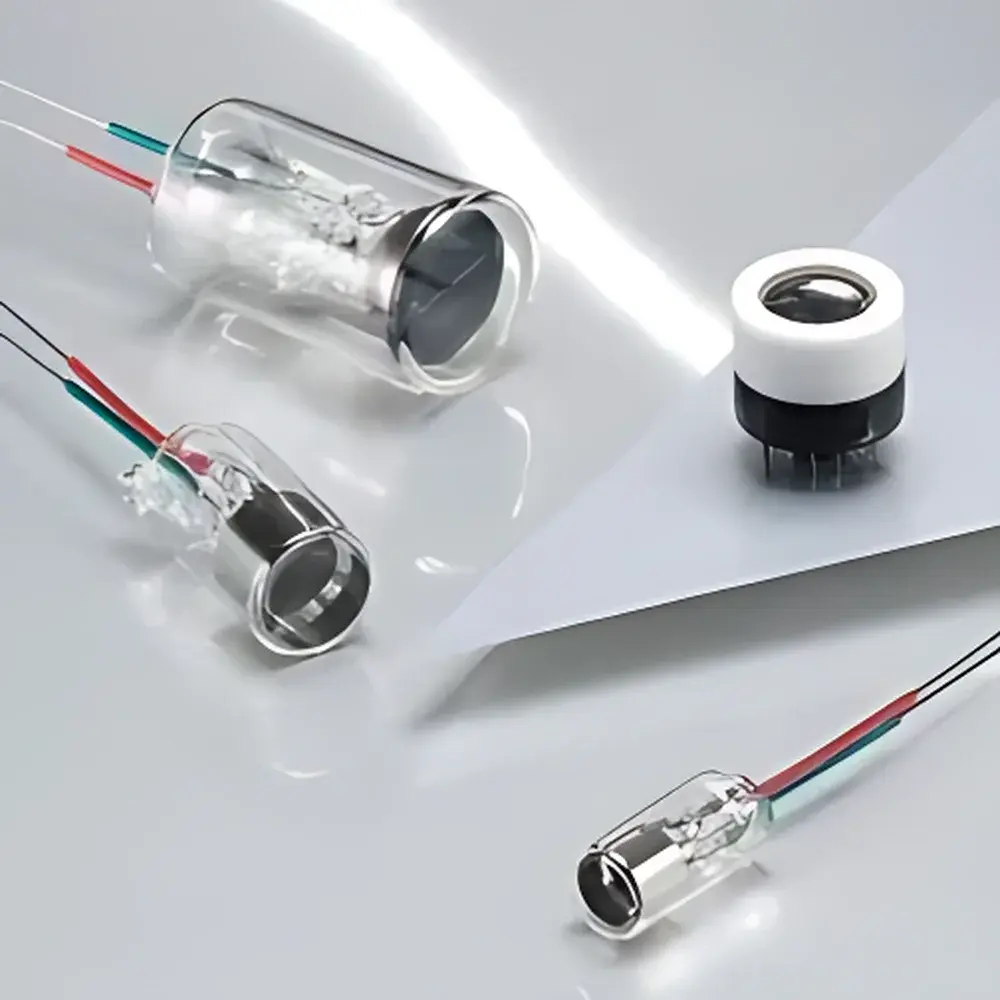
Hamamatsu Phototube
| Brand | Hamamatsu |
|---|---|
| Origin | Japan |
| Manufacturer Type | Original Equipment Manufacturer (OEM) |
| Import Status | Imported |
| Model Series | Phototube |
| Component Category | Optical Element |
| Compliance | RoHS-compliant, CE-marked for laboratory instrumentation use |
Overview
Hamamatsu phototubes are vacuum-based photoemissive detectors engineered for high-sensitivity, low-noise detection of ultraviolet (UV), visible (VIS), and near-infrared (NIR) radiation. Operating on the principle of the external photoelectric effect, these devices convert incident photons into measurable photocurrent via electron emission from a photosensitive cathode surface under vacuum conditions. Unlike semiconductor photodiodes, phototubes offer inherent immunity to dark current drift, negligible temperature dependence, and picosecond-level temporal response—making them indispensable in time-resolved spectroscopy, laser pulse characterization, fluorescence lifetime measurement, and low-light analytical chemistry applications where signal fidelity and timing precision are critical.
Key Features
- Vacuum-sealed glass or metal-ceramic envelope architecture ensuring long-term stability and minimal aging effects
- Photosensitive cathodes deposited with alkali-antimonide (e.g., S-1, S-4, S-5, S-11, S-20) or multialkali (e.g., Na-K-Sb-Cs) photocathode materials tailored for specific spectral responsivity profiles
- Wide spectral response range: 115 nm (vacuum UV) to 900 nm (near-infrared), depending on cathode composition and window material (e.g., fused silica, borosilicate glass, or MgF₂)
- High peak quantum efficiency (up to 30% at optimal wavelength) and excellent signal-to-noise ratio (SNR) in photon-counting and analog current modes
- Low dark current (<1 pA typical at 25°C) and sub-nanosecond rise time for ultrafast optical event capture
- Modular anode configurations—including side-on, end-on, and hemispherical geometries—to support integration into spectrometers, monochromators, fluorimeters, and custom optical benches
Sample Compatibility & Compliance
Hamamatsu phototubes are compatible with standard laboratory light sources including deuterium lamps, xenon arc lamps, pulsed lasers (Nd:YAG, Ti:sapphire), and LED arrays across UV–VIS–NIR bands. Their vacuum integrity and cathode uniformity ensure reproducible calibration traceable to NIST-traceable irradiance standards. All models comply with IEC 61000-6-3 (EMC emission limits) and IEC 61000-6-2 (immunity requirements) for scientific instrumentation. Selected variants meet ISO/IEC 17025-relevant metrological criteria for use in GLP-compliant analytical workflows and regulated pharmaceutical QC environments. RoHS compliance ensures restricted substance control in accordance with Directive 2011/65/EU.
Software & Data Management
While phototubes themselves are passive analog transducers, they integrate seamlessly with industry-standard data acquisition systems—including National Instruments DAQ modules, Keysight digitizers, and Hamamatsu’s own C7942 series photon counting units. Output signals (analog current or pulse trains) interface directly with LabVIEW, MATLAB, Python (via PyVISA or NI-DAQmx drivers), and Igor Pro for real-time spectral analysis, kinetic decay fitting, and statistical photon arrival time histogramming. Firmware-agnostic operation supports audit trail generation and timestamp synchronization when paired with IEEE 1588-2008–compliant timing hardware—enabling full 21 CFR Part 11–aligned data integrity in regulated laboratories.
Applications
- UV/VIS absorption and reflectance spectroscopy in pharmaceutical raw material identification (USP & EP compliant methods)
- Laser-induced fluorescence (LIF) detection in capillary electrophoresis and microfluidic cytometry
- Time-correlated single-photon counting (TCSPC) for molecular lifetime studies in biophysics and photochemistry
- Radiometric calibration of optical sensors and reference light sources in metrology labs
- Plasma diagnostics and synchrotron beamline monitoring requiring vacuum-compatible, radiation-hardened detection
- Chemiluminescence and bioluminescence assays in clinical diagnostics and environmental toxin screening
FAQ
What is the typical operating voltage range for Hamamatsu phototubes?
Most phototubes require a stable DC bias between –100 V and –1500 V applied to the anode relative to the photocathode; exact values depend on gain requirements and cathode type.
Can phototubes be used in continuous-wave (CW) versus pulsed light measurements?
Yes—phototubes support both analog current mode (CW) and single-photon counting mode (pulsed), with appropriate amplification and discrimination circuitry.
How does window material affect spectral response?
Fused silica windows transmit down to ~185 nm; MgF₂ extends cutoff to ~115 nm; borosilicate glass blocks below ~300 nm—selection must match source emission profile.
Are Hamamatsu phototubes suitable for OEM integration into analytical instruments?
Yes—they are supplied with standardized mechanical footprints, pinout diagrams, and detailed photocathode uniformity maps for seamless system-level qualification.
Do phototubes require warm-up time before stable operation?
No—unlike PMTs, phototubes exhibit instantaneous response with no thermionic stabilization delay; baseline stability is achieved within seconds after power application.




