
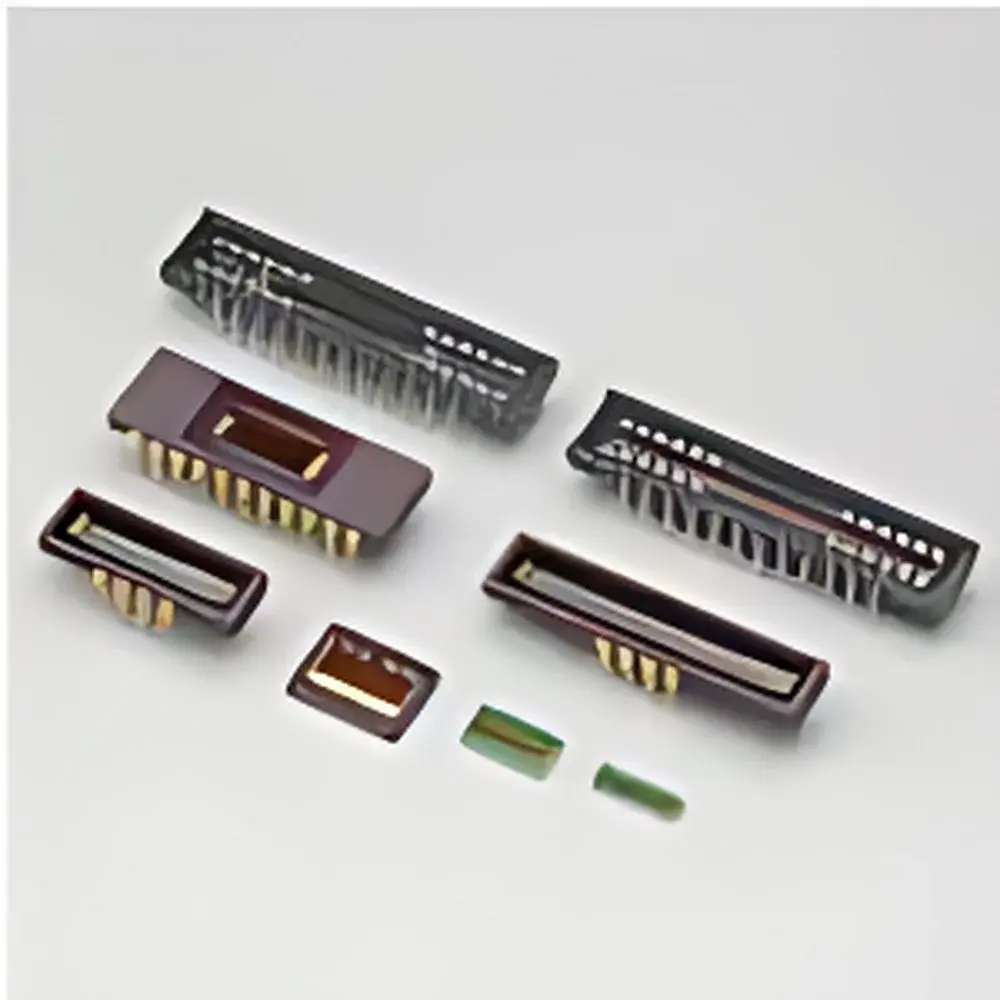
Hamamatsu CMOS Linear and Area Array Sensors for Hyperspectral Imaging
| Origin | Japan |
|---|---|
| Manufacturer Type | Authorized Distributor |
| Origin Category | Imported |
| Model | CMOS Series |
| Pricing | Available Upon Request |
Overview
Hamamatsu CMOS linear and area array sensors are high-performance, low-power photodetector platforms engineered for precision spectral acquisition in hyperspectral imaging (HSI) systems. Unlike conventional CCD-based detectors, these CMOS sensors leverage complementary metal-oxide-semiconductor technology to deliver superior readout speed, on-chip signal amplification options, and enhanced radiation hardness—critical attributes for demanding analytical applications ranging from fluorescence lifetime imaging to Raman spectroscopy and UV-Vis-NIR reflectance analysis. Each sensor is optimized for specific optical configurations: linear arrays (1D) enable high-resolution scanning spectrometers with sub-micron pixel pitch and customizable integration time; area arrays (2D) support snapshot HSI modalities requiring spatial-spectral data cubes at frame rates up to 10 MHz. All devices feature back-thinned or front-illuminated architectures with anti-reflective coatings, ensuring quantum efficiency exceeding 75% across broad spectral bands—from deep ultraviolet (200 nm) to near-infrared (1100 nm).
Key Features
- Wide spectral response: Configurable ranges from 200–1100 nm, including deep-UV-enhanced variants (e.g., S1011x series) and NIR-optimized models (e.g., S1110x with peak sensitivity at 680 nm)
- High-speed readout: Up to 50 MHz for 512-pixel linear arrays (S11105), 10 MHz for 2048-pixel formats (S11638, S11108), and selectable 5/10 MHz operation for 256×256 area arrays (S9132)
- Low-noise architecture: Dark current as low as 5 fA (S9226-03/S9226-04) and RMS noise down to 0.02 mV (S11106), enabling detection of weak luminescence signals in GLP-compliant QC workflows
- Flexible interface options: TTL/CMOS-compatible digital outputs, analog voltage or current output modes, and dual-supply compatibility (3.3 V / 5 V) for seamless integration into OEM spectrometer designs
- Modular packaging: Hermetically sealed ceramic or metal packages with window options (quartz, fused silica, or custom AR-coated glass) to meet vacuum, humidity, or sterilization requirements per ISO 13485 and IEC 61000-4 standards
Sample Compatibility & Compliance
These CMOS arrays are compatible with a wide range of optical coupling methods—including direct fiber-optic input, lens-based imaging onto the active area, and scintillator-coupled configurations for X-ray or beta-particle detection in food safety and pharmaceutical QA/QC. When integrated into validated hyperspectral systems, they support compliance with ASTM E131 (Standard Terminology Relating to Molecular Spectroscopy), ISO/IEC 17025 (General Requirements for the Competence of Testing and Calibration Laboratories), and FDA 21 CFR Part 11 when paired with audit-trail-enabled firmware and secure user authentication protocols. The S9132 and S1011x series are routinely deployed in Class 1000 cleanroom environments for DNA sequencing instrumentation and meet RoHS 3 and REACH substance restrictions.
Software & Data Management
Hamamatsu provides comprehensive SDKs (C/C++, Python, LabVIEW) for real-time data acquisition, dark-frame subtraction, pixel non-uniformity correction (NUC), and spectral calibration via NIST-traceable reference sources. Raw sensor output supports HDF5 and SPE file formats for interoperability with ENVI, MATLAB, and Thermo Scientific OMNIC software suites. For regulated industries, optional firmware modules implement full 21 CFR Part 11 compliance—including electronic signatures, immutable audit trails, role-based access control, and automatic metadata stamping (timestamp, integration time, gain setting, temperature). Data integrity is further ensured through cyclic redundancy checks (CRC-32) embedded in each frame header.
Applications
- Fluorescence & Raman Spectroscopy: High-gain, low-noise variants (e.g., S9226-03) enable single-photon-level detection in confocal micro-Raman setups and time-resolved fluorimetry
- Food & Pharmaceutical Inspection: Scintillator-coupled linear arrays (e.g., S10453-Q series) perform rapid, non-destructive contaminant screening and moisture mapping in inline production lines
- Forensic & Currency Authentication: UV-VIS-NIR multispectral response allows discrimination of security inks, paper fiber composition, and latent fingerprint development
- Space-Based Remote Sensing: Radiation-tolerant packaging and extended temperature operation (−40°C to +70°C) qualify S1110x and S1011x arrays for CubeSat-borne Earth observation payloads
- Genomic Analysis: S9132 256×256 area array enables parallelized electropherogram detection in capillary electrophoresis and next-generation sequencing platforms
FAQ
Are these sensors supplied with factory calibration data?
Yes—each unit ships with individual spectral responsivity curves, linearity coefficients, and dark current vs. temperature profiles traceable to Hamamatsu’s internal ISO/IEC 17025-accredited metrology lab.
Can I integrate these into an existing OEM spectrometer design?
Absolutely. Pin-compatible footprints, standardized LVDS or CMOS digital interfaces, and mechanical drawings (STEP/IGES) are provided under NDA for rapid prototyping and volume manufacturing handoff.
Do you offer evaluation kits with driver electronics and software?
Yes—evaluation boards include programmable timing controllers, adjustable gain stages, thermoelectric coolers (for select low-noise models), and GUI-based acquisition software with spectral stitching and export to CSV/HDF5.
What is the typical lead time for volume orders?
Standard delivery is 8–12 weeks from PO confirmation; expedited builds (4–6 weeks) are available for qualified customers under annual supply agreements.
Is technical support available for system-level integration challenges?
Yes—Hamamatsu’s global application engineering team provides remote debugging, optical layout review, and firmware co-development support under service-level agreements (SLAs).
Related Products





