
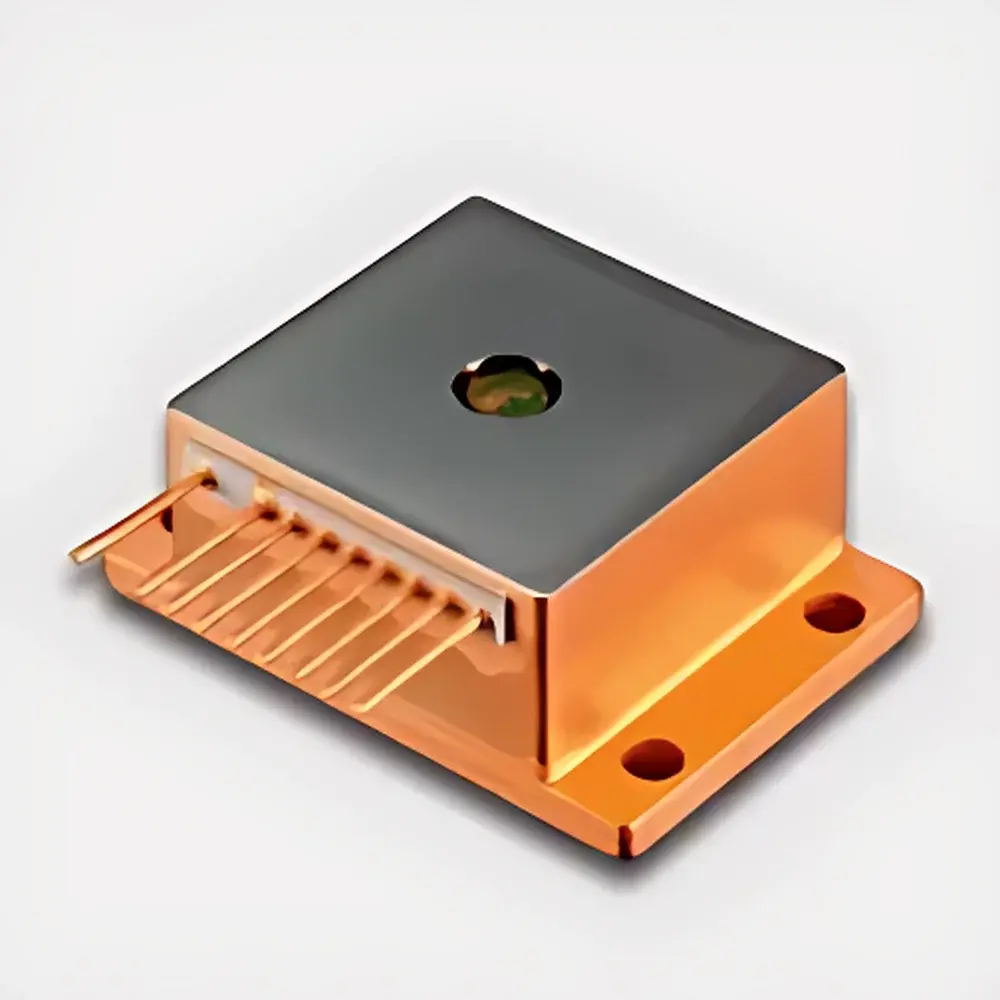
Hamamatsu L12006-1631H-C Distributed Feedback Quantum Cascade Laser (DFB-QCL)
| Brand | Hamamatsu |
|---|---|
| Origin | Japan |
| Manufacturer Type | Original Equipment Manufacturer (OEM) |
| Import Status | Imported |
| Model | L12006-1631H-C |
| Core Component | Semiconductor Quantum Cascade Laser Module |
| Emission Type | Continuous-Wave (CW) DFB |
| Central Wavelength (Typ.) | 6.13 µm |
| Operating Temperature Range | 10–50 °C |
| Spectral Linewidth (Max.) | 0.2 cm⁻¹ |
| Tuning Range (Min.) | ±1.0 cm⁻¹ |
| Output Power (Min.) | 20 mW |
| Threshold Current (Max.) | 1 A |
| Side Mode Suppression Ratio (Min.) | 25 dB |
| Package Type | HHL (Hermetically Sealed High-Power Laser Housing) |
Overview
The Hamamatsu L12006-1631H-C is a high-stability, continuous-wave (CW) distributed feedback quantum cascade laser (DFB-QCL) engineered for precision mid-infrared spectroscopy. Unlike conventional diode lasers based on interband transitions, QCLs operate via intersubband transitions within the conduction band of engineered semiconductor heterostructures—enabling tailored emission in the 4–12 µm spectral region where fundamental vibrational absorption bands of numerous gases (e.g., CO, NO, CH₄, NH₃, H₂S, and VOCs) reside. This device emits at a nominal wavelength of 6.13 µm with intrinsic single-mode operation, supported by a monolithically integrated DFB grating that ensures narrow linewidth (25 dB). Its hermetically sealed HHL (High-Power Laser Housing) package incorporates thermoelectric cooling (TEC), monitor photodiode, and precision collimation optics—designed for integration into gas sensing platforms requiring long-term stability, low drift, and compliance with industrial and regulatory measurement protocols.
Key Features
- Single-frequency CW emission at 6.13 µm (typ.), optimized for detection of sulfur-containing compounds and organic vapors exhibiting strong rovibrational absorption near this wavelength
- DFB grating structure providing inherent wavelength selectivity, eliminating external cavity complexity while maintaining mode-hop-free tuning over ±1.0 cm⁻¹
- Integrated TEC and thermistor enabling precise temperature control (10–50 °C operating range) critical for wavelength stability and reproducible calibration
- HHL package featuring fiber-pigtailed or free-space collimated output options, hermetic sealing to ISO Class 5 cleanroom standards, and mechanical compatibility with standard optomechanical mounts
- Minimum optical output power of 20 mW under CW operation—sufficient for direct absorption, photoacoustic, or cavity-enhanced detection schemes without intermediate amplification
- Threshold current ≤1 A ensures efficient drive electronics design and reduced thermal load during extended duty cycles
Sample Compatibility & Compliance
The L12006-1631H-C is compatible with gas-phase samples in static or flowing configurations, including trace-level analytes in ambient air, industrial exhaust streams, or controlled laboratory atmospheres. Its narrow linewidth and stable central wavelength support quantitative analysis per ASTM E2897 (Standard Practice for Calibration of Tunable Diode Laser Absorption Spectrometers) and ISO 14687 (Hydrogen fuel purity specifications). The device meets RoHS Directive 2011/65/EU and complies with IEC 60825-1:2014 safety requirements for Class 3B laser products. When integrated into analytical systems, it supports audit-ready data acquisition aligned with GLP and GMP frameworks—including timestamped spectral logging, hardware-enforced interlock signaling, and configurable analog/digital interfaces for synchronization with gas handling controllers.
Software & Data Management
Hamamatsu provides the QCL Control Suite—a Windows-based application supporting real-time current/temperature ramping, wavelength calibration via reference gas cells (e.g., N₂O or CO), and automated line-shape fitting using Voigt profiles. The suite exports spectra in HDF5 and CSV formats, includes built-in tools for baseline correction and multicomponent spectral deconvolution, and offers API access (C/C++, Python bindings) for integration into custom LabVIEW, MATLAB, or Python-based instrument control architectures. All operational parameters—including drive current, TEC setpoint, photodiode feedback, and internal temperature—are logged with millisecond resolution and support FDA 21 CFR Part 11-compliant electronic signatures when deployed in regulated environments.
Applications
- Real-time monitoring of industrial process emissions (e.g., semiconductor fab scrubbers, chemical reactor off-gas)
- Environmental air quality networks measuring ppb-level NOₓ, SO₂, and formaldehyde in urban and rural settings
- Medical breath analysis research targeting biomarkers such as acetone (diabetes), ammonia (renal function), and ethane (oxidative stress)
- Security screening for explosives precursors (e.g., nitromethane, triacetone triperoxide) via standoff or point-sampling configurations
- Calibration source for Fourier-transform infrared (FTIR) spectrometers and dual-comb systems operating in the 6–7 µm window
- Research-grade source for nonlinear frequency conversion experiments requiring high-brightness, diffraction-limited mid-IR radiation
FAQ
What is the recommended drive configuration for optimal wavelength stability?
Use a low-noise, current-regulated laser driver with active temperature feedback loop closed on the integrated thermistor; avoid open-loop constant-current operation above 25 °C ambient.
Is this laser qualified for use in explosion-proof enclosures?
The L12006-1631H-C itself is not intrinsically safe certified; however, its HHL package can be mounted inside ATEX/IECEx-rated housings when paired with appropriate barrier circuits and thermal management per EN 60079-15.
Can the output be fiber-coupled using standard SMF-28?
No—standard silica fibers exhibit high absorption beyond 2.2 µm. Use fluoride (ZBLAN) or chalcogenide (As₂S₃) fibers with AR-coated connectors rated for 6.13 µm operation.
Does Hamamatsu provide NIST-traceable wavelength calibration data?
Yes—each unit ships with a factory-measured wavelength vs. temperature/current map referenced to NIST SRM 1921b (CO₂ absorption lines) and includes uncertainty budget per ISO/IEC 17025 guidelines.
What is the expected lifetime under continuous operation at 20 mW output?
Based on accelerated life testing per Telcordia GR-468-CORE, median lifetime exceeds 25,000 hours at 25 °C heatsink temperature and 80% of max rated current.






