
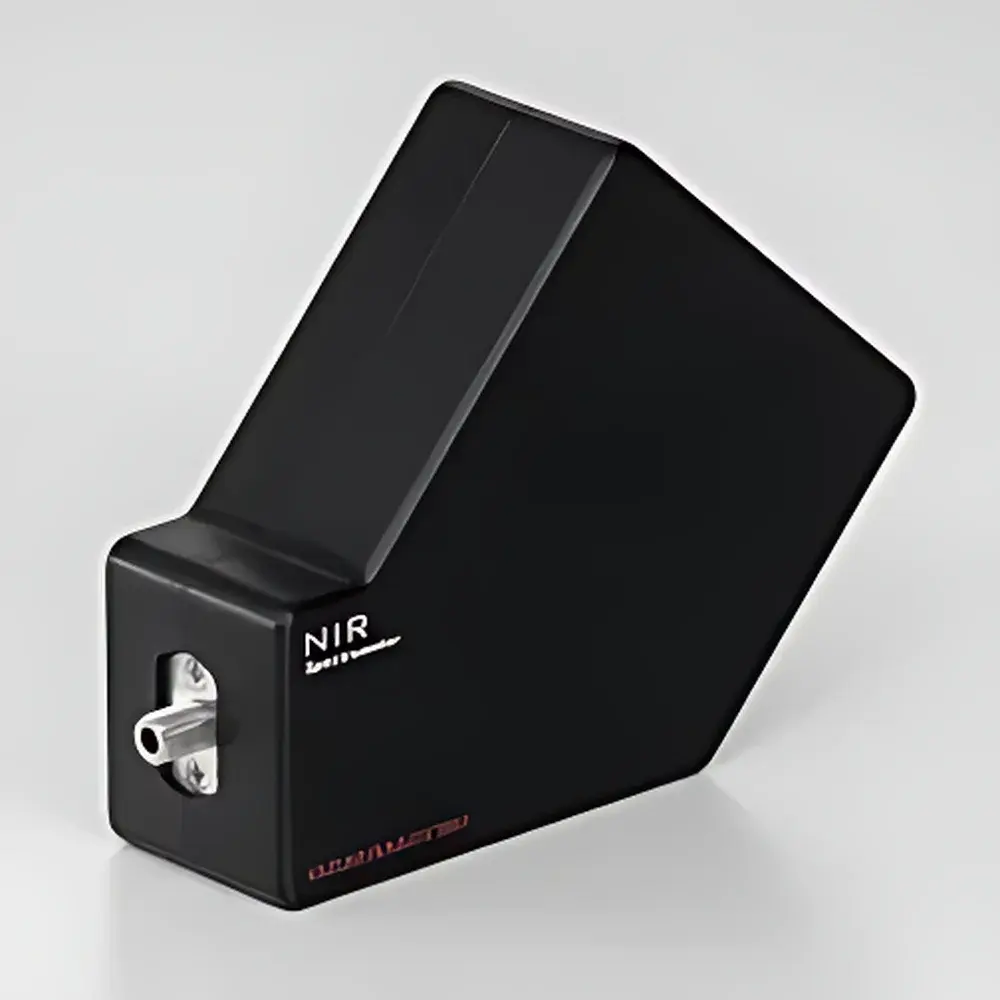
Hamamatsu TG Series Miniature Infrared Fiber Optic Spectrometer
| Brand | Hamamatsu |
|---|---|
| Origin | Japan |
| Manufacturer Type | Original Equipment Manufacturer (OEM) |
| Product Origin | Imported |
| Model | TG Series |
| Spectral Range | 900–1700 nm |
| Detector | InGaAs linear array |
| Pixel Count | 512 pixels |
| Spectral Resolution (FWHM, max) | 7 nm |
| A/D Resolution | 16 bits |
| Cooling | Uncooled |
| Interface | USB 2.0 |
| Power Supply | Bus-powered via USB |
Overview
The Hamamatsu TG Series Miniature Infrared Fiber Optic Spectrometer is a compact, integrated spectroscopic measurement system engineered for near-infrared (NIR) spectral analysis in resource-constrained or embedded environments. Based on the Czerny-Turner optical layout, the TG series integrates a fixed-grating monochromator, collimating and focusing optics, and a thermoelectrically uncooled InGaAs linear image sensor into a single palm-sized housing. It operates on the principle of dispersive spectroscopy: incident light—delivered via standard SMA-905 fiber optic coupling—is diffracted by a ruled or holographic grating, spatially separated by wavelength across the detector array, and digitized with 16-bit precision. Designed for operation under USB bus power (5 V DC), it eliminates the need for external power supplies or cooling infrastructure, making it suitable for field-deployable instrumentation, OEM integration into process analyzers, and portable NIR quality control systems operating in the 900–1700 nm range—covering key absorption bands of C–H, O–H, and N–H bonds in organic compounds.
Key Features
- Compact monolithic design (approx. 85 × 60 × 30 mm) enabling integration into space-limited platforms including handheld analyzers, inline process sensors, and drone-mounted payloads.
- Uncooled InGaAs linear array sensor with 512 active pixels ensures stable dark current performance and reduced thermal drift during extended measurements without active temperature regulation.
- USB 2.0 interface provides plug-and-play connectivity, real-time data streaming, and full device control—including integration time, averaging cycles, and pixel binning—via vendor-provided DLL libraries compatible with C/C++, LabVIEW, Python (PyUSB), and MATLAB.
- Factory-calibrated wavelength and intensity response delivered as non-volatile lookup tables; supports user-defined recalibration using NIST-traceable reference sources (e.g., tungsten-halogen lamps, rare-earth oxide filters).
- Rugged aluminum alloy housing with anodized finish offers mechanical stability and EMI shielding compliant with IEC 61326-1 for industrial electromagnetic compatibility.
Sample Compatibility & Compliance
The TG series is optimized for fiber-coupled transmission, reflectance, and absorbance measurements of liquids, powders, and solid surfaces in laboratory, pilot-scale, and GMP-aligned manufacturing settings. Its 900–1700 nm spectral window aligns with ASTM E1655 (Standard Practices for Infrared Multivariate Quantitative Analysis) and supports method development per USP Spectrophotometry and Light-Scattering. While the spectrometer itself does not carry CE, UKCA, or FDA 510(k) certification, its hardware architecture and firmware design accommodate validation requirements for regulated environments: audit trails can be implemented at the application layer, and raw spectral data export (ASCII, CSV, HDF5) enables traceability per ALCOA+ principles. The absence of thermoelectric cooling simplifies qualification protocols but requires ambient temperature monitoring (15–35 °C recommended) to maintain specified resolution and photometric linearity.
Software & Data Management
Hamamatsu provides a Windows-compatible demonstration application for rapid setup, spectral acquisition, baseline correction, peak identification, and export to common formats. More critically, comprehensive dynamic-link library (DLL) documentation—including function prototypes, error codes, and memory management guidelines—is supplied for custom software development. This enables seamless integration into LIMS, MES, or SCADA systems, supporting automated batch reporting, statistical process control (SPC) charting, and multivariate calibration deployment (e.g., PLS regression models trained in Unscrambler or Pirouette). All spectral acquisitions include embedded metadata (timestamp, integration time, sensor temperature, firmware version), facilitating ISO/IEC 17025-compliant data integrity workflows.
Applications
- Real-time monitoring of polymer melt index and moisture content in extrusion lines using NIR absorption at 1450 nm (O–H stretch) and 1720 nm (C=O first overtone).
- Non-destructive quantification of active pharmaceutical ingredients (APIs) and excipients in tablet blends, compliant with FDA Process Analytical Technology (PAT) guidance.
- Field-based soil organic carbon (SOC) assessment via diffuse reflectance spectroscopy in agricultural survey tools.
- OEM integration into gas analyzers targeting methane (1650 nm) and carbon dioxide (1570 nm) detection in environmental monitoring networks.
- Educational labs requiring low-cost, robust NIR platforms for teaching chemometrics, optical design fundamentals, and embedded system interfacing.
FAQ
Is the TG series spectrometer suitable for quantitative analysis in regulated pharmaceutical environments?
Yes—when deployed with validated user-developed software, documented calibration procedures, and appropriate change control, it meets foundational data integrity expectations for Stage 1–2 PAT implementations.
What is the typical measurement repeatability under constant ambient conditions?
With fixed integration time and ambient temperature stabilization (±1 °C), photometric repeatability is ≤0.5% RSD over 100 consecutive scans for stable broadband sources.
Can the device operate continuously for extended periods (e.g., >8 hours)?
Yes—the uncooled InGaAs sensor and passive thermal design support uninterrupted operation; however, periodic dark reference acquisition is recommended every 30–60 minutes to compensate for slow baseline drift.
Does Hamamatsu provide spectral calibration certificates with NIST traceability?
No—certificates are not included by default, but Hamamatsu supplies calibration data files and supports third-party certification using accredited metrology labs per ISO/IEC 17025.
Are there options for synchronization with external triggers or other instruments?
Yes—the TG series supports TTL-level external trigger input for synchronized acquisition with pumps, actuators, or laser sources, configurable via DLL command set.
Related Products






