
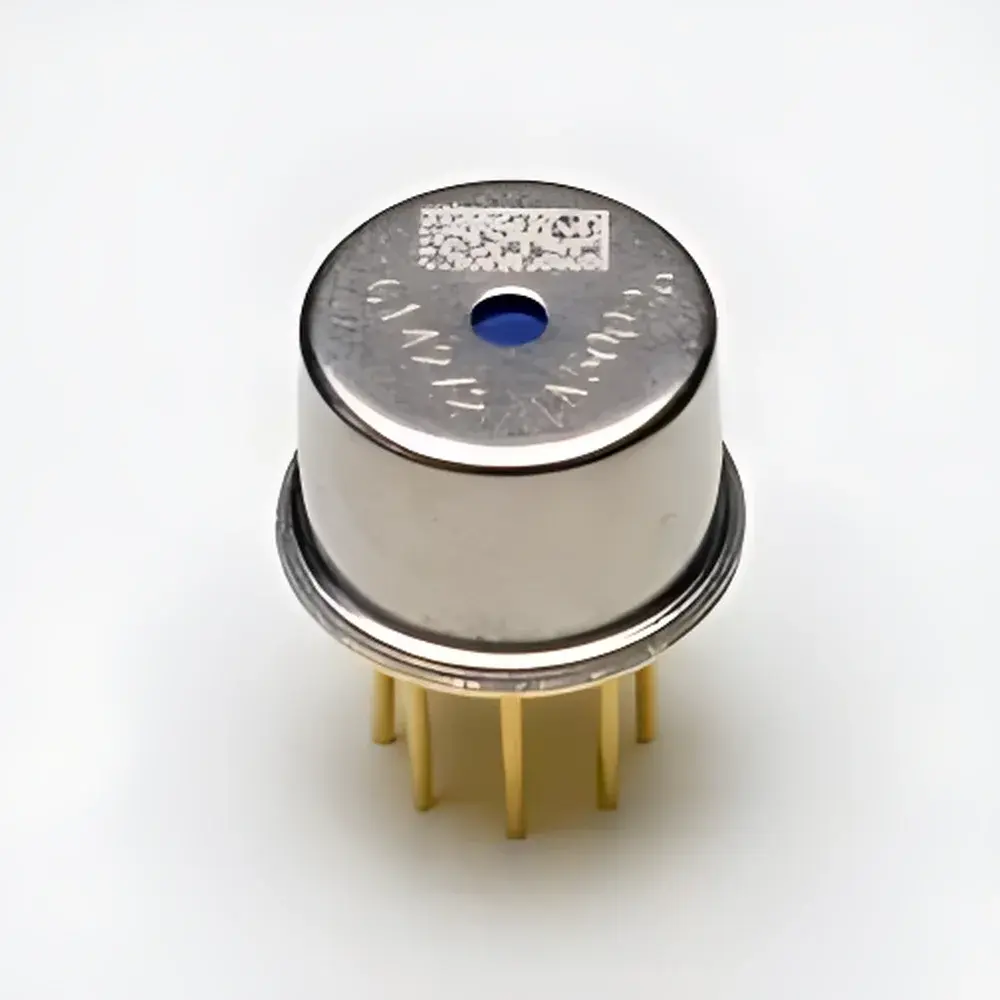
Hamamatsu MEMS-FPI Near-Infrared Spectral Sensor C14272
| Brand | Hamamatsu |
|---|---|
| Origin | Japan |
| Manufacturer Type | Original Equipment Manufacturer (OEM) |
| Product Category | Imported |
| Model | C14272 |
| Spectral Range | 1350–1650 nm |
| Spectral Resolution (FWHM) | ≤18 nm |
| Dark Current | ≤10 nA |
| Photosensitive Area | Ø0.3 mm |
| Package | Hermetically Sealed TO-5 |
| Weight | 1 g |
| Integrated Components | MEMS Fabry–Pérot Interferometer (FPI), InGaAs PIN Photodiode, Thermistor, Bandpass Filter |
Overview
The Hamamatsu MEMS-FPI Near-Infrared Spectral Sensor C14272 is an OEM-grade monolithic spectral detection module engineered for integration into compact, low-power NIR spectroscopic systems operating in the short-wave infrared (SWIR) band. At its core lies a microelectromechanical systems (MEMS)-actuated Fabry–Pérot interferometer (FPI), enabling voltage-tunable spectral selection across a continuous wavelength range from 1350 nm to 1650 nm. Unlike dispersive spectrometers requiring optical alignment and moving parts, the C14272 leverages electrostatic actuation of a tunable air-gap cavity to achieve precise, repeatable wavelength scanning—eliminating mechanical wear and minimizing thermal drift. The integrated InGaAs PIN photodiode provides direct photon-to-current conversion with high quantum efficiency in the target band, while the on-chip thermistor enables real-time temperature compensation critical for stable spectral calibration. Designed for embedded deployment, the device operates without external optics or collimation, making it suitable for portable analyzers, process monitoring sensors, and miniaturized quality control instruments where space, power, and reliability are constrained.
Key Features
- Voltage-tunable MEMS-FPI filter with continuous spectral scanning from 1350 nm to 1650 nm
- Integrated InGaAs PIN photodiode with Ø0.3 mm active area and dark current ≤10 nA (typ., Ta = 25 °C)
- On-board bandpass filter to suppress out-of-band radiation beyond 1350–1650 nm, improving signal-to-noise ratio
- Hermetically sealed TO-5 metal can package ensuring long-term stability under high-humidity environments (IEC 60068-2-30 compliant)
- Integrated thermistor for real-time temperature monitoring and spectral calibration correction
- Ultra-compact footprint (Ø9.5 mm × 4.5 mm height) and ultra-light mass (1 g), enabling integration into handheld or drone-mounted platforms
- No external driver circuit required for basic operation; compatible with standard 0–5 V analog tuning interface
Sample Compatibility & Compliance
The C14272 is optimized for non-destructive, contactless measurement of absorption features associated with C–H, O–H, and N–H overtones and combination bands—commonly used in quantification of moisture, hydrocarbons, polymers, and pharmaceutical excipients. Its spectral window aligns with key analytical regions defined in ASTM E1655 (Standard Practices for Infrared Multivariate Quantitative Analysis) and supports method development per USP (Near-Infrared Spectroscopy). As a component-level sensor—not a standalone instrument—it complies with RoHS Directive 2011/65/EU and meets JEDEC J-STD-020 moisture sensitivity level (MSL) 1 requirements. While not certified as a finished medical or industrial device, the C14272’s hermetic packaging and stable MEMS architecture support design-in compliance with ISO 13485 (medical device QMS) and IEC 61508 (functional safety) when incorporated into validated end-systems.
Software & Data Management
The C14272 interfaces via analog voltage input (tuning) and analog current output (photodiode signal), allowing seamless integration with commercial data acquisition systems (e.g., National Instruments DAQmx, Keysight U2300A) or custom microcontroller-based readout circuits (e.g., STM32 with 12-bit DAC + transimpedance amplifier). Hamamatsu provides reference schematics, timing diagrams, and spectral calibration datasets (wavelength vs. drive voltage, responsivity vs. λ) in CSV format. For traceable spectral analysis, users may implement two-point wavelength calibration using known absorption lines (e.g., water vapor at 1392 nm or 1407 nm) and apply linear or polynomial correction models. When deployed in regulated environments (e.g., pharmaceutical manufacturing), raw sensor output can be logged with timestamp, temperature, and voltage metadata to satisfy FDA 21 CFR Part 11 audit trail requirements—provided the host system implements electronic signatures and data integrity controls.
Applications
- Embedded NIR moisture analyzers for agricultural grain, powder coatings, and lyophilized biologics
- Real-time polymer identification and blend uniformity verification in extrusion and tablet coating processes
- Portable fuel quality screening (e.g., biodiesel FAME content, ethanol-gasoline ratio)
- Miniaturized blood glucose and hemoglobin monitoring prototypes (research use only)
- Gas sensing platforms targeting CH₄ (1653 nm) and CO₂ (1572 nm) in environmental monitoring networks
- OEM integration into smart agricultural sensors for plant water status and nitrogen content estimation
FAQ
What is the recommended drive voltage range for full spectral tuning?
The nominal tuning range of 1350–1650 nm corresponds to a typical drive voltage of 0–30 V DC across the MEMS FPI electrodes. Voltage linearity and hysteresis are characterized in Hamamatsu’s C14272 Datasheet Rev. 3.0.
Can the C14272 operate uncooled in industrial ambient conditions?
Yes—the integrated thermistor and temperature-compensated calibration coefficients enable stable operation from –10 °C to +60 °C. Performance specifications assume Ta = 25 °C; extended-range characterization data is available upon request.
Is spectral calibration data provided with each unit?
No—calibration is batch-characterized. Hamamatsu supplies mean calibration curves and tolerance bands (±1.5 nm wavelength accuracy, ±5% responsivity) for each production lot. Unit-level calibration is available as an optional service.
Does the TO-5 package support reflow soldering?
No—hermetic metal packages are incompatible with standard Pb-free reflow profiles. Manual soldering with localized heat control (≤350 °C for <5 s) is recommended per MIL-STD-750 Method 2016.
How does the integrated bandpass filter affect stray light rejection?
The on-chip filter achieves >OD4 attenuation below 1300 nm and above 1700 nm, reducing second-order diffraction artifacts and ambient IR interference without requiring external optical filtering.



