
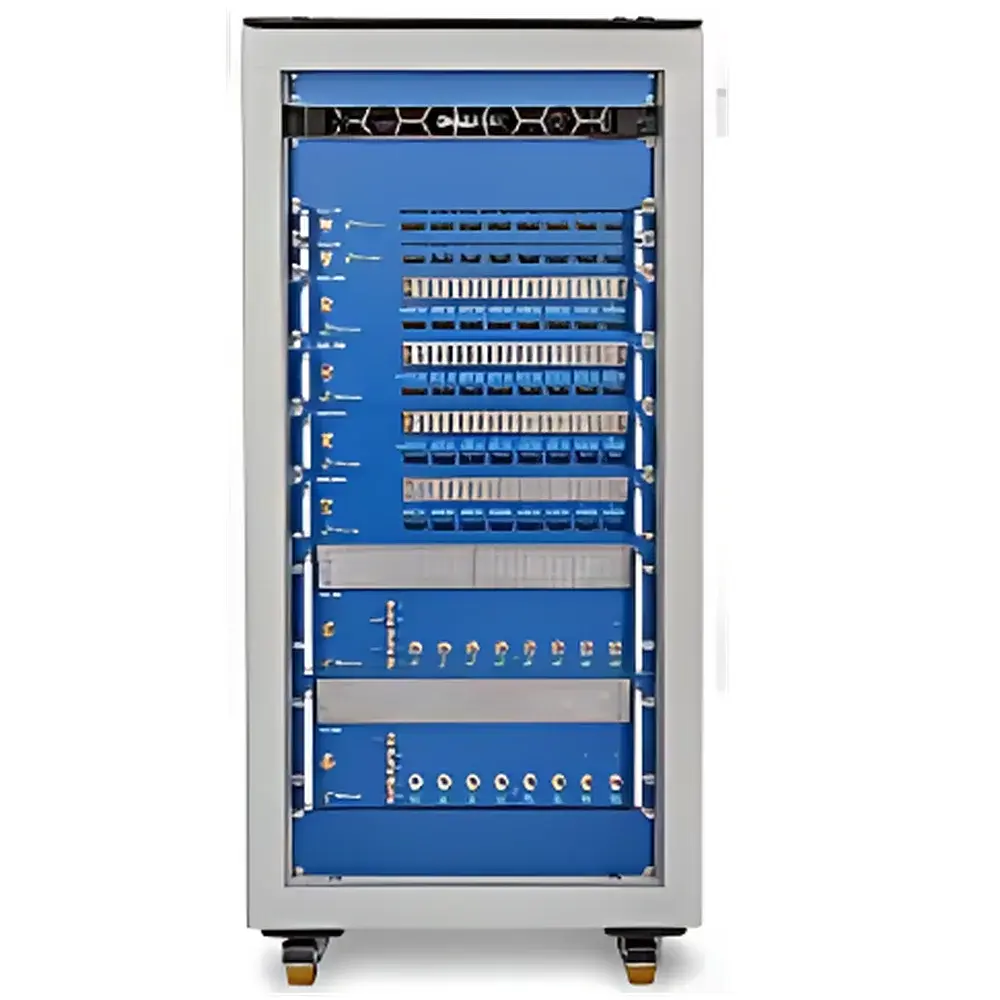
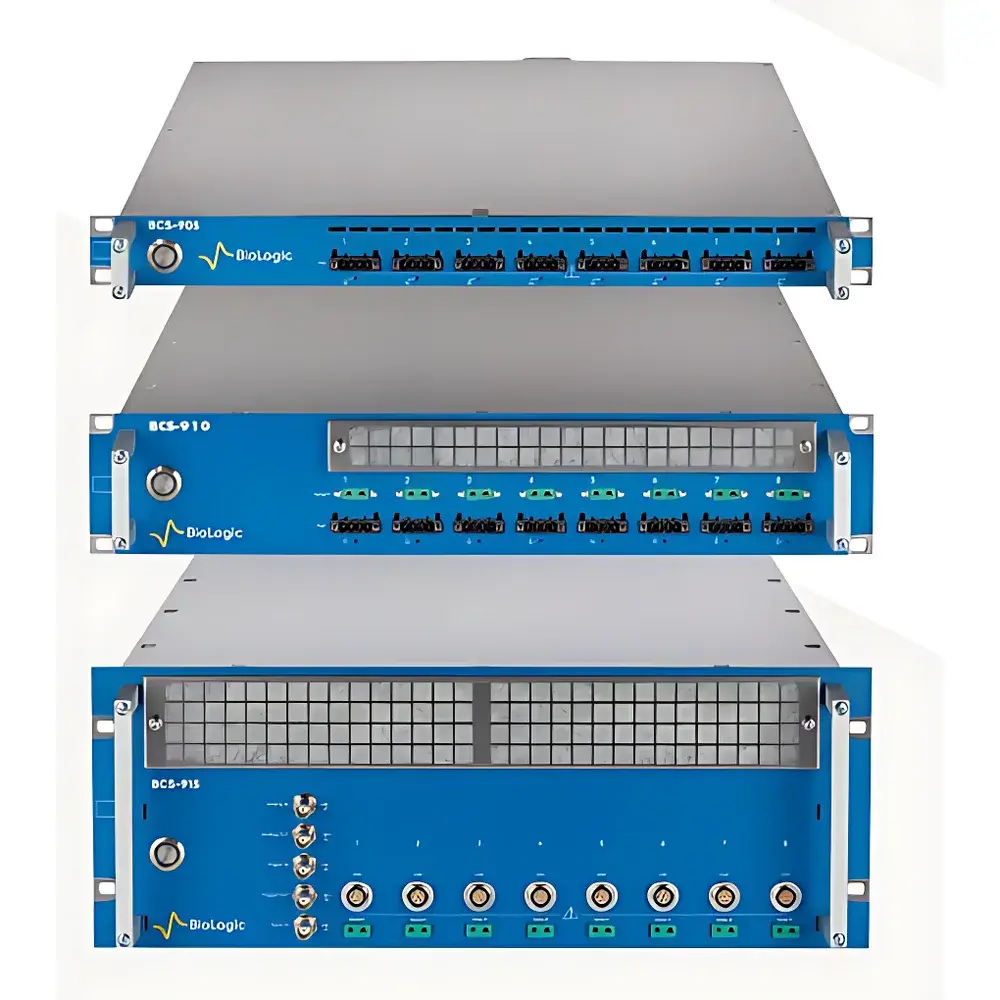
Bio-Logic BCS-900 Series High-Precision Multifunctional Battery Cycler & Electrochemical Workstation
| Brand | Bio-Logic |
|---|---|
| Origin | France |
| Model | BCS-905 / BCS-910 / BCS-915 |
| Instrument Type | Multichannel Electrochemical Workstation & Battery Cycler |
| Channel Configuration | Modular Multichannel (up to 16 channels per rack) |
| Current Range | BCS-905: 15 µA–150 mA (5 ranges) |
| BCS-910 | 150 µA–1.5 A (5 ranges) |
| BCS-915 | 1.5 mA–15 A (5 ranges) |
| Current Accuracy | ±0.015% of range + ±0.05% of reading (15 µA–150 mA) |
| Potential Accuracy | ±0.01% of set value + 300 µV |
| Potentiostatic Range | BCS-905/910: 0–10 V |
| BCS-915 | 0–9 V |
| EIS Frequency Range | 10 mHz–10 kHz |
| Resolution | 18-bit DAC/ADC for current and voltage control and acquisition |
| Thermal Compatibility | Fixture support up to 150 °C |
| Parallel Operation | Scalable to 120 A via synchronized multi-unit parallel configuration |
Overview
The Bio-Logic BCS-900 Series is a modular, high-fidelity electrochemical battery testing platform engineered for precision galvanostatic/potentiostatic cycling, impedance spectroscopy, and advanced electroanalytical techniques in R&D and quality assurance environments. Unlike conventional battery cyclers or standalone potentiostats, the BCS-900 integrates true dual-mode operation—simultaneously satisfying the stringent requirements of both battery cell validation (per ISO 12405, IEC 62660, and SAE J2929) and fundamental electrochemistry (including CV, LSV, CA, CP, and EIS). Its architecture is built upon a real-time deterministic control loop with 18-bit analog-to-digital and digital-to-analog conversion, enabling sub-microampere current resolution and microvolt-level potential stability—critical for detecting subtle degradation mechanisms in Li-ion, solid-state, Na-ion, and flow battery systems.
Key Features
- Modular multichannel scalability: Configurable from single-channel (BCS-905) to high-current (BCS-915) units, supporting up to 16 independent channels per control rack with synchronized timing and phase alignment.
- Unified electrochemical-battery test engine: Eliminates hardware switching between cycling and analytical modes—CV, EIS, GITT, PITT, and hybrid pulse protocols execute natively without recalibration or reconfiguration.
- Dual-control architecture: Combines local embedded firmware execution (programmed via Bio-Logic’s EC-Lab® software) with optional remote server-based orchestration—enabling unattended 24/7 operation, centralized fleet monitoring, and audit-compliant job queuing.
- Thermally robust interface design: Compatible with heated/cryogenic fixtures (−40 °C to +150 °C), including spring-loaded, tab-contact, and pouch-cell clamping solutions certified for UL 1642 and UN 38.3 compliance testing.
- Parallel current scaling: Multiple BCS-915 units can be hardware-synchronized to deliver up to 120 A continuous current with <±50 ppm inter-unit current deviation—validated per ASTM D7282 for high-power cell and module characterization.
Sample Compatibility & Compliance
The BCS-900 supports coin cells (CR2032, CR2016), prismatic, cylindrical (18650, 21700), pouch, and custom-format cells. All current and potential ranges comply with IEC 61000-4-30 (power quality immunity) and meet CE/UKCA safety directives. Firmware and data handling conform to FDA 21 CFR Part 11 requirements when deployed with EC-Lab® v12.42+ and optional electronic signature modules. Full traceability—including parameter versioning, operator ID, timestamped metadata, and raw binary export—is maintained across all test sessions for GLP/GMP-aligned laboratories.
Software & Data Management
EC-Lab® software provides a unified interface for protocol definition, real-time visualization, and post-experiment analysis. It includes built-in EIS fitting (Kramers-Kronig validation), differential capacity (dQ/dV) mapping, state-of-charge (SOC) estimation models, and customizable reporting templates compliant with ISO/IEC 17025 documentation standards. Raw data is stored in open-format .mpt files (ASCII-compatible) with embedded calibration coefficients, ensuring long-term reproducibility and third-party interoperability (e.g., Python Pandas, MATLAB, OriginLab).
Applications
- Accelerated aging studies under variable temperature and SOC conditions
- Electrode material screening (anode/cathode slurry optimization, binder evaluation)
- SEI growth kinetics quantification via low-frequency EIS and potential-step relaxation
- Full-cell balancing and formation protocol development
- Failure mode analysis (Li plating detection, gas evolution correlation, impedance rise modeling)
- Support for DOE-defined test matrices in NREL, Argonne, and JRC battery validation programs
FAQ
Is the BCS-900 compatible with third-party thermal chambers?
Yes—the system features TTL-triggered I/O ports and RS-485 Modbus RTU support for bidirectional communication with major environmental chamber vendors (Weiss, ESPEC, Angelantoni).
Can EIS and cycling be performed simultaneously on the same cell?
No—EIS and galvanostatic cycling are mutually exclusive in real time due to signal orthogonality constraints; however, automated sequential execution (e.g., cycle → rest → EIS → repeat) is fully scriptable with sub-second transition timing.
What calibration standards does Bio-Logic recommend for routine verification?
Annual calibration using NIST-traceable reference resistors (100 Ω to 1 MΩ) and precision voltage sources (±10 ppm stability) is advised; Bio-Logic provides certified calibration kits (CAL-BCS-9xx) with documented uncertainty budgets per ISO/IEC 17025.
Does the system support battery management system (BMS) signal injection?
Yes—optional CAN bus interface module (CAN-BCS) enables real-time telemetry exchange with external BMS controllers for HIL (hardware-in-the-loop) validation of protection algorithms and SOC/SOH estimation logic.
Related Products





