
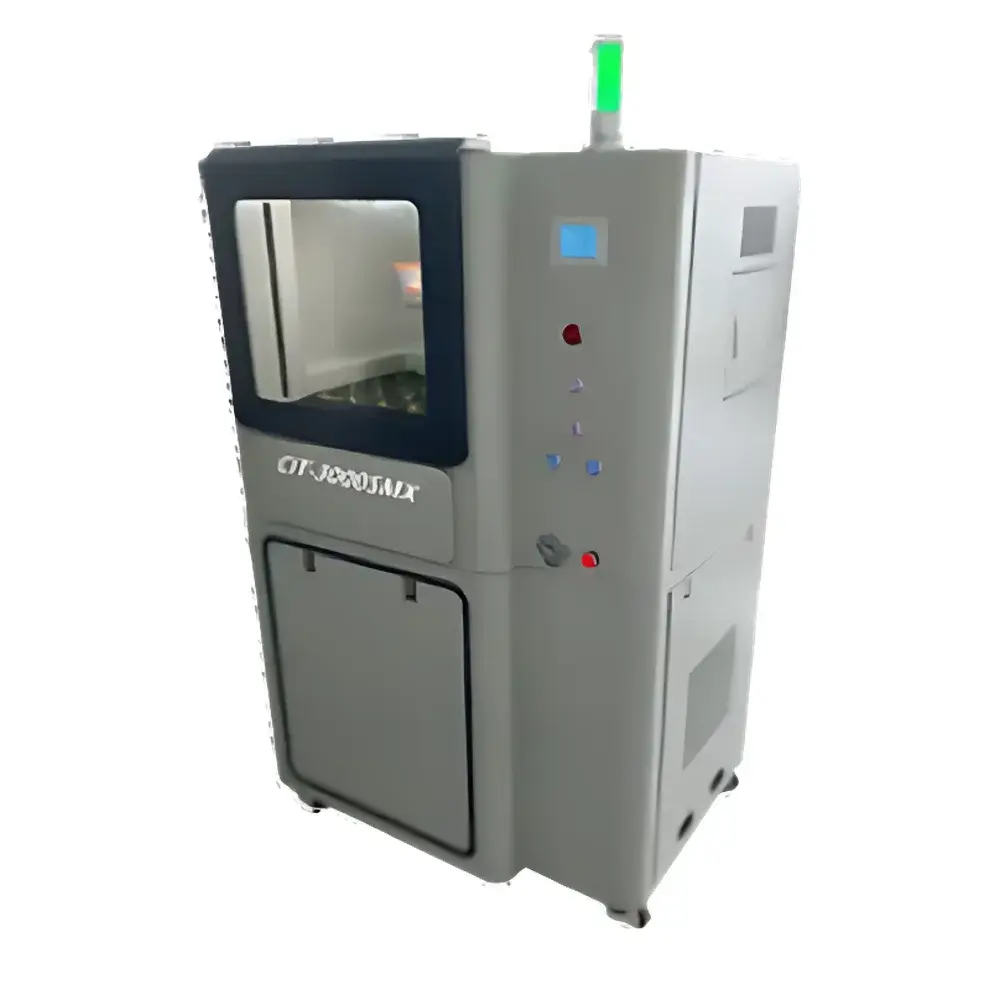
X-Ray Fluorescence Spectrometer (EDX) – Sichuan Xinxianda CIT-3000SMX Energy Dispersive XRF Analyzer
| Brand | Sichuan Xinxianda |
|---|---|
| Origin | Sichuan, China |
| Model | CIT-3000SMX |
| Element Range | Na (11)–U (92) |
| Detection Range | 0.1 ppm–99.99% |
| Energy Resolution | <100 eV (@5.89 keV) |
| Repeatability (RSD) | ≤0.05% |
| Detector | FAST SDD (Silicon Drift Detector) |
| Sample Capacity | 25-position automated carousel |
| Measurement Time | 100–300 s per sample |
| Vacuum Level | 1×10⁻² Pa (stable for ≥30 min) |
| X-ray Tube | 0–50 kV, 1–1000 µA |
| Sample Mass | 3–8 g |
| Dimensions (L×W×H) | 970×750×1600 mm |
| Weight | 160 kg |
Overview
The Sichuan Xinxianda CIT-3000SMX is a benchtop-to-floor-standing energy dispersive X-ray fluorescence (EDXRF) spectrometer engineered for non-destructive, multi-element quantitative analysis of solid and powdered samples. Based on the fundamental principle of X-ray fluorescence—where primary X-rays excite inner-shell electrons in atoms, resulting in characteristic secondary (fluorescent) X-ray emission—the CIT-3000SMX delivers high-fidelity elemental composition data across the periodic table from sodium (Na, Z=11) to uranium (U, Z=92). Its optimized optical path features a top-illumination geometry with vacuum or helium purge capability, minimizing absorption losses for light elements (e.g., Mg, Al, Si, P, S, Cl), while the integrated FAST SDD detector ensures rapid photon counting and superior peak separation. The system employs a digitally controlled X-ray tube (0–50 kV, 1–1000 µA) paired with a 2K/4K digital pulse processor, enabling precise excitation control and spectral deconvolution. Designed for industrial laboratories requiring throughput and reproducibility, the CIT-3000SMX supports unattended operation via its 25-position robotic autosampler and motorized sample rotation stage—critical for mitigating heterogeneity-related bias in bulk materials such as ores, slags, and ceramics.
Key Features
- Top-illumination optical configuration with sealed vacuum chamber (1×10⁻² Pa baseline, leak rate <1×10⁻⁵ Pa·m³/s), ensuring stable detection of elements down to Na without atmospheric attenuation
- FAST Silicon Drift Detector (SDD) with active area ≥25 mm² and FWHM resolution <100 eV at Mn Kα (5.89 keV), enabling accurate quantification of overlapping peaks (e.g., Cr–Fe–Mn, Pb–As–Sb)
- Automated sample handling: precision robotic arm with vertical lift-and-place mechanism; programmable sample rotation (0–360°) to average microstructural variation and surface texture effects
- Digital pulse processing architecture supporting live dead-time correction, pile-up rejection, and real-time spectrum accumulation up to 16 M channels
- Radiation safety compliance: fully shielded cabinet meeting GBZ 115–2002 national standard; registered with China’s Ministry of Ecology and Environment (MEE) under Class II radiation device requirements
- Modular power supply and thermal management system ensuring long-term stability (<0.05% RSD over 11 consecutive measurements per ISO 18115-1:2017)
Sample Compatibility & Compliance
The CIT-3000SMX accommodates pressed pellets, fused beads, loose powders (3–8 g), and flat-surface solids up to Ø100 mm × 30 mm thick. Its vacuum-compatible sample chamber accepts both air-mode (for heavy elements >Ca) and vacuum/helium-mode (for Na–Cl) analyses. Method validation aligns with ASTM E1621–22 (Standard Guide for XRF Analysis of Waste Materials), ISO 21043–1:2021 (XRF for cement and building materials), and GB/T 176–2017 (cement chemical analysis). While not pre-certified for FDA 21 CFR Part 11, the instrument’s audit trail-capable software architecture supports GLP/GMP-compliant deployment when configured with user access controls, electronic signatures, and raw-data archiving protocols.
Software & Data Management
The proprietary QuantMaster™ analysis suite provides full spectral acquisition, background subtraction (SNIP algorithm), peak fitting (Gaussian-Lorentzian hybrid), matrix correction (Fundamental Parameters + empirical calibration), and report generation in PDF/CSV/XLSX formats. All spectra are stored with metadata (date/time, operator ID, measurement parameters, vacuum status). Raw .spc files retain full 16-bit channel intensity arrays for reprocessing. Optional LIMS integration via ASTM E1482-compliant XML export enables traceability across enterprise QA/QC workflows. Software updates are delivered via secure HTTPS channel with SHA-256 signature verification.
Applications
- Metallurgy & Mining: Grade control of Fe, Cu, Pb, Zn, Sn, Mo, W, V, Ti in ores, concentrates, and smelter feedstocks; slag composition monitoring (CaO, SiO₂, Al₂O₃, MgO, MnO)
- Environmental Testing: Regulatory screening of As, Cd, Cr, Hg, Pb, Ni, Zn in soil, sediment, and dust according to EPA Method 6200 and China’s HJ 803–2016
- Construction Materials: Rapid compositional verification of cement clinker, fly ash, glass cullet, refractory bricks, and ceramic glazes
- Recycling & Scrap Sorting: Identification and sorting of alloy families (e.g., Al-Si vs. Al-Mg, stainless grades 304/316) based on Cr–Ni–Mo–Mn signatures
- Quality Assurance Labs: Incoming raw material inspection, finished product release testing, and supplier qualification per ISO/IEC 17025 internal procedures
FAQ
What is the minimum detectable limit (MDL) for light elements like magnesium or aluminum?
MDLs are matrix-dependent but typically range from 10–50 ppm for Mg and Al in low-Z matrices (e.g., glass, limestone) under vacuum conditions. Calibration using certified reference materials (CRMs) is required for method-specific MDL determination.
Can the CIT-3000SMX analyze liquid samples?
No—this is a solid-sample-focused EDXRF platform. Liquids require containment in X-ray-transparent capsules (e.g., Mylar film) and are subject to evaporation and stratification artifacts; dedicated WD-XRF or ICP-MS platforms are recommended for routine liquid analysis.
Is remote diagnostics or service support available?
Yes—optional Ethernet-connected remote maintenance mode allows authorized engineers to monitor system health, review error logs, and update firmware via encrypted TLS tunnel, compliant with ISO/IEC 27001 information security guidelines.
How often does the SDD detector require recalibration?
Energy calibration drift is 5°C temperature change).
Does the instrument meet international CE or UL certification requirements?
The CIT-3000SMX complies with Chinese national safety standards (GB 4793.1–2019, GB/T 18268.1–2010) and electromagnetic compatibility (EMC) per GB/T 18268.26–2010. CE/UL certification requires region-specific third-party assessment and is available upon request for export configurations.




