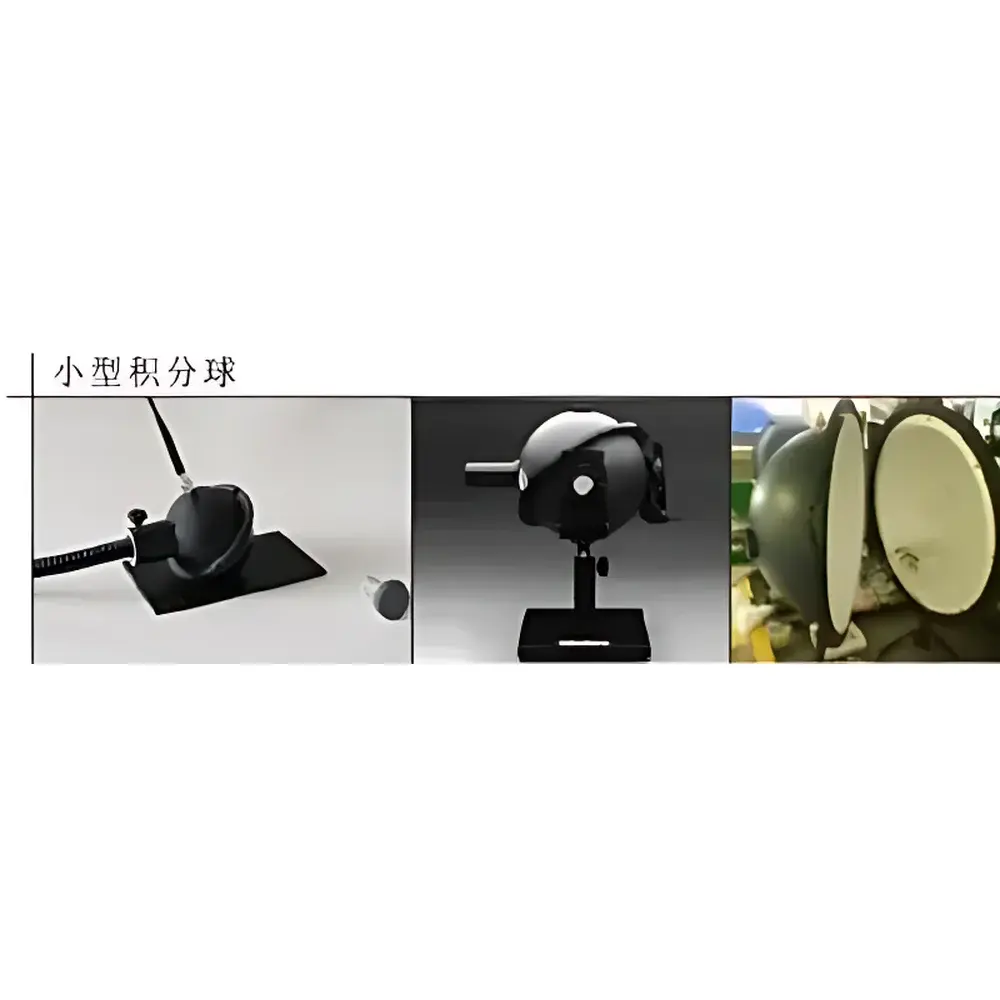
Jingfei SPHERE Series Integrating Sphere
| Brand | Jingfei Technology |
|---|---|
| Origin | Zhejiang, China |
| Manufacturer Type | OEM/ODM Producer |
| Model | SPHERE |
| Diameter Options | 30 mm, 60 mm, 200 mm, 300 mm, 500 mm, 1.0 m, 1.5 m, 1.75 m, 2.0 m |
| Coating Reflectance | >98% (250–2500 nm) |
| Spectral Uniformity | Flat response across UV-VIS-NIR |
| Coating Stability | Chemically inert, non-yellowing, abrasion-resistant |
| Construction | Monolithic spherical shell, minimal internal obstructions |
Overview
The Jingfei SPHERE Series Integrating Sphere is a precision optical component engineered for photometric, radiometric, and spectrophotometric measurement applications. Based on the fundamental principle of multiple diffuse reflections within a highly reflective, spectrally neutral cavity, the integrating sphere homogenizes incident light through Lambertian scattering—ensuring spatial and angular uniformity of radiant flux at any internal point. This physical behavior enables two primary operational modes: radiance mode, where the sphere serves as a uniform secondary source for calibration or illumination; and reflectance mode, where it functions as a collecting aperture to quantify total hemispherical reflectance (THR) of planar or curved samples. The sphere’s performance is governed by its geometry (diameter-to-port-area ratio), coating spectral reflectance (>98% from 250 nm to 2500 nm), and internal surface integrity—critical parameters for minimizing vignetting, port losses, and wavelength-dependent nonlinearity.
Key Features
- High-Performance Diffuse Coating: Barium sulfate (BaSO₄)-based or polytetrafluoroethylene (PTFE)-derived proprietary coating with certified reflectance ≥98% across ultraviolet (250 nm), visible (380–780 nm), and near-infrared (780–2500 nm) spectra—validated per ASTM E275 and ISO 13406-2.
- Monolithic Spherical Construction: Seamless, one-piece molded aluminum or stainless-steel housing with electropolished interior surface—eliminates seam-induced scattering anomalies and ensures mechanical stability under thermal cycling.
- Modular Port Configuration: Standardized SMA905, FC/PC, or threaded (M27×0.75) optical ports for detector coupling, fiber insertion, or auxiliary source integration; optional baffle systems minimize first-reflection errors per CIE Publication 127.
- Scalable Geometry Range: Nine calibrated diameters (30 mm to 2.0 m) support diverse use cases—from micro-optics characterization (e.g., LED chip testing per LM-79) to large-area solar reflectance measurement (ASTM E903).
- Environmental Robustness: Coating exhibits no measurable yellowing or adhesion loss after 5,000 h accelerated aging (40 °C / 90% RH), complying with IEC 60068-2-30 humidity testing protocols.
Sample Compatibility & Compliance
The SPHERE series accommodates flat, curved, textured, or translucent samples up to 80% of the sphere’s internal diameter. For reflectance measurements, sample mounting fixtures conform to ISO 2813 (gloss), ASTM D2244 (color difference), and ISO 11664-4 (CIE colorimetry). Radiation-mode configurations meet traceability requirements for NIST-traceable lamp calibration (NIST SRM 2031, 2032) and are compatible with GLP/GMP environments when paired with audit-trail-enabled spectroradiometers. All spheres are supplied with factory calibration certificates documenting spatial uniformity (<±0.5% irradiance variation across 80% central area) and spectral reflectance profiles (measured on PerkinElmer Lambda 1050+).
Software & Data Management
Jingfei provides optional SDKs (C/C++, Python, LabVIEW) for seamless integration with third-party acquisition platforms—including Ocean Insight OceanView, Thorlabs ThorImage, and custom MATLAB-based analysis pipelines. Raw sphere output data (intensity vs. wavelength/time) adheres to ASTM E1331 spectral data format (SDMX) and supports metadata embedding per ISO/IEC 17025 clause 7.5.2. When used with compliant spectroradiometers, full 21 CFR Part 11 electronic record integrity—including user authentication, audit trails, and electronic signatures—is achievable via configurable software layers.
Applications
- Radiant flux measurement of LEDs, laser diodes, OLEDs, and broadband sources (per IES LM-79, CIE S 025)
- Total hemispherical reflectance (THR) and transmittance of coatings, films, paints, and architectural materials (ASTM E903, ISO 9050)
- Colorimetric analysis (CIE XYZ, L*a*b*, ΔE₀₀) in display manufacturing and pigment R&D
- Fluorescence quantum yield determination using excitation/emission dual-sphere setups
- Calibration of reference detectors, camera sensors, and satellite earth observation payloads
- Diffuse transmittance of frosted glass, opal diffusers, and medical imaging phantoms
FAQ
What is the minimum recommended sphere diameter for measuring a 10 mm × 10 mm LED package?
For accurate spatial averaging and minimal port substitution error, the sphere diameter should be ≥10× the largest sample dimension—thus a 100 mm minimum is advised; the 200 mm SPHERE model is preferred for production-grade LM-79 compliance.
Can the SPHERE be used under vacuum or inert gas environments?
Yes—custom variants with welded hermetic ports and vacuum-compatible PTFE coating (rated for 10⁻⁶ mbar) are available upon request.
Is coating reapplication possible after extended use?
Yes—Jingfei offers certified recoating services with full recalibration and ISO 17025-accredited certification.
How is sphere throughput validated during factory calibration?
Each unit undergoes absolute throughput verification using a NIST-traceable tungsten-halogen standard lamp and double-monochromator spectroradiometer, reporting uncertainty ≤1.2% (k=2) at 550 nm.
Do you provide application-specific configuration guides?
Yes—comprehensive white papers covering LM-79 LED testing, ASTM E903 solar reflectance, and fluorescence quantum yield methods are included with every shipment.