
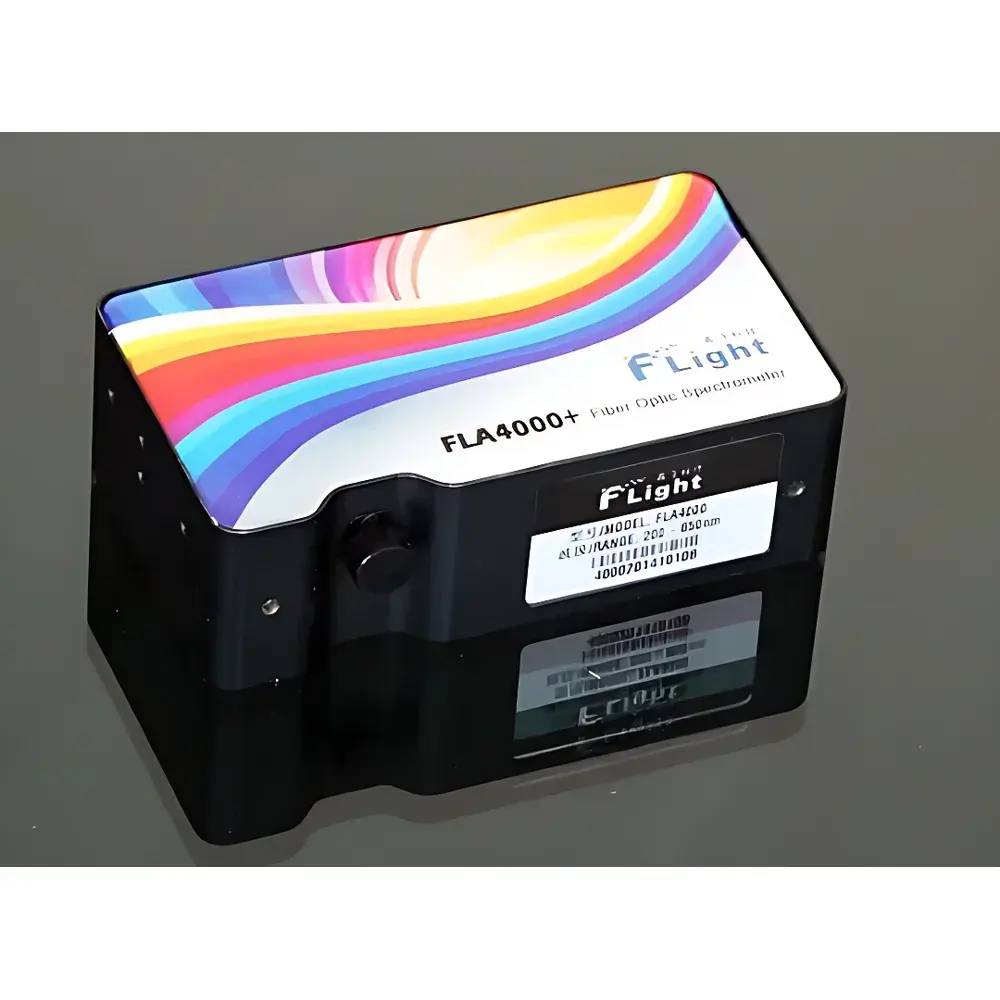
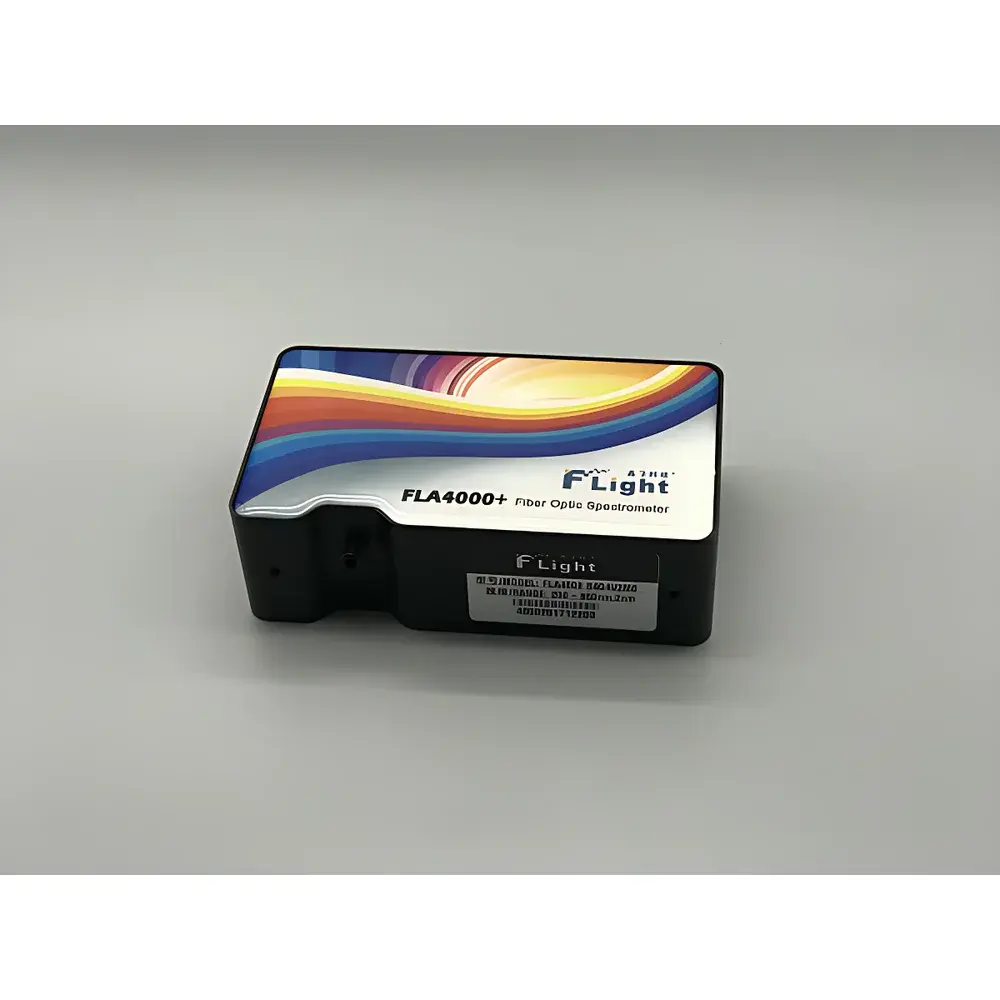
Jingfei FLA4000 Fiber Optic Spectrometer
| Spectral Range | 200–1100 nm |
|---|---|
| Detector | Hamamatsu CMOS Linear Array (1024 pixels) |
| Optical Resolution (FWHM) | 0.32–0.8 nm (configurable via grating & slit) |
| Slit | Standard 70 µm (optional) |
| Signal-to-Noise Ratio | 380:1 (typ.), up to 500:1 (peak) |
| Dynamic Range | 1.6 × 10⁶ |
| Stray Light | < 0.1% |
| Integration Time | 1 ms – 65 s |
| A/D Converter | 16-bit with auto-zero dark correction |
| FIFO Depth | 4K samples |
| Interface | USB 2.0 (standard), RS232, RS485 |
| Dimensions | 128 × 72 × 40 mm |
| Weight | 500 g |
| Calibration Storage | Onboard EEPROM |
| Linearity | >99.8% |
Overview
The Jingfei FLA4000 Fiber Optic Spectrometer is a compact, high-performance benchtop-grade spectrometer engineered for precision UV-VIS-NIR spectral acquisition in laboratory, industrial, and field-deployable applications. Based on the principle of Czerny-Turner optical architecture coupled with a fixed-grating monochromator design, the FLA4000 delivers stable, repeatable spectral measurements across a broad 200–1100 nm range. Its core optical path is optimized for minimal aberration and thermal drift, supporting consistent wavelength calibration over extended operational periods. The instrument integrates a Hamamatsu CMOS linear array detector (1024 pixels), selected for its low read noise, high quantum efficiency in the UV region, and excellent responsivity up to 1100 nm. Unlike CCD-based alternatives, the CMOS sensor enables rapid frame rates and robust performance under variable ambient lighting—critical for real-time process monitoring and kinetic studies.
Key Features
- High-fidelity spectral acquisition with configurable optical resolution (FWHM down to 0.32 nm, dependent on grating groove density and input slit width)
- 16-bit analog-to-digital conversion with hardware-level auto-zero dark current compensation, ensuring accurate baseline stability across integration times from 1 ms to 65 s
- 4K-deep onboard FIFO buffer enabling continuous high-speed data streaming without packet loss
- Onboard EEPROM storing individual unit calibration coefficients (wavelength, intensity, nonlinearity), eliminating manual recalibration during system migration or software reinstallation
- Multi-interface connectivity: USB 2.0 (plug-and-play, hot-swap compatible), RS232, and RS485 for integration into SCADA, PLC-controlled, or OEM embedded environments
- Compact form factor (128 × 72 × 40 mm, 500 g) with aluminum alloy housing providing mechanical rigidity and passive thermal management
Sample Compatibility & Compliance
The FLA4000 is designed as a modular spectroscopic engine—not a standalone measurement system—but rather a calibrated spectral detection module intended for integration into custom optical configurations. It supports standard SMA905 fiber coupling (core diameter 200–600 µm), enabling compatibility with absorption cells, integrating spheres, reflection probes, fluorescence cuvette holders, and plasma emission setups. When paired with NIST-traceable tungsten-halogen or deuterium lamps, the system supports ASTM E308 (computing colorimetric values), ISO 13406-2 (display luminance profiling), and USP (spectrophotometric system suitability). The onboard EEPROM calibration conforms to GLP data integrity requirements by preserving immutable instrument-specific response functions; raw spectral data retains full traceability to factory calibration conditions. While not certified to IEC 61000-4 EMC standards out-of-box, its shielded enclosure and differential signaling on RS485/RS232 interfaces facilitate compliance in controlled lab environments.
Software & Data Management
The FLA4000 operates with cross-platform SDKs (C/C++, Python, LabVIEW, MATLAB) and includes a native Windows application supporting real-time spectral visualization, batch acquisition, and export in CSV, TXT, and industry-standard JCAMP-DX formats. All software modules implement timestamped metadata logging—including integration time, detector temperature (via internal thermistor), and firmware revision—ensuring audit readiness per FDA 21 CFR Part 11 when deployed in regulated QC/QA workflows. Raw spectra retain full 16-bit depth throughout processing; no lossy compression is applied during acquisition or export. The SDK supports asynchronous callback acquisition, enabling synchronization with external triggers (TTL-compatible) for pump-probe experiments or inline manufacturing inspection.
Applications
- UV-Vis quantitative analysis of aqueous and organic solutions (e.g., concentration determination of dyes, pharmaceutical actives, nitrate)
- NIR-based moisture and fat content screening in agricultural feedstock and food products
- LED and OLED spectral power distribution (SPD) characterization for photobiological safety assessment (IEC 62471)
- Plasma emission monitoring in semiconductor etch and deposition chambers
- Fluorescence lifetime pre-screening via steady-state spectral deconvolution
- Educational labs requiring rugged, low-maintenance instrumentation for spectroscopy fundamentals instruction
FAQ
Is the FLA4000 compliant with FDA 21 CFR Part 11 for electronic records and signatures?
Yes—when used with validated software configurations that enforce user authentication, audit trails, and electronic signature workflows, the FLA4000’s onboard calibration storage and timestamped raw data output satisfy foundational ALCOA+ principles.
Can the resolution be improved beyond 0.32 nm?
No—the 0.32 nm specification represents the theoretical limit under optimal configuration (e.g., 2400 grooves/mm grating + 10 µm slit); practical resolution is constrained by optical alignment stability and signal-to-noise trade-offs at narrow slit widths.
Does the instrument support external triggering?
Yes—TTL-compatible trigger input is available via the DB9 connector (RS232/RS485 interface port), supporting both rising-edge start and gated acquisition modes.
What is the typical warm-up time required for spectral stability?
Less than 15 minutes under ambient conditions (23 ± 2 °C); detector dark current drift remains within ±0.5% of full scale after stabilization.
Is OEM integration supported?
Yes—mechanical drawings, electrical pinouts, and low-level command protocol documentation are provided under NDA for embedded integration into analytical platforms or automated test systems.





