
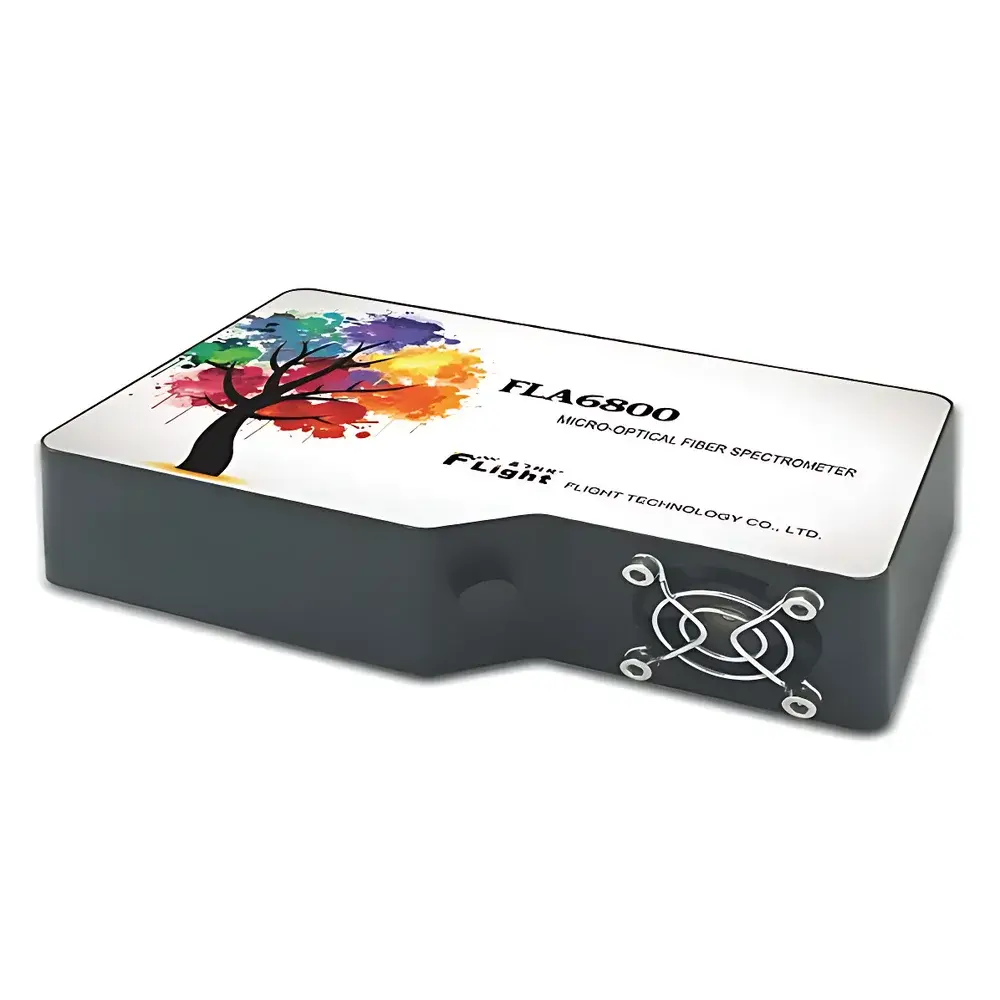
Jingfei FLA6800 Near-Infrared Fiber-Optic Spectrometer (1000–1700 nm)
| Brand | Jingfei Technology |
|---|---|
| Origin | Zhejiang, China |
| Manufacturer Type | OEM Manufacturer |
| Instrument Type | Benchtop Laboratory Spectrometer |
| Optical Principle | Fixed Grating with Linear InGaAs Array Detector (Non-scanning) |
| Wavelength Range | 1000–1700 nm |
| Measurement Modes | Transmission, Reflection, Absorbance |
| Chemometrics Software | FLA Suite |
| Detector | InGaAs (256-pixel linear array) |
| Pixel Resolution | 256 pixels |
| Slit Width | 200 µm (standard, optional) |
| Optical Resolution (FWHM) | ≤3.2 nm |
| Stray Light | <0.1% |
| SNR | 1200:1 (full signal, 1 s integration) |
| Linearity | >99.8% |
| Dynamic Range | 900,000 (typical, 16-bit digitization) |
| A/D Converter | 16-bit high-speed |
| FIFO Buffer | 4 KB |
| Interface | USB 2.0 |
| Dimensions | 182 × 110 × 50 mm |
| Weight | 1500 g |
| Power Supply | Bus-powered via USB 2.0 (no external power required) |
Overview
The Jingfei FLA6800 is a compact, benchtop near-infrared (NIR) fiber-optic spectrometer engineered for high-fidelity spectral acquisition in the 1000–1700 nm range. It employs a fixed-grating optical design coupled with a thermoelectrically stabilized 256-pixel InGaAs linear array detector — eliminating mechanical scanning and enabling rapid, repeatable spectral capture. The instrument operates on the principle of dispersion-based spectroscopy: incident light is collimated, diffracted by a ruled or holographic grating, and focused onto the InGaAs detector array, where photon intensity per wavelength channel is digitized in parallel. This non-scanning architecture ensures high temporal stability, minimal moving-part wear, and immunity to scan-speed-induced artifacts — critical for quantitative chemometric modeling and real-time process monitoring. Designed for laboratory environments in academic research, materials science, and applied chemistry labs, the FLA6800 delivers robust performance under variable ambient conditions while maintaining factory-calibrated wavelength and radiometric accuracy.
Key Features
- Bus-powered operation via USB 2.0 interface — no external power supply required, enabling portable deployment and field-ready measurements
- Integrated 16-bit analog-to-digital converter with 4 KB hardware FIFO buffer, supporting high-speed data streaming at up to 100 spectra per second (configurable integration time)
- Thermally stabilized InGaAs detector array (256 pixels) with optimized quantum efficiency across 1000–1700 nm; optional TE cooling available for extended dynamic range and dark-current suppression
- Factory-wavelength-calibrated optics with NIST-traceable reference data stored in onboard memory — ensuring inter-unit consistency and traceable spectral alignment
- Modular optical interface: SMA 905-compatible fiber input enables seamless integration with halogen, tungsten-halogen, or NIR LED sources, integrating spheres, transmission cells, and diffuse reflectance probes
- Compact form factor (182 × 110 × 50 mm) and lightweight construction (1.5 kg) facilitate integration into custom optical benches, robotic sampling stations, or mobile analytical platforms
Sample Compatibility & Compliance
The FLA6800 supports transmission, reflectance (diffuse and specular), and absorbance measurement geometries via interchangeable fiber-coupled accessories. It is routinely deployed in compliance-sensitive environments including university core facilities, contract research organizations (CROs), and GLP-aligned laboratories. While not pre-certified for FDA 21 CFR Part 11, the instrument’s architecture supports audit-trail-capable software workflows when used with validated versions of the FLA chemometrics suite. Its optical performance adheres to ISO 17025-relevant parameters for spectral reproducibility (±0.2 nm wavelength repeatability over 8-hour operation) and linearity (R² > 0.9999 across 10–90% signal range). Stray light (1200:1) meet ASTM E1421–22 requirements for NIR instrumentation used in quantitative organic analysis and polymer characterization.
Software & Data Management
The FLA software suite provides native driver support for Windows OS (x64), offering real-time spectrum visualization, batch acquisition scripting, and export in CSV, ASCII, and JCAMP-DX formats. It includes embedded preprocessing tools (Savitzky-Golay smoothing, multiplicative scatter correction, first/second derivative), PCA model building, and PLS regression calibration modules — all compliant with standard chemometric validation protocols (e.g., cross-validation, RMSEC/RMSEP reporting). Raw spectral metadata — including integration time, lamp status, temperature sensor output, and detector gain settings — are automatically embedded in each acquired file. The software supports hot-plug detection and USB enumeration without system reboot, and permits concurrent multi-instrument control for synchronized multi-channel measurements.
Applications
- Quantitative analysis of moisture, protein, fat, and starch in agricultural commodities (grains, forages, seeds) per AOAC 2000.01 and ISO 12099
- In-line monitoring of polymer melt index, crystallinity, and additive concentration during extrusion and injection molding
- Pharmaceutical raw material identification and blend uniformity assessment in accordance with USP <1119> NIR guidelines
- Non-destructive evaluation of semiconductor wafer thickness and dopant profiling via substrate absorption edge analysis
- Carbon nanotube and graphene dispersion quality assessment through characteristic NIR absorption band ratios (e.g., ~1060 nm, ~1200 nm)
- Environmental soil organic carbon (SOC) estimation using partial least squares models trained on reference laboratory data
FAQ
Is the FLA6800 suitable for GMP-regulated environments?
Yes — when deployed with validated FLA software configurations and documented calibration procedures, it meets foundational requirements for instrument qualification (IQ/OQ) under ICH Q9 and ISO 13485 frameworks.
Can the spectrometer be triggered externally via TTL signal?
No — the current hardware revision does not include GPIO or TTL trigger input; synchronization is achieved via software-controlled acquisition timing.
What is the recommended integration time range for optimal SNR?
For most routine measurements, 10–500 ms yields optimal balance between signal fidelity and frame rate; longer integrations (>1 s) require active thermal stabilization to minimize dark-current drift.
Does the instrument support OEM integration into third-party systems?
Yes — Jingfei provides a documented C/C++ SDK with low-level register access, DLL wrappers, and Python bindings (via ctypes), enabling full control from LabVIEW, MATLAB, or custom industrial HMI platforms.
How is wavelength calibration maintained over time and temperature?
Each unit undergoes multi-point Hg/Ar lamp calibration at 25°C; onboard thermistor feedback enables real-time pixel-to-wavelength mapping correction within ±0.3 nm over 15–35°C ambient range.




