
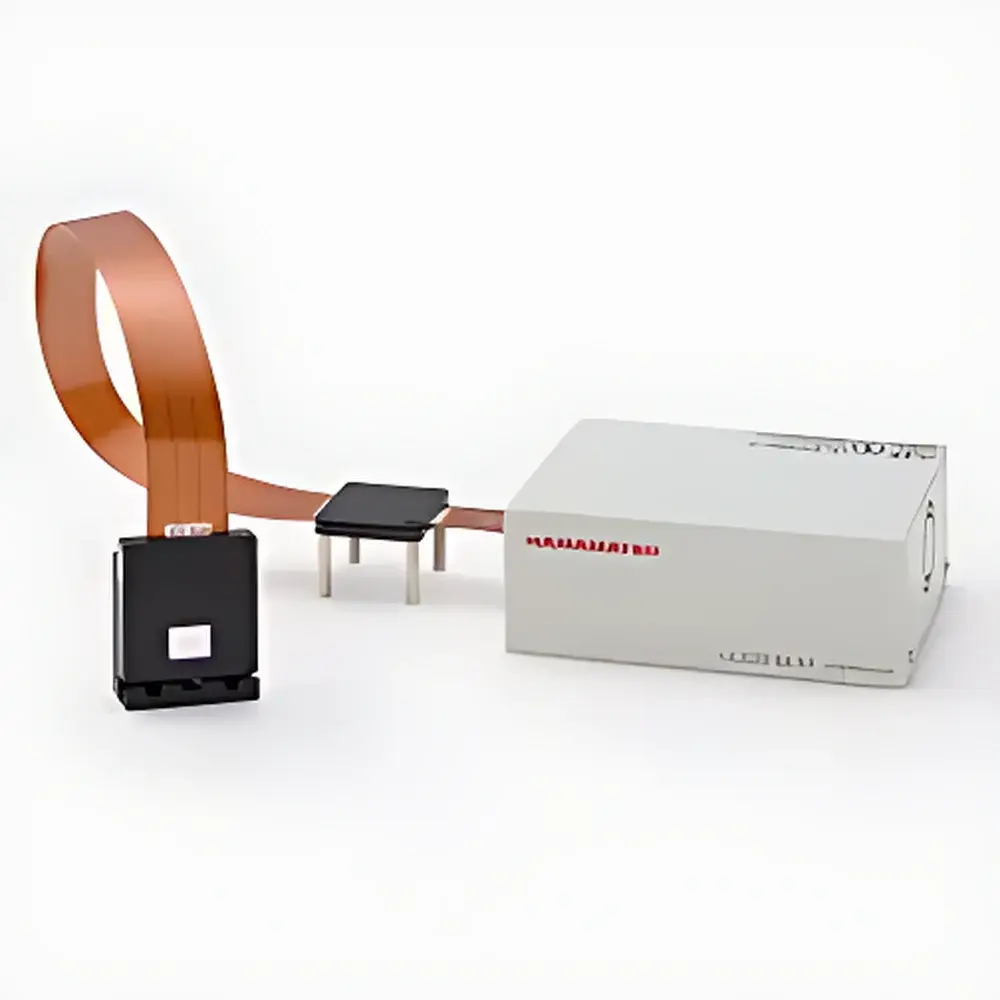
Hamamatsu LCOS-SLM X15213-05 Reflective Pure-Phase Spatial Light Modulator
| Brand | Hamamatsu |
|---|---|
| Origin | Japan |
| Manufacturer Type | Original Equipment Manufacturer (OEM) |
| Import Category | Imported Instrument |
| Model | X15213-05 |
| Pixel Pitch | 12.5 µm |
| Input Interface | DVI-D / USB-B (USB 2.0 High-Speed) |
| DVI Format | SXGA (1280 × 1024) |
| Frame Rate | 60 Hz |
| Gray Levels | 256 (8-bit) |
| Active Pixel Count | 1272 × 1024 |
| Active Area | 15.9 mm × 12.8 mm |
| Maximum Spatial Resolution | 40 lp/mm |
| Fill Factor | 96% |
| Rise Time | 10 ms |
| Fall Time | 20 ms |
| Operating Wavelength | 410 ± 10 nm |
| Optical Efficiency | 97% (measured at λ = 405 nm) |
Overview
The Hamamatsu X15213-05 is a high-performance reflective pure-phase spatial light modulator (SLM) based on silicon-on-silicon liquid crystal on silicon (LCOS) technology. Engineered for precision wavefront control in demanding optical systems, it enables programmable phase modulation of incident light without significant amplitude distortion. Unlike transmissive SLMs, its reflective architecture maximizes optical throughput and thermal stability—critical for high-power UV applications. The device operates within a narrow spectral band centered at 410 nm (±10 nm), making it particularly suited for applications involving 405 nm diode lasers, such as holographic optical trapping, adaptive optics in microscopy, structured illumination, and quantum optics experiments requiring high-fidelity phase encoding. Its monolithic LCOS chip integrates pixelated voltage-controlled liquid crystal layers directly onto a CMOS backplane, enabling fast, localized electric field manipulation and sub-wavelength phase resolution.
Key Features
- Pure-phase modulation with negligible amplitude coupling—optimized for interferometric and coherent optical systems
- 97% optical efficiency at 405 nm, achieved through high fill factor (96%) and anti-reflection coating on the aluminum mirror layer
- SXGA-native resolution (1272 × 1024 active pixels) with 12.5 µm pitch, supporting up to 40 line pairs per millimeter spatial frequency content
- DVI-D interface compatibility ensures plug-and-play integration with standard laboratory PCs; no proprietary frame grabbers or drivers required
- Integrated USB-B (USB 2.0 high-speed) port enables firmware updates, calibration data loading, and real-time parameter adjustment
- Linearized phase response across all 256 gray levels, factory-calibrated to compensate for inherent LC birefringence nonlinearity and wavefront aberrations
- Thermally robust design rated for continuous-wave optical power densities up to 100 mW/cm² at 405 nm—validated under ISO 11146-compliant beam profiling conditions
Sample Compatibility & Compliance
The X15213-05 is designed for integration into optical setups compliant with ISO 10110 (optical element specifications), ISO 11146 (laser beam parameters), and IEC 60825-1 (laser safety). Its reflective geometry supports collimated or slightly convergent input beams with incidence angles up to ±15° relative to normal—enabling compatibility with off-axis holography and multi-beam interference configurations. The device meets RoHS Directive 2011/65/EU and REACH Regulation (EC) No. 1907/2006 for hazardous substance restrictions. While not certified for medical device use under FDA 21 CFR Part 820, its traceable calibration procedures align with GLP principles for research-grade instrumentation. Full optical characterization reports—including measured MTF, phase uniformity maps, and temporal response histograms—are supplied with each unit for audit readiness.
Software & Data Management
Hamamatsu provides the SLM Control Suite v3.x—a cross-platform application (Windows/macOS/Linux) supporting DVI signal generation, phase pattern sequencing, and real-time feedback via USB. The suite exports phase masks in industry-standard formats (TIFF, BMP, HDF5) with embedded metadata (wavelength, pixel scale, gamma correction table). It supports scripting via Python API (PyHamamatsu-SLM), enabling integration into automated workflows governed by ASTM E2500-18 (verification of computerized systems). All phase calibration files are digitally signed and versioned; audit logs record timestamped user actions, pattern uploads, and hardware configuration changes—meeting FDA 21 CFR Part 11 requirements for electronic records and signatures when deployed in regulated environments. Firmware updates preserve backward compatibility with existing pattern libraries and calibration profiles.
Applications
- Holographic optical tweezers (HOT) and dynamic beam shaping for single-cell manipulation
- Adaptive optics correction in widefield and confocal fluorescence microscopes (e.g., compensation of spherical aberration in deep-tissue imaging)
- Computer-generated holography (CGH) for structured illumination microscopy (SIM) and super-resolution techniques
- Quantum optics experiments including spatial mode sorting (e.g., Laguerre-Gaussian mode decomposition) and entangled photon state engineering
- UV laser pulse shaping for coherent control in photochemistry and ultrafast spectroscopy
- Optical testing of aspheric lenses and freeform surfaces using digital shearing interferometry
FAQ
Is the X15213-05 compatible with non-DVI video sources such as HDMI or DisplayPort?
No—only native DVI-D signals are supported. Conversion from HDMI or DisplayPort requires an externally powered, timing-accurate converter that preserves SXGA resolution and 60 Hz frame synchronization; Hamamatsu does not validate third-party converters.
Can the device be used outside its specified 410 ± 10 nm range?
Operation beyond this band results in reduced diffraction efficiency and uncalibrated phase response. For 355 nm or 488 nm applications, Hamamatsu offers alternate models (X15213-03 and X15213-07) with wavelength-optimized coatings.
What is the recommended method for phase calibration verification?
Users should perform interferometric validation using a Mach-Zehnder or Twyman-Green setup with a stabilized 405 nm reference laser; Hamamatsu supplies NIST-traceable phase step calibration targets and uncertainty budgets for ISO/IEC 17025-accredited labs.
Does the unit include mounting hardware for optical breadboard integration?
Yes—the standard package includes a kinematic mount with SM1-threaded (1.035″-40) adapter, six-axis alignment capability, and C-mount-compatible flange for OEM integration.




