
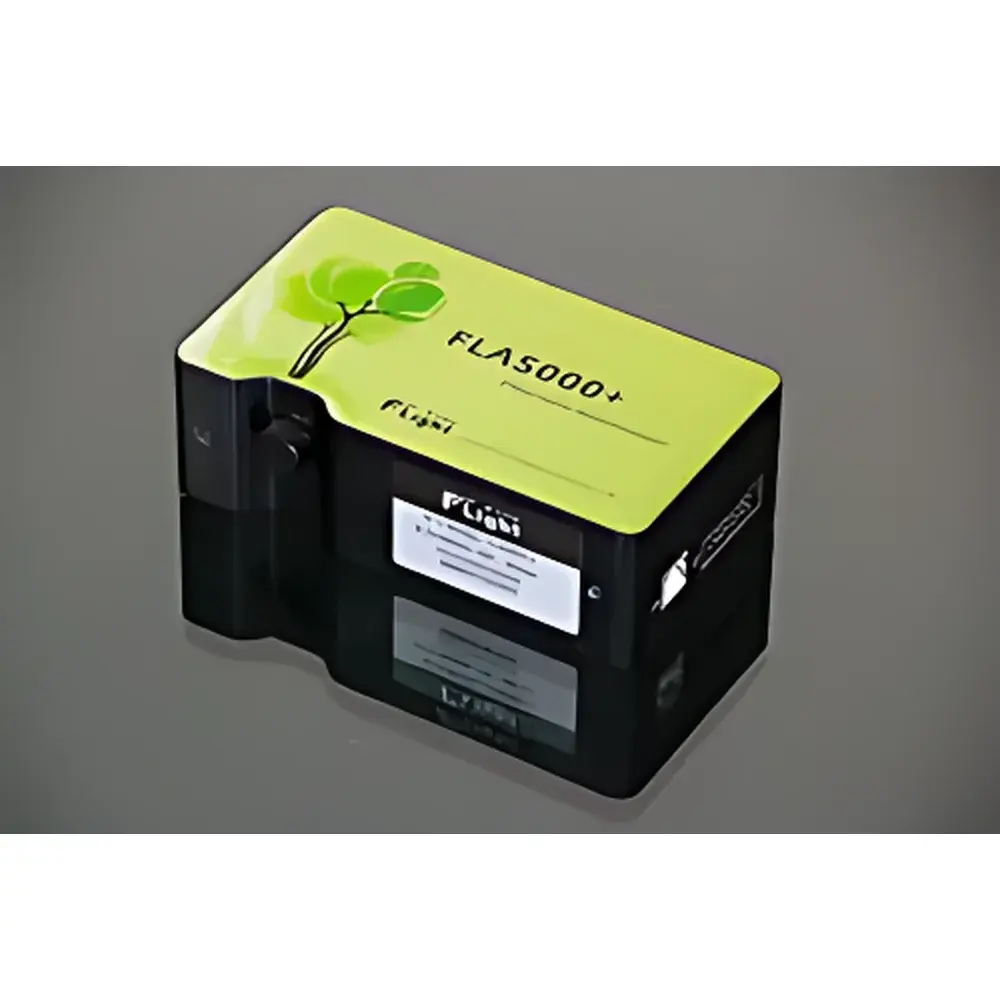
Jingfei FLA5000(VIS) Fiber Optic Spectrometer
| Spectral Range | 350–1100 nm |
|---|---|
| Detector | Hamamatsu CMOS linear array (2048 pixels) |
| Optical Resolution (FWHM) | ≤1.20 nm |
| Stray Light | <0.1% |
| Signal-to-Noise Ratio | 380:1 |
| Dynamic Range | 250,000 |
| Sensitivity | 1300 V/(lx·s) |
| A/D Conversion | 16-bit with auto-zero dark correction |
| Data Buffer | 4K-depth FIFO |
| Interface | USB 2.0, RS232, RS485 |
| Slit Width | 70 µm (standard, optional) |
| Linearity | >99.8% |
| Dimensions | 128 × 72 × 40 mm |
| Weight | 500 g |
Overview
The Jingfei FLA5000(VIS) Fiber Optic Spectrometer is a compact, high-performance benchtop spectrometer engineered for precision visible-to-NIR spectral analysis in laboratory, industrial, and field-deployable environments. Based on the principle of fixed-grating Czerny-Turner optical architecture, it employs a Hamamatsu CMOS linear image sensor (2048 pixels) to deliver stable, reproducible spectral acquisition across a broad 350–1100 nm range. Its miniature form factor (128 × 72 × 40 mm), low mass (500 g), and plug-and-play USB 2.0 connectivity enable seamless integration into modular optical systems—including absorption, reflectance, fluorescence, and emission setups—without requiring external power supplies or cooling hardware. The spectrometer’s optical path is sealed and optimized to minimize thermal drift and mechanical misalignment, supporting long-term measurement stability under ambient conditions. All calibration coefficients—including wavelength, intensity, and nonlinearity corrections—are permanently stored in on-board EEPROM, ensuring traceable, instrument-specific data integrity across software platforms and user sessions.
Key Features
- High-fidelity spectral acquisition with ≤1.20 nm FWHM optical resolution (configurable via grating and slit selection)
- 16-bit analog-to-digital conversion with real-time auto-zero electronic dark current correction, enhancing baseline stability and low-light performance
- 4K-depth FIFO buffer enabling continuous high-speed data streaming without packet loss during extended acquisitions
- Multi-interface support: USB 2.0 (primary), RS232, and RS485 for flexible system integration in automated or embedded applications
- On-device EEPROM storage of factory calibration data, wavelength mapping, and detector linearity tables—ensuring metrological traceability and cross-platform compatibility
- Optimized optical design with stray light suppression <0.1%, critical for quantitative reflectance and low-intensity emission measurements
- Robust mechanical housing with thermal isolation features to maintain spectral fidelity across operating temperatures from 15°C to 35°C
Sample Compatibility & Compliance
The FLA5000(VIS) supports a wide range of sample geometries and measurement modalities through standardized SMA905 fiber-optic coupling. It is routinely deployed in compliance-critical workflows including ASTM E308 (computing colorimetric coordinates), ISO 13655 (spectral measurement of graphic arts materials), and USP (UV-Vis spectroscopic qualification of pharmaceutical excipients). While not intrinsically certified for GMP or FDA 21 CFR Part 11, its deterministic firmware behavior, audit-ready calibration metadata, and software-agnostic data export (ASCII, CSV, binary) facilitate validation under GLP/GMP frameworks when integrated with validated host applications. The device meets CE marking requirements for electromagnetic compatibility (EN 61326-1) and safety (EN 61010-1), and complies with RoHS Directive 2011/65/EU.
Software & Data Management
The spectrometer operates natively with Jingfei’s cross-platform SpectraView SDK (Windows/macOS/Linux), providing full low-level register access, trigger synchronization, and real-time spectrum averaging. Data output includes raw pixel counts, calibrated intensity (counts/nm), and optionally radiometrically corrected values when paired with NIST-traceable calibration lamps. Export formats include UTF-8 CSV (with header metadata), HDF5 (for time-series batch capture), and IEEE 754-compliant binary streams. The SDK supports Python (via ctypes bindings), MATLAB (Instrument Control Toolbox), and LabVIEW (NI-VISA drivers), enabling integration into automated QA/QC pipelines. All acquired spectra retain embedded timestamps, instrument serial number, and calibration version—supporting ALCOA+ data integrity principles in regulated environments.
Applications
- Color measurement and spectral matching in paint, textile, and display manufacturing
- In-line process monitoring of LED phosphor emission profiles and solar cell quantum efficiency
- Quantitative absorbance analysis in water quality testing (e.g., nitrate, chlorophyll-a)
- Fluorescence lifetime precursor characterization via steady-state spectral deconvolution
- Reflectance spectroscopy for agricultural crop health assessment (NDVI, PRI indices)
- Educational labs requiring rugged, entry-level spectrometers with full spectral transparency and open API access
FAQ
Is the FLA5000(VIS) suitable for UV-range measurements below 350 nm?
No—the FLA5000(VIS) is optimized for 350–1100 nm; for UV-enhanced response (200–400 nm), a quartz-window variant with UV-grade optics and back-thinned CCD is required.
Can the resolution be improved beyond 1.20 nm FWHM?
Resolution is determined by grating groove density and entrance slit width; 1.20 nm represents the maximum achievable with the standard 70 µm slit and included grating—narrower slits or higher-density gratings reduce throughput and SNR.
Does the device support external triggering for time-resolved measurements?
Yes—TTL-compatible trigger input (rising-edge) is provided via the RS232/RS485 expansion header, enabling synchronization with pulsed light sources or mechanical shutters.
How is wavelength calibration maintained over temperature fluctuations?
The onboard thermistor monitors sensor temperature, and the calibration model applies second-order polynomial correction to wavelength coefficients—validated across ±5°C ambient shifts.
Is spectral data export compatible with third-party chemometrics software?
Yes—CSV exports include full wavelength axis, intensity vector, and metadata headers, supporting direct import into Unscrambler, Pirouette, or R packages such as hyperSpec and ChemoSpec.





