
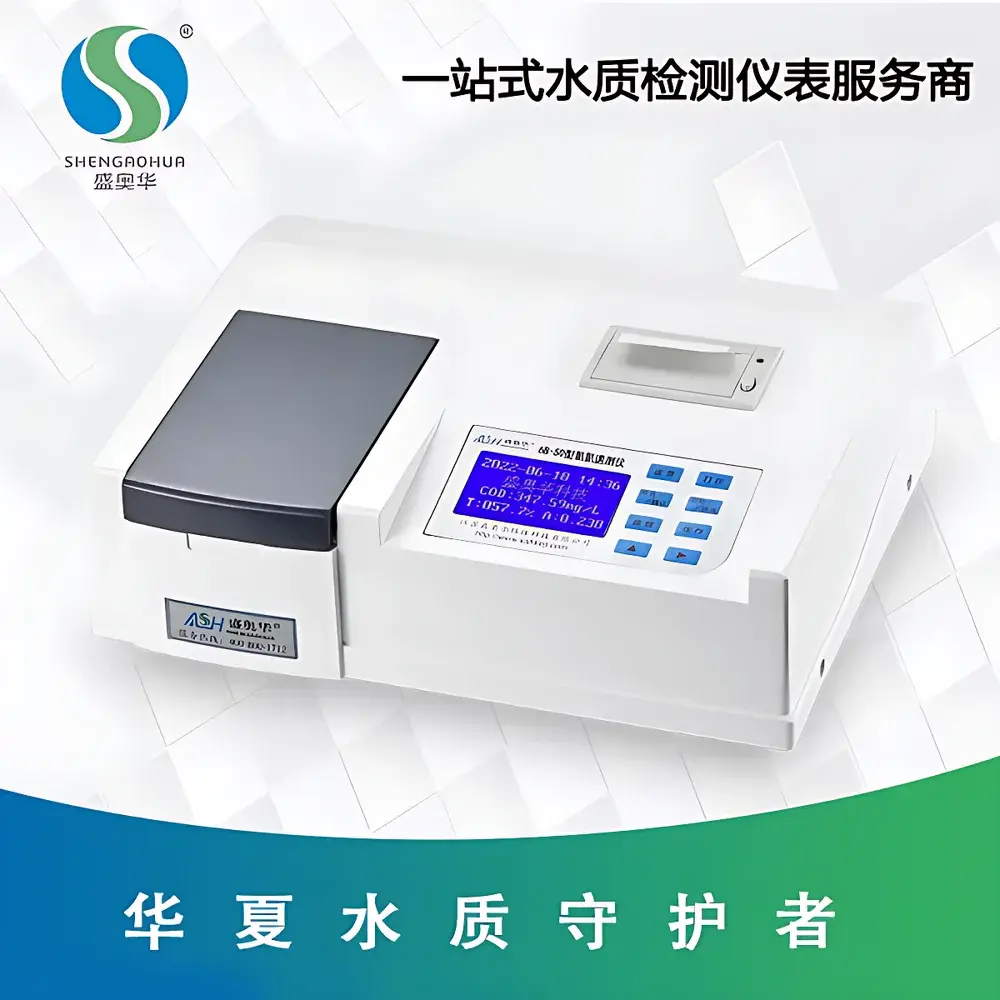
Shengaohua 6B-50 Ammonia Nitrogen Rapid Analyzer
| Brand | Shengaohua |
|---|---|
| Origin | Jiangsu, China |
| Manufacturer Type | Direct Manufacturer |
| Instrument Type | Laboratory Benchtop Analyzer |
| Measurement Principle | Colorimetric Method (Nesslerization or Salicylate, per standard compliance) |
| Measurement Range | 0.01–100 mg/L NH₃–N |
| Accuracy | ≤ ±5% of reading |
| Detection Limit | 0.01 mg/L |
| Measurement Time | 15–20 min per batch |
| Batch Capacity | 12 samples |
| Repeatability | ±5% |
| Photometric Stability | ≤ 0.001 A/10 min |
| Operating Temperature | 5–40 °C |
| Relative Humidity | <85% RH (non-condensing) |
| Preloaded Calibration Curves | 4 factory-standard + 96 user-definable |
| Total Curve Storage | 100 curves |
| Data Memory | 2000 measurement records |
| Display | Full Chinese LCD interface |
| Power Supply | AC 220 V ±10%, 50 Hz |
| Dimensions | 330 × 260 × 120 mm |
Overview
The Shengaohua 6B-50 Ammonia Nitrogen Rapid Analyzer is a dedicated benchtop photometric instrument engineered for precise, routine quantification of ammonia nitrogen (NH₃–N) in aqueous environmental and industrial samples. It operates on the internationally recognized colorimetric principle—specifically optimized for either Nesslerization (for higher-range samples) or the salicylate-hypochlorite method (for enhanced sensitivity and reduced interference)—ensuring compatibility with ASTM D1426, ISO 7150-1, and HJ 535–2009 (Chinese EPA standard). Designed for laboratory-based water quality analysis, the 6B-50 delivers direct concentration readouts without manual calculation, minimizing operator dependency and analytical variability. Its optical architecture incorporates a stable tungsten-halogen light source, precision interference filters, and a silicon photodiode detector, collectively ensuring high photometric reproducibility and long-term baseline stability (≤0.001 A/10 min). The analyzer supports both regulatory compliance workflows and method development environments, serving as a core tool in wastewater treatment monitoring, drinking water safety verification, and effluent discharge reporting.
Key Features
- Integrated dual-mode calibration system: supports both standard solution-based curve generation and slope-intercept validation using certified reference materials
- Expandable curve library: stores up to 100 calibration curves—including 4 pre-validated factory curves and 96 user-editable entries—with automatic curve selection based on sample dilution factor
- High-throughput batch processing: accommodates 12 samples simultaneously in standardized 10–25 mL cuvettes, reducing turnaround time to 15–20 minutes per run
- Robust data governance: retains 2000 timestamped measurement records locally, each tagged with operator ID, curve ID, date/time, and raw absorbance values
- Full Chinese LCD interface with intuitive menu navigation, real-time status indicators, and on-screen error diagnostics
- Compliance-ready design: meets electrical safety requirements per GB 4793.1 (equivalent to IEC 61010-1), and supports audit-trail-capable operation when paired with external LIMS via RS232 output
Sample Compatibility & Compliance
The 6B-50 is validated for use with clarified, filtered, or centrifuged liquid samples from municipal wastewater, surface water, groundwater, industrial process streams, and pretreated effluents. It accommodates common interferences through built-in correction protocols—for example, turbidity compensation via dual-wavelength measurement (optional accessory), and masking agents for heavy metal interference (e.g., EDTA addition per ASTM D1426). The instrument conforms to key regulatory frameworks governing environmental laboratories: it supports GLP-compliant documentation practices, enables traceable calibration verification per ISO/IEC 17025:2017 Clause 7.7, and facilitates method validation in accordance with US EPA Method 350.1 and ISO 14911. While not FDA 21 CFR Part 11–certified out-of-the-box, its data export functionality (CSV via USB or RS232) permits integration into validated electronic lab notebook (ELN) or LIMS platforms requiring electronic signature and change control.
Software & Data Management
Data handling is performed entirely onboard, with no proprietary software dependency. All measurements are stored with metadata including measurement ID, curve identifier, dilution factor, raw absorbance at peak wavelength (typically 420 nm or 655 nm depending on chemistry), and calculated NH₃–N concentration (mg/L). Historical datasets can be printed directly via integrated thermal printer (standard) or exported in comma-separated format for post-processing in Excel, R, or Python-based QA/QC pipelines. Firmware supports field-upgradable calibration parameters and curve coefficients via secure USB flash drive—enabling remote method updates without service dispatch. Audit logs record all critical events: curve modifications, zero-point adjustments, firmware version changes, and power-cycle timestamps—supporting internal quality audits and accreditation reviews.
Applications
- Wastewater treatment plant (WWTP) operators performing daily influent/effluent ammonia monitoring per discharge permit limits
- Environmental testing labs conducting accredited analyses for ISO 17025 scope expansion in nutrient parameter testing
- Industrial QC departments in pulp & paper, food & beverage (e.g., dairy, brewing), and pharmaceutical manufacturing verifying process water quality
- Academic and research institutions implementing standardized water chemistry curricula and student-led method validation exercises
- Municipal drinking water utilities performing source water screening and distribution system integrity checks
FAQ
What ammonia nitrogen measurement methods does the 6B-50 support?
It is configured for two primary colorimetric chemistries: the Nessler reagent method (for 0.2–100 mg/L range) and the salicylate-hypochlorite method (for 0.01–5 mg/L range), both aligned with international standard test procedures.
Can the instrument be used for field deployment?
No—it is a laboratory-grade benchtop unit requiring stable AC power, controlled ambient temperature (5–40 °C), and minimal vibration; portable variants are not available in this series.
Is third-party calibration verification supported?
Yes. The device accepts NIST-traceable ammonia standards (e.g., Sigma-Aldrich CRM 82003) for independent accuracy verification, and stores calibration verification results alongside routine measurements.
How is data integrity ensured during power interruption?
All measurement records and calibration curves are stored in non-volatile flash memory; no data loss occurs during unexpected shutdowns.
Does the 6B-50 comply with ISO/IEC 17025 documentation requirements?
It provides the foundational data elements required for method validation and uncertainty estimation—absorbance repeatability, curve linearity (R² ≥ 0.999), detection limit confirmation, and intermediate precision metrics—enabling labs to complete their own ISO/IEC 17025 technical records.







