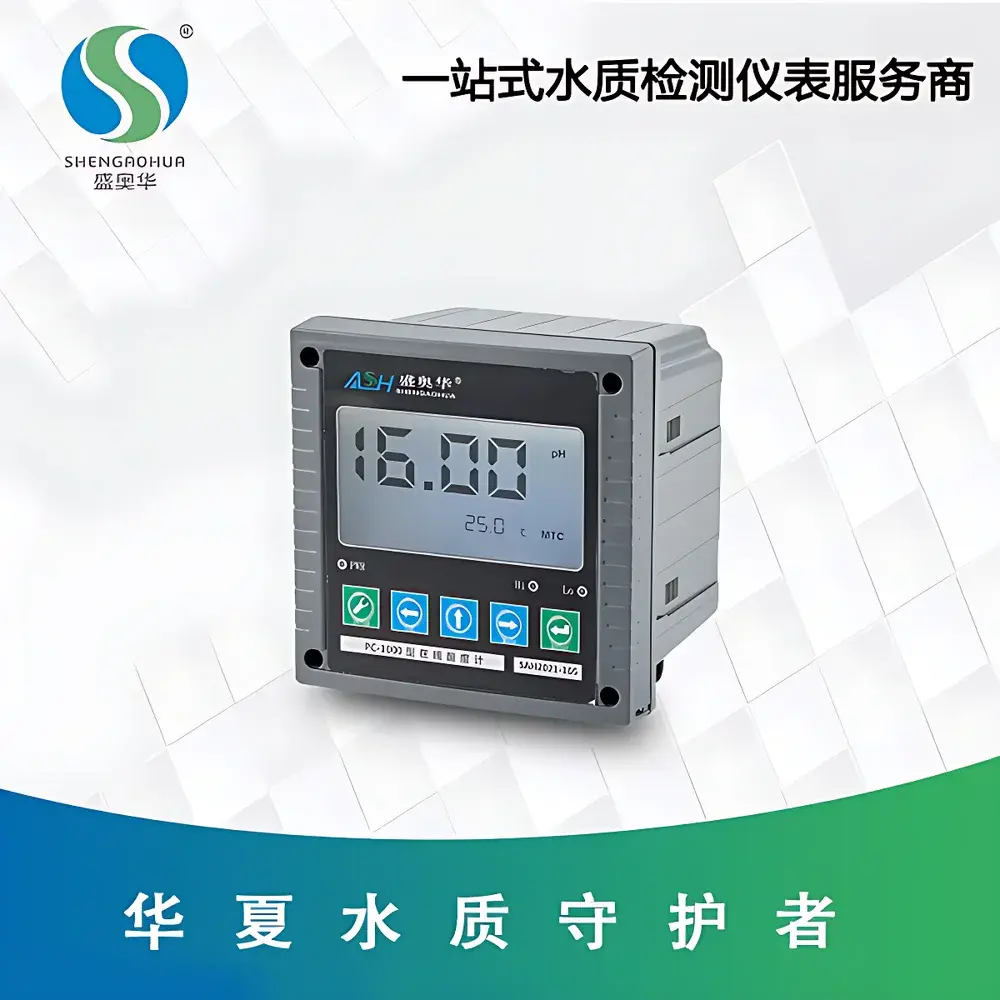
Shengaohua PC-1000 Online pH/ORP/Temp Transmitter
| Brand | Shengaohua |
|---|---|
| Origin | Jiangsu, China |
| Manufacturer Type | Direct Manufacturer |
| Model | PC-1000 |
| Measurement Range | pH 0–14, ORP −1999 to +1999 mV, Temp 0–60 °C |
| Resolution | 0.01 pH, 1 mV, 0.1 °C |
| Accuracy | ±0.01 pH ±1 digit, ±0.1% ORP ±1 digit, ±0.2 °C ±1 digit |
| Temperature Compensation | NTC 30 kΩ / PT1000 (auto & manual) |
| Calibration | 3-point pH calibration |
| Input Impedance | >10¹² Ω |
| Display | 4.3-inch LCD |
| Output 1 | Isolated 4–20 mA (configurable for pH/ORP, load ≤600 Ω) |
| Output 2 | Isolated 4–20 mA (configurable for temperature, load ≤600 Ω) |
| Relay Outputs | 2 × SPDT, 240 VAC / 0.5 A max (HI/LO alarm + cleaning timer: ON 0–99:59 min, OFF 0–999:59 h) |
| Voltage Output | DC ±12 V / 1 W max |
| Power Supply | 220 VAC |
| Mounting Options | Wall-mount, pipe-mount, panel-mount |
| Cutout Size | 90 × 90 mm |
| Dimensions | 110 × 95 × 95 mm |
| Weight | 1.5 kg |
Overview
The Shengaohua PC-1000 Online pH/ORP/Temp Transmitter is an industrial-grade, multi-parameter process analyzer engineered for continuous, real-time monitoring of aqueous solutions in demanding production environments. Utilizing high-impedance potentiometric measurement principles compliant with IEC 60746-1 and ISO 10523 standards, the instrument delivers stable, drift-resistant pH readings across the full 0–14 pH range. Its dual-channel isolated 4–20 mA analog outputs support independent scaling for pH/ORP and temperature signals—enabling seamless integration into DCS, PLC, or SCADA systems without signal interference. The built-in NTC 30 kΩ or PT1000 temperature sensor interface provides automatic or manual temperature compensation, ensuring accurate pH values under dynamic thermal conditions common in wastewater treatment, chemical dosing, boiler feedwater control, and food & beverage processing lines.
Key Features
- Triple-parameter capability: Simultaneous pH, ORP (oxidation-reduction potential), and temperature measurement with dedicated resolution and accuracy specifications per parameter
- High-input-impedance amplifier (>10¹² Ω) minimizes electrode loading effects and extends glass electrode service life
- Three-point pH calibration with user-defined buffer recognition (e.g., pH 4.01, 7.00, 10.01) and slope/offset diagnostics for traceable verification
- Dual isolated 4–20 mA outputs—each independently configurable for any measured parameter, with selectable linear or square-root scaling
- Two programmable SPDT relay outputs supporting discrete control logic: one for process alarms (HI/LO thresholds), the other for automated electrode cleaning cycles (ON time: 0–99:59 min; OFF time: up to 999:59 h)
- 4.3-inch backlit LCD with intuitive icon-based navigation and real-time trend display for all active parameters
- Flexible mounting architecture: compatible with wall, pipe, and panel installation; standard 90 × 90 mm cutout simplifies retrofitting into existing control panels
- Robust enclosure rated for operation in ambient temperatures from −5 °C to +45 °C and relative humidity up to 85% non-condensing
Sample Compatibility & Compliance
The PC-1000 is designed for use with standard combination pH electrodes (e.g., gel-filled, refillable, or solid-state sensors) and ORP electrodes meeting DIN 19263 and ASTM D1293 requirements. It supports both NTC 30 kΩ and PT1000 temperature probes, enabling compliance with regional calibration infrastructure. While not certified to SIL or ATEX standards out-of-the-box, its electrical isolation, relay ratings (240 VAC / 0.5 A), and CE-marked power supply meet general-purpose industrial safety expectations per IEC 61000-6-2 (EMC immunity) and IEC 61000-6-4 (EMC emissions). Data logging and audit trail functionality are dependent on external SCADA or historian systems; the unit itself maintains no internal storage but provides timestamp-synchronized analog and relay status outputs suitable for GLP-aligned process validation protocols.
Software & Data Management
The PC-1000 operates as a standalone transmitter with no embedded firmware update capability or native Ethernet/Wi-Fi connectivity. Remote data access—including live pH/ORP/temperature values, relay states, and calibration logs—is achieved via its analog outputs interfaced with third-party HMI platforms or cloud-connected gateways (e.g., MQTT-enabled edge devices). For regulatory environments requiring electronic record integrity, the instrument’s 4–20 mA outputs may be connected to FDA 21 CFR Part 11-compliant data acquisition systems that enforce user authentication, audit trails, and electronic signatures. Configuration is performed locally via front-panel keypad; no proprietary software or driver installation is required.
Applications
- Continuous pH monitoring in municipal and industrial wastewater neutralization basins
- ORP-controlled chlorine dosing in potable water disinfection systems
- pH stabilization in pharmaceutical clean-in-place (CIP) rinse cycles
- Real-time acidity tracking during dairy fermentation or juice pasteurization
- Boiler feedwater alkalinity control to prevent corrosion and scale formation
- Chemical blending tanks where precise acid/base addition depends on feedback from stable pH measurement
FAQ
Does the PC-1000 support digital communication protocols such as Modbus RTU or HART?
No—the device provides only analog (4–20 mA) and relay-based I/O. Digital protocol support requires external protocol converters or gateway hardware.
Can the temperature compensation be disabled for specialized applications?
Yes. Manual temperature compensation mode allows fixed reference temperature entry, and auto-compensation can be deactivated entirely via menu settings.
What electrode types are recommended for long-term immersion in abrasive or high-TDS effluents?
For such conditions, Shengaohua recommends ruggedized epoxy-body combination electrodes with double-junction reference systems and ceramic junctions—compatible with the PC-1000’s high-impedance input stage.
Is the unit suitable for hazardous area installations?
Not without additional certification. The PC-1000 is intended for general-purpose industrial zones (non-classified locations). Explosion-proof enclosures or intrinsically safe barriers must be supplied externally if used near flammable vapors.
How often should calibration be performed in continuous operation?
Calibration frequency depends on process stability and electrode aging. Typical practice ranges from daily (critical pharmaceutical batches) to weekly (municipal wastewater); the unit stores last-calibration date and slope value for quality documentation purposes.
Related Products