
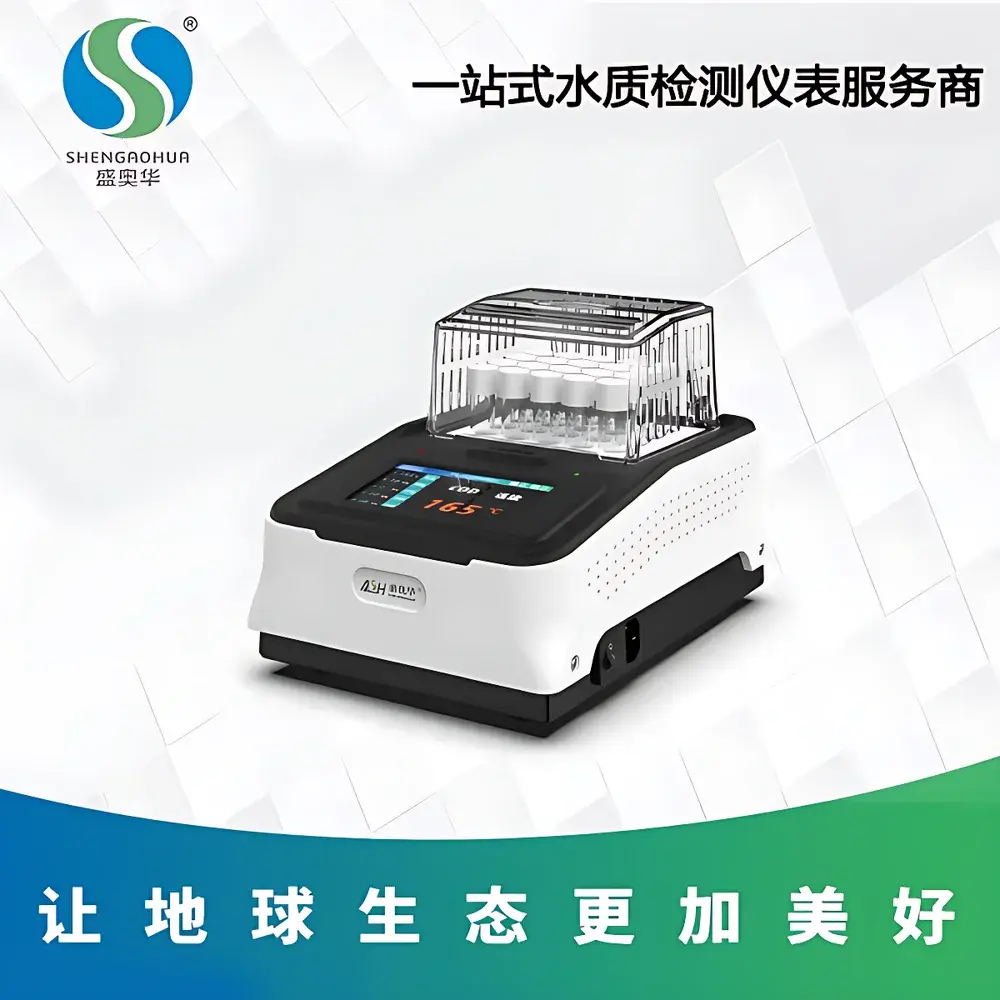
Shengaohua SH-20A Intelligent COD Digestion Analyzer (20-Position)
| Brand | Shengaohua |
|---|---|
| Origin | Jiangsu, China |
| Manufacturer Type | Direct Manufacturer |
| Country of Origin | China |
| Model | SH-20A |
| Digestion Method | Rapid Digestion |
| Heating Module | Single Aluminum Block Heater |
| Batch Capacity | 20 samples |
| Temperature Range | Ambient to 185 °C |
| Temperature Accuracy | ±0.5 °C |
| Digestion Vessel Capacity | 20 × 16 mm tubes |
| Timer Accuracy | ±0.1 s |
| Display | 5-inch IPS Touchscreen |
| Preloaded Temperature Curves | 7 standard |
| Customizable Curves | 11 user-defined |
| Heating Rate | ≤10 min to setpoint |
| Power Supply | AC 220 V ±20% |
| Rated Power | 400 W |
| Net Weight | 2.7 kg |
| Housing Material | Imported high-transparency PP engineering plastic |
| Safety Features | Overvoltage/surge protection, magnetic lid interlock, airflow-optimized thermal management |
| Operating Modes | Continuous or discontinuous heating |
| Alarm Options | 10 s, 60 s, or continuous audible alert |
Overview
The Shengaohua SH-20A Intelligent COD Digestion Analyzer is a precision-engineered 20-position rapid digestion system designed for standardized chemical oxygen demand (COD) determination in accordance with ISO 6060, EPA Method 410.4, and HJ 828–2017 (China’s national standard for COD analysis). It operates on the principle of closed-tube, acid-dichromate oxidation under controlled thermal conditions—where water samples are digested with potassium dichromate (K₂Cr₂O₇) and concentrated sulfuric acid (H₂SO₄) at elevated temperatures (up to 185 °C) to oxidize organic matter quantitatively. The SH-20A employs a single high-thermal-conductivity aluminum heating block with adaptive power modulation, ensuring uniform temperature distribution across all 20 sample positions and minimizing inter-vial thermal deviation. Its integrated thermal architecture—featuring air-guided convection channels and directional heat dissipation paths—enhances long-term operational stability and extends component service life, especially during extended batch runs typical in environmental laboratories and third-party testing facilities.
Key Features
- 5-inch IPS high-resolution capacitive touchscreen with intuitive icon-driven interface and multilingual menu support (English default)
- Dual-mode heating control: selectable continuous or discontinuous (pulse-width modulated) operation to reduce energy consumption without compromising digestion reproducibility
- 18 preconfigured thermal profiles: 7 factory-calibrated curves aligned with common regulatory methods (e.g., 150 °C/120 min for standard COD, 165 °C/30 min for fast digestion), plus 11 fully editable user-defined protocols with independent ramp-hold-step programming
- Real-time temperature and countdown display with visual breathing LED indicator for status awareness during active digestion cycles
- Intelligent load-sensing power regulation: dynamically adjusts heating output based on actual number of loaded vials to maintain ±0.5 °C accuracy and minimize thermal overshoot
- Robust safety architecture including overvoltage/surge suppression circuitry, magnetic lid interlock switch, and thermally isolated internal routing to protect electronics from corrosive fumes
- Modular PP housing engineered for chemical resistance, impact resilience, and optimal airflow—certified compliant with IEC 61010-1 for laboratory electrical safety
Sample Compatibility & Compliance
The SH-20A accommodates standard 16 mm OD digestion tubes (e.g., borosilicate glass or quartz) used in spectrophotometric COD assays. Its uniform heating block geometry ensures consistent thermal transfer regardless of tube fill volume (1–5 mL range). The instrument meets functional requirements for GLP-compliant workflows: all temperature/time settings are digitally recorded with timestamping; parameter changes generate audit-trail entries accessible via USB export. While not inherently 21 CFR Part 11 compliant (lacking electronic signature modules), it supports traceable manual documentation practices required under ISO/IEC 17025 and CNAS accreditation frameworks. All materials contacting ambient air or heat zones conform to RoHS Directive 2011/65/EU restrictions on hazardous substances.
Software & Data Management
No proprietary PC software is bundled; however, the SH-20A provides full USB-A port functionality for firmware updates and parameter backup/restore. All digestion protocols—including custom curve definitions, setpoints, dwell times, and alarm configurations—are stored non-volatile memory with battery-backed retention (>10 years). Time-stamped run logs (date, start/end time, target temp, actual avg. temp, cycle duration) can be exported as CSV files for integration into LIMS or QA/QC reporting systems. Optional RS-232 serial output (via adapter) enables basic remote monitoring in centralized lab environments.
Applications
This analyzer serves routine and high-throughput COD testing across municipal wastewater treatment plants, industrial effluent monitoring stations, environmental consultancies, university research labs, and accredited third-party testing organizations. Its versatility supports diverse matrices: domestic sewage, electroplating rinse waters, textile dye baths, pharmaceutical process streams, aquaculture pond inflows, and pulp/paper mill discharges. The broad temperature range (ambient to 185 °C) also permits adaptation to alternative oxidation protocols—for example, total phosphorus (TP) or total nitrogen (TN) digestion per ISO 11908 and ISO 11909—when paired with appropriate reagent kits and post-digestion analysis instrumentation.
FAQ
What is the maximum recommended operating temperature for routine COD digestion?
The standard digestion protocol operates at 150 °C for 120 minutes, but the SH-20A is rated for continuous use up to 185 °C—suitable for accelerated methods requiring higher thermal energy input.
Does the instrument support external data logging or network connectivity?
It features USB-A for local file transfer and firmware updates; Ethernet or Wi-Fi interfaces are not supported. Integration with SCADA or LIMS requires intermediate hardware gateways.
How is temperature uniformity verified across all 20 positions?
Shengaohua performs block homogeneity validation using NIST-traceable PT100 probes at 5 representative locations (center + four quadrants) prior to shipment; typical deviation is ≤±0.3 °C at 150 °C steady state.
Can the SH-20A be used for chloride interference correction protocols?
Yes—its programmable ramp-and-hold capability allows implementation of two-stage digestion (e.g., low-temp pre-digestion followed by high-temp main oxidation), compatible with mercury-free chloride compensation methods per ASTM D1252.
What maintenance is required to sustain calibration integrity?
Annual verification of temperature sensor drift using a calibrated reference thermometer is recommended; no routine recalibration is needed unless physical damage or performance deviation exceeds ±0.5 °C tolerance.
Related Products







