
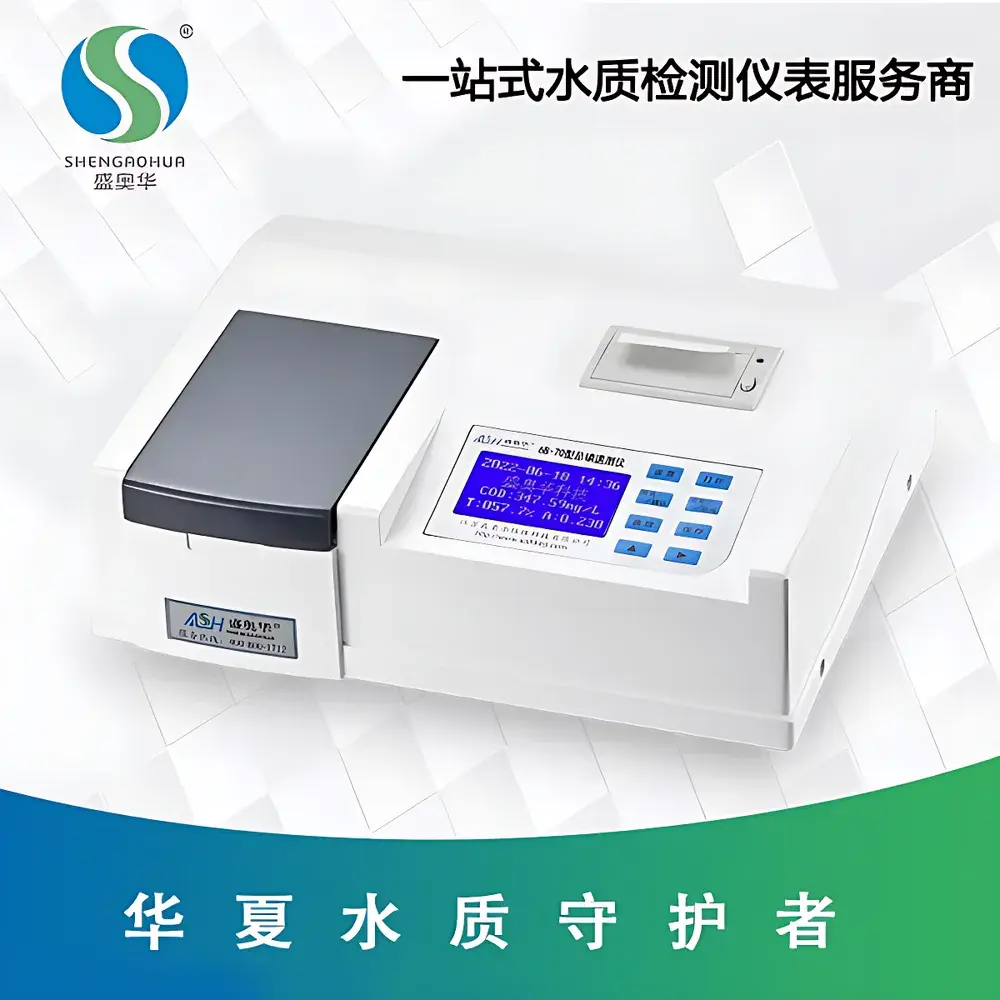
Shengaohua 6B-70 Total Phosphorus Analyzer
| Brand | Shengaohua |
|---|---|
| Origin | Jiangsu, China |
| Manufacturer Type | Direct Manufacturer |
| Product Category | Domestic Instrument |
| Model | 6B-70 |
| Application | Laboratory-Based Water Quality Analysis |
| Measurement Principle | Spectrophotometry (Molybdenum Blue Method) |
| Measuring Range | 0.01–20 mg/L (selectable calibration curves) |
| Accuracy | ≤ ±5% |
| Detection Limit | 0.01 mg/L |
| Resolution | 0.001 mg/L |
| Photometric Stability | ≤ 0.001 A/10 min |
| Repeatability | ±3% |
| Temperature Control Accuracy | ±0.5 °C at 123 °C |
| Digestion Time Accuracy | ≤ ±2% |
| Operating Ambient | 5–40 °C, RH <85% (non-condensing) |
| Sample Capacity | Configurable options — 9 / 12 / 16 / 20 / 25 / 30 positions |
| Built-in Curves | 4 factory-calibrated standard curves + 96 user-definable curves |
| Display | Backlit Chinese LCD |
| Power Supply | AC 220 V ±10%, 50 Hz |
| Dimensions | 330 × 260 × 120 mm |
Overview
The Shengaohua 6B-70 Total Phosphorus Analyzer is a dedicated laboratory-grade spectrophotometric instrument engineered for precise quantification of total phosphorus (TP) in aqueous environmental samples. It implements the standardized molybdenum blue colorimetric method (ISO 6878:2004, APHA 4500-P E, and EPA Method 365.1), wherein orthophosphate—liberated from all phosphorus species via high-temperature acid digestion—is reacted with ammonium molybdate and antimony potassium tartrate under acidic conditions, followed by reduction to form a phosphomolybdenum blue complex. Absorbance is measured at 700 nm using a narrow-band interference filter and cold LED light source (rated lifetime ≥100,000 hours), ensuring long-term photometric stability and minimal spectral drift. The system integrates digestion and measurement into a single workflow: samples undergo automated thermal digestion at 123 ± 0.5 °C for 30 minutes, then proceed directly to optical analysis. Designed for compliance-driven laboratories, the 6B-70 supports traceable calibration, curve validation, and manual or semi-automated data recording—making it suitable for routine monitoring in wastewater treatment plants, municipal environmental labs, and industrial effluent QA/QC.
Key Features
- Cold LED light source with narrow-band interference optics (700 nm), delivering superior photometric stability (≤0.001 A/10 min) and eliminating lamp replacement cycles
- Integrated dual-function module: programmable digital temperature controller (123 ± 0.5 °C) with independent timer systems for digestion and measurement stages
- Backlit Chinese-language LCD interface enabling direct concentration readout (mg/L), real-time temperature/time display, and intuitive menu navigation
- Pre-loaded calibration architecture: 4 factory-verified standard curves compliant with national and international TP protocols; additional 96 slots for user-defined curve storage with slope/intercept logging
- Modular sample rack design supporting flexible capacity configurations (9, 12, 16, 20, 25, or 30 positions) to accommodate varying throughput demands
- Corrosion-resistant transparent protective cover engineered from chemically inert polymer, rated for prolonged exposure to H2SO4/HNO3-based digestants
- Self-diagnostic firmware with error-code reporting for temperature deviation, timing fault, or photometric saturation events
Sample Compatibility & Compliance
The 6B-70 accepts liquid samples within pH 2–12 and turbidity ≤50 NTU (pre-filtration recommended for suspended solids >20 mg/L). It is validated for use with domestic wastewater, surface water, groundwater, industrial effluents (e.g., textile dye baths, pulp & paper process streams, pharmaceutical rinse waters), and digested sludge supernatants. All digestion and analysis procedures align with ISO 6878:2004 (Water quality — Determination of phosphorus — Ammonium molybdate spectrophotometric method), GB/T 11893–1989 (Chinese national standard for total phosphorus), and ASTM D515-88 (Standard Test Method for Phosphorus in Water). While not 21 CFR Part 11–certified out-of-the-box, audit trails can be maintained manually via printed reports or exported CSV logs; optional RS232/USB output enables integration with LIMS for GLP/GMP-aligned data handling.
Software & Data Management
The analyzer operates via embedded firmware with no external PC dependency. Calibration curves are stored in non-volatile memory with timestamped versioning. Users may import reference standards to recalibrate slopes or offset intercepts—each modification is logged with operator ID (numeric input), date, and curve ID. Measurement results include sample ID (user-entered), digestion temperature/time, absorbance value, calculated concentration, and pass/fail flag against method-defined repeatability thresholds (±3%). Data export is supported via serial interface (RS232) or USB flash drive (FAT32 formatted), generating comma-separated files compatible with Excel, LabArchives, or Empower. No proprietary software installation is required; raw data retains full traceability to instrument serial number and firmware revision.
Applications
- Routine compliance testing of discharge permits (e.g., China’s GB 8978–1996, EU Urban Wastewater Treatment Directive)
- Process control in biological nutrient removal (BNR) systems, including A²/O and MBR configurations
- Research on phosphorus speciation kinetics during advanced oxidation or coagulation-flocculation trials
- QA/QC verification of phosphate-based cleaning agents in food & beverage manufacturing
- Field-deployable lab support for river basin monitoring networks requiring rapid turnaround (<50 min/sample)
- Educational use in university environmental engineering labs for method validation exercises
FAQ
What digestion reagents are required for the 6B-70?
Potassium persulfate (K₂S₂O₈) and sulfuric acid (H₂SO₄) are used for oxidative digestion per ISO 6878. Pre-mixed reagent tablets are available from Shengaohua as consumables.
Can the instrument measure orthophosphate without digestion?
Yes—by bypassing the heating module and selecting the “Direct PO₄³⁻” mode, the 6B-70 functions as an orthophosphate analyzer with identical optical performance.
Is third-party calibration verification supported?
The device accepts NIST-traceable phosphate standards (e.g., SRM 3188) for independent accuracy validation; certificate of analysis must accompany each standard batch.
How is temperature uniformity across the digestion block ensured?
The aluminum heating block incorporates dual platinum resistance thermometers (PT100) and PID feedback control, maintaining ±0.5 °C zone-to-zone variance across all positions.
What maintenance intervals are recommended?
Optical path cleaning every 200 measurements; digestion chamber descaling with 10% citric acid solution every 500 cycles; annual verification of temperature and photometric calibration using certified reference materials.
Related Products







