
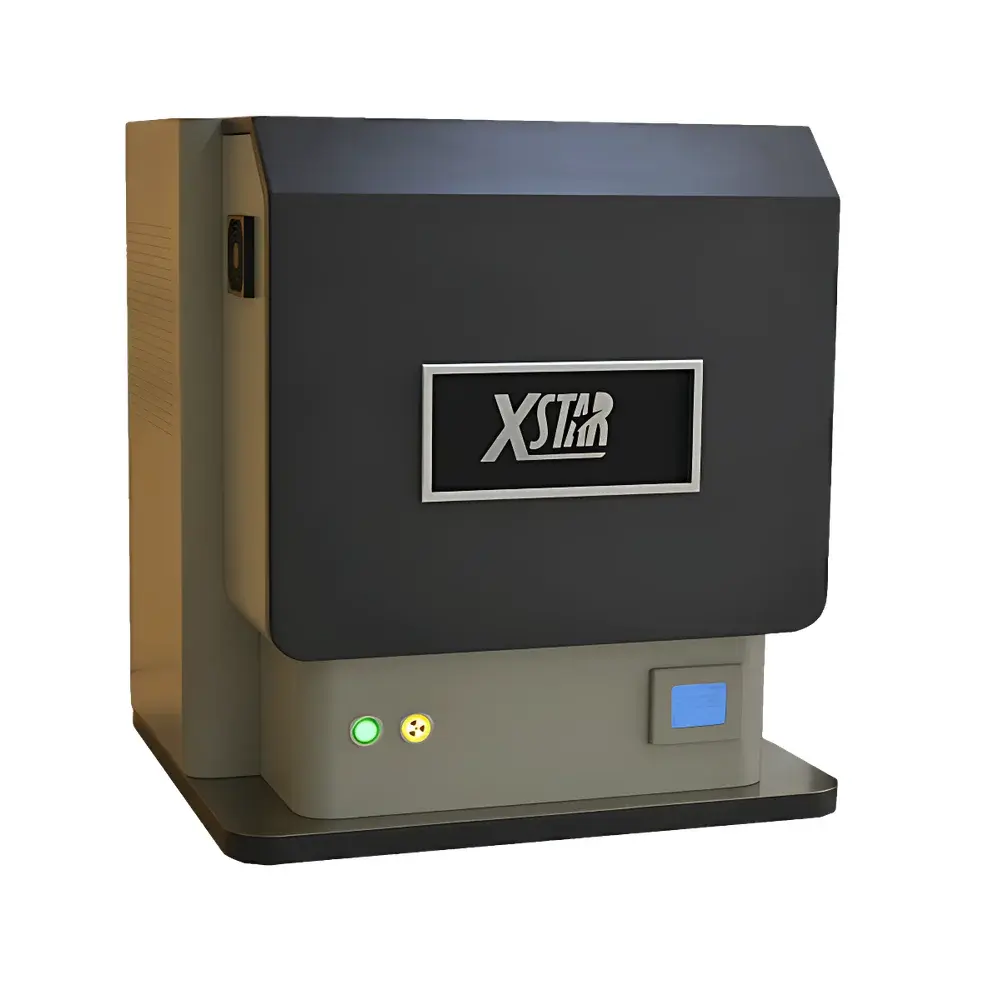
Xinxianda CIT-3000SMQ Cement Multi-Element Energy Dispersive X-Ray Fluorescence Spectrometer
| Brand | Xinxianda |
|---|---|
| Origin | Sichuan, China |
| Model | CIT-3000SMQ |
| Element Range | Na (11)–U (92) |
| Concentration Range | 1 ppm – 99.99% |
| Energy Resolution | ≤125 eV (Mn Kα) |
| Repeatability | ≤0.1% RSD |
| Operating Voltage | 0–25 kV |
| Tube Current | 1–1000 µA |
| Measurement Time | 60–120 s per sample |
| Vacuum Capability | Yes |
| Detector | Peltier-cooled Si-PIN semiconductor |
| Energy Range | 1–30 keV |
| Simultaneous Elements | Up to 9 |
| Sample Mass | 10–15 g |
| Radiation Dose Rate | <25 µSv/h |
| Ambient Temp. | 10–35 °C |
| Humidity | 30–70% RH |
| Power Supply | AC 220 V ±10%, 50/60 Hz |
Overview
The Xinxianda CIT-3000SMQ is a benchtop energy dispersive X-ray fluorescence (EDXRF) spectrometer engineered specifically for comprehensive elemental analysis in cement manufacturing and raw material quality control. Based on the physical principle of X-ray fluorescence—where primary X-rays excite atoms in a solid sample, causing emission of characteristic secondary X-rays—the instrument quantifies elemental composition by measuring the energy and intensity of these emitted photons. Unlike wavelength-dispersive systems, EDXRF enables rapid, simultaneous multi-element detection without mechanical scanning, making it ideal for high-throughput routine analysis in industrial QA/QC laboratories. The CIT-3000SMQ was developed under technical guidance from China’s Ministry of Natural Resources as part of the “Multi-Element Analyzer for Cement Industry” initiative, incorporating feedback from major domestic cement producers to optimize performance for clinker, raw meal, limestone, and finished cement matrices.
Key Features
- Digital pulse processing architecture with 2048-channel MCA (multi-channel analyzer), enabling real-time spectral acquisition and high count-rate throughput without pulse pile-up or dead-time loss.
- Peltier-cooled Si-PIN semiconductor detector with energy resolution ≤125 eV at Mn Kα (5.9 keV), eliminating dependence on liquid nitrogen while maintaining sensitivity for light elements (Na–Cl).
- Integrated vacuum chamber to enhance excitation efficiency and detection limits for elements below calcium (Z < 20), critical for accurate sulfur, chlorine, and phosphorus quantification in cement.
- Programmable X-ray tube (0–25 kV, 1–1000 µA) with digital HV/LV control, allowing optimized excitation conditions for different element groups within a single measurement sequence.
- Automated spectral stabilization algorithm compensates for long-term drift in peak position and gain, ensuring measurement consistency over extended operational periods without manual recalibration.
- Benchtop mechanical design with ergonomic sample chamber access, integrated vibration-damping base, and shielded X-ray enclosure compliant with national radiation safety standards (GBZ 117–2020).
Sample Compatibility & Compliance
The CIT-3000SMQ accepts pressed powder pellets (10–15 g, ≥30 MPa compaction pressure) prepared using the included hydraulic press and die set. It supports analysis of heterogeneous, non-homogeneous cementitious materials—including raw mix, kiln feed, clinker nodules, and ground Portland cement—without dissolution or digestion. All measurements adhere to ISO 29581-2:2010 (Cement — Test methods — Part 2: Chemical analysis by X-ray fluorescence) and GB/T 176–2017 (Chemical analysis of cement). Instrument firmware and software support audit trail logging, user access levels, and electronic signature functionality aligned with GLP and GMP documentation requirements. Radiation shielding meets IEC 61010-1 and national occupational exposure limits (<25 µSv/h at 5 cm from housing surface).
Software & Data Management
The system runs on a dedicated Windows-based application with native Chinese and English language interfaces. Core modules include: (1) Spectral deconvolution engine with automatic peak identification and background subtraction; (2) Empirical and fundamental parameter (FP) calibration workflows supporting matrix-matched standards; (3) Cement-specific calculation module for LSF (lime saturation factor), SM (silica modulus), and AM (alumina modulus) based on measured CaO, SiO₂, Al₂O₃, and Fe₂O₃ concentrations; (4) Open database architecture permitting user-defined calibration libraries, sample templates, and report formats; (5) Export options for CSV, PDF, and XML compliant with LIMS integration protocols. All data files retain full metadata (operator ID, timestamp, measurement parameters, spectrum file) and support version-controlled archiving.
Applications
- Routine monitoring of raw material variability (limestone, clay, sand, iron ore) to maintain consistent raw mix chemistry.
- Real-time assessment of kiln feed homogeneity and correction of deviations prior to pyroprocessing.
- Quality verification of clinker mineralogy proxies (e.g., C₃S/C₂S ratio inferred from Ca/Si/Al/Fe ratios).
- Trace element screening (e.g., Cl⁻, SO₃, alkalis) to prevent deleterious effects on setting behavior and durability.
- Compliance testing against national standards (e.g., GB 175–2023) for chloride content (<0.10% max) and total alkalis (Na₂O + 0.658K₂O).
- Supplier qualification and incoming inspection of gypsum, slag, and pozzolanic additives.
FAQ
Does the CIT-3000SMQ require liquid nitrogen cooling?
No. It employs an electrically cooled Si-PIN detector with Peltier thermoelectric modules, enabling continuous operation without cryogenic consumables.
Can the instrument analyze sulfur and chlorine accurately in cement?
Yes—vacuum operation significantly improves sensitivity for low-Z elements; detection limits for S and Cl are typically <50 ppm and <30 ppm, respectively, under optimized conditions.
Is method validation support available for regulatory submissions?
The software includes built-in tools for linearity verification, limit of detection (LOD) estimation, precision assessment (repeatability/reproducibility), and recovery testing per ISO/IEC 17025 guidelines.
What maintenance is required beyond routine cleaning and vacuum pump oil changes?
Annual verification of X-ray tube output stability, detector resolution, and energy calibration using certified reference materials (CRMs) is recommended for continued compliance with ISO 29581-2.
Can third-party LIMS systems interface with the CIT-3000SMQ?
Yes—the instrument supports ODBC-compliant database export and configurable ASCII report templates compatible with major laboratory informatics platforms.





