
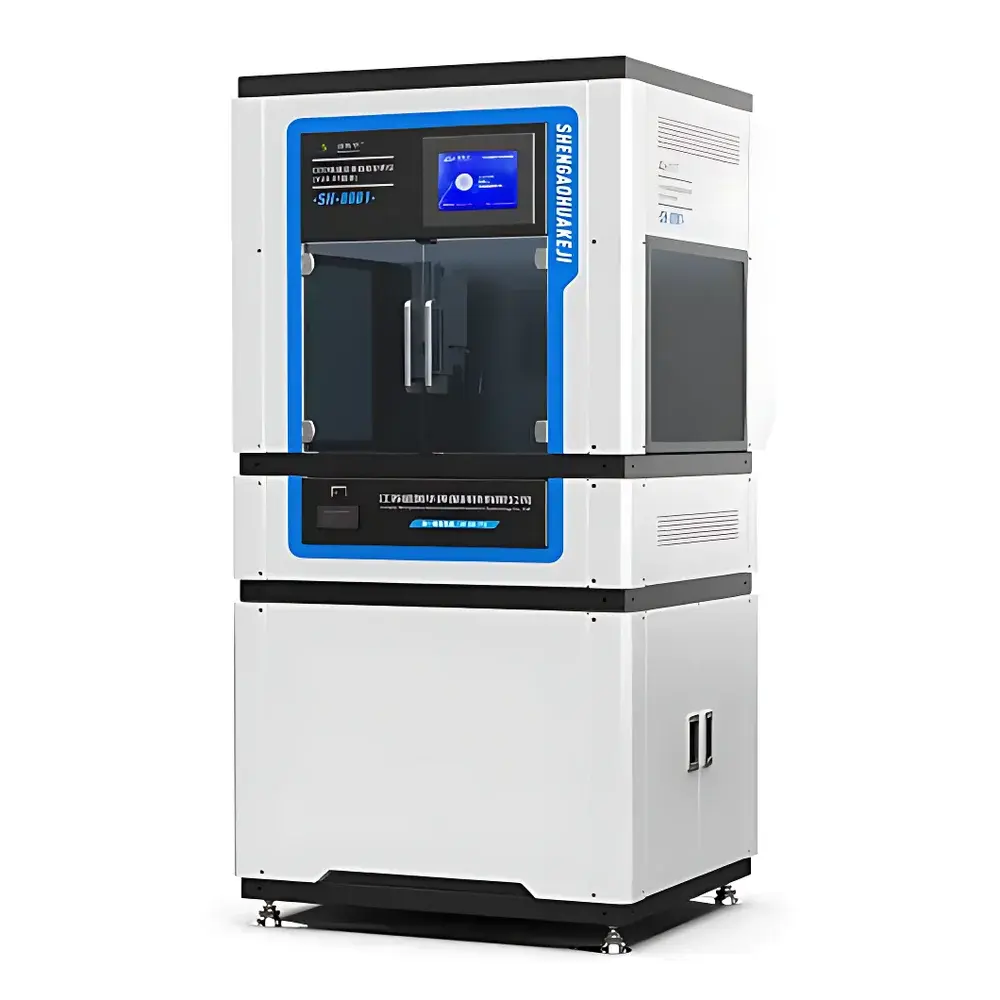
ShengAohua SH-8801 Automated COD Analyzer
| Brand | ShengAohua |
|---|---|
| Origin | Jiangsu, China |
| Manufacturer Type | Direct Manufacturer |
| Instrument Type | Laboratory Benchtop |
| Measurement Principle | Rapid Digestion Method (HJ/T 399–2007) |
| Wavelength | 420 nm / 610 nm ±1 nm |
| COD Range | 50–1000 mg/L |
| Accuracy | ±5% |
| Repeatability | ±5% |
| LOD | 50 mg/L |
| Analysis Time per Batch | 10–20 min |
| Sample Throughput | 20 samples/batch |
| Optical Stability | ≤±0.002 Abs/h |
| Photometric Repeatability | 0.2% T |
| Absorbance Reproducibility | ±0.003 Abs |
| Liquid Dispensing Accuracy | ≤1% |
| Heating Control | Adaptive PID at 165 °C ±1 °C |
| Cooling | High-airflow silent fan |
| Dimension (Cabinet) | 830 × 800 × 1780 mm |
| Dimension (Desktop) | 830 × 700 × 700 mm |
| Weight | ~60 kg |
| Power Supply | AC 220 V ±10%, 50 Hz |
| Rated Power | ~780 W |
| Operating Environment | 0–50 °C, 10–90% RH |
| Positioning Precision (Robotic Arm) | 0.1 mm |
| Display | 8-inch IPS capacitive touchscreen |
| Light Source | Imported cold-light LED (100,000 h lifetime) |
| Optical Path | Post-dispersion design |
| Data Interface | IoT-enabled cloud upload (ShengAohua Cloud Data Service) |
| Compliance | HJ/T 399–2007, HJ 924–2017, GB/T 32208–2015, GB/T 12519–2010 |
Overview
The ShengAohua SH-8801 Automated COD Analyzer is a laboratory-grade benchtop instrument engineered for precise, high-throughput chemical oxygen demand (COD) determination in water and wastewater samples using the standardized rapid digestion method specified in HJ/T 399–2007. Unlike manual or semi-automated systems, the SH-8801 integrates a fully programmable 3-axis robotic handling system to execute sample aspiration, vial capping/un-capping, reagent addition, vortex mixing, thermal digestion at 165 °C ±1 °C, post-digestion cooling, photometric measurement, and data reporting — all without operator intervention. Its optical architecture employs dual-wavelength absorbance detection (420 nm and 610 nm ±1 nm) with post-dispersion light path design to minimize ambient light interference and ensure long-term photometric stability (≤±0.002 Abs/h). The analyzer delivers quantitative results across a validated linear range of 50–1000 mg/L COD, meeting national metrological verification requirements per GB/T 32208–2015 and general analytical instrumentation specifications under GB/T 12519–2010.
Key Features
- Fully automated workflow: Robotic arm with 0.1 mm positioning accuracy handles up to 20 samples per batch, including tube loading, cap manipulation via precision rotary chuck, reagent dispensing, 360° tube rotation for homogeneous mixing, and post-digestion cooling using high-airflow silent fans.
- Dual-wavelength photometry: Cold-light LED source (100,000 h lifetime) with narrow-band filters at 420 nm and 610 nm enables selective detection of dichromate reduction products, minimizing matrix interference.
- Adaptive thermal control: PID-regulated heating module dynamically adjusts power delivery to maintain 165 °C ±1 °C during digestion, ensuring consistent oxidation efficiency across variable sample loads.
- Enhanced optical integrity: Post-dispersion optical path and 360° rotational cuvette scanning reduce path-length variability and eliminate orientation-dependent measurement bias inherent in fixed-position tube readers.
- Integrated safety monitoring: Dual-sensor fault detection (ultrasonic level sensing + infrared obstruction detection) triggers real-time alerts for overflow, misalignment, or mechanical obstruction.
- Modular fluidic design: Dual-channel anti-spill, anti-contamination washing system prevents cross-sample carryover; large-angle orbital shaking ensures complete homogenization prior to measurement.
Sample Compatibility & Compliance
The SH-8801 is validated for use with standard COD digestion reagents compliant with HJ/T 399–2007, including potassium dichromate–sulfuric acid–silver sulfate–mercuric sulfate solutions. It accommodates standard 16 mm OD glass digestion tubes and supports both open-tube and capped digestion protocols. All hardware, firmware, and calibration routines conform to Chinese national standards: HJ 924–2017 (instrument performance requirements), GB/T 32208–2015 (verification procedures for COD analyzers), and GB/T 12519–2010 (general technical conditions for analytical instruments). While not pre-certified for FDA 21 CFR Part 11 or ISO/IEC 17025, its audit-trail-capable software architecture, user-access-controlled calibration logs, and immutable raw data storage support GLP-aligned laboratory practices when deployed with appropriate SOPs.
Software & Data Management
The SH-8801 runs on ShengAohua’s proprietary AOS (Analytical Operating System), a real-time embedded platform accessible via an 8-inch IPS capacitive touchscreen with intuitive Chinese/English bilingual interface. The software provides method-driven workflows aligned with HJ/T 399–2007, customizable assay templates, manual and auto-calibration routines, and built-in validation checks (e.g., blank drift, linearity verification). All measurement data — including raw absorbance values, calculated COD concentrations, timestamps, operator IDs, and instrument status logs — are stored locally in encrypted binary format and simultaneously transmitted via secure MQTT protocol to the ShengAohua Cloud Data Service. Remote firmware updates are supported over HTTPS, enabling version-controlled software maintenance without onsite technician visits. Export options include CSV, PDF reports, and direct integration with LIMS via configurable RESTful API endpoints.
Applications
The SH-8801 serves laboratories requiring regulatory-compliant, high-volume COD analysis across diverse sectors: municipal and industrial wastewater treatment plants (for process control and discharge compliance), third-party environmental testing labs (for HJ/T 399–2007–mandated reporting), water resource management agencies (river/lake monitoring), petrochemical and pharmaceutical manufacturing QA/QC units, academic research groups studying organic pollutant degradation kinetics, and environmental engineering consultancies conducting baseline assessments. Its 10–20 minute per-batch cycle time and 20-sample capacity make it especially suitable for routine daily monitoring where reproducibility, traceability, and minimal hands-on time are critical operational constraints.
FAQ
Does the SH-8801 comply with international standards such as ISO 6060 or ASTM D1252?
The instrument is designed and verified per Chinese national standards (HJ/T 399–2007, HJ 924–2017). While its methodology aligns conceptually with ISO 6060 (dichromate oxidation), formal equivalence certification to ISO or ASTM is not claimed. Users requiring ISO/IEC 17025 accreditation must validate performance in-house per their scope of accreditation.
Can the instrument be integrated into an existing LIMS environment?
Yes — raw data and report exports are available in CSV and PDF formats. A RESTful API interface is provided for custom LIMS integration; documentation and authentication protocols are supplied upon request.
What is the expected lifetime of consumables such as digestion tubes and reagents?
Standard borosilicate glass digestion tubes are reusable after proper cleaning and inspection. Reagent shelf life follows manufacturer specifications (typically 12 months unopened, 30 days after opening when refrigerated). No proprietary consumables are required.
Is remote diagnostic support available?
Yes — the onboard IoT module enables secure remote connection for firmware diagnostics, log retrieval, and configuration review by ShengAohua technical support engineers, subject to customer network policy approval.
How is calibration traceability maintained?
The system supports NIST-traceable potassium hydrogen phthalate (KHP) standard solutions for daily calibration verification. All calibration events are timestamped, user-logged, and archived with spectral baseline data for full audit trail generation.







