
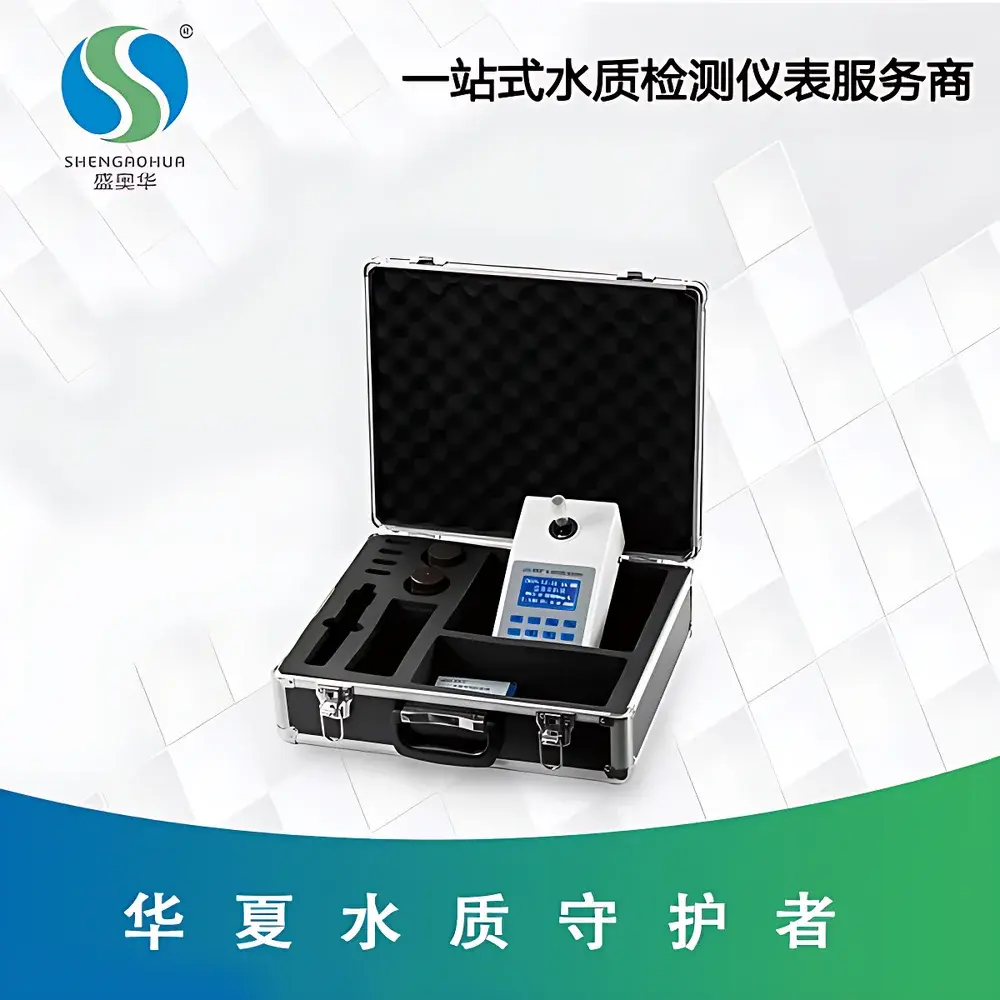
Shengaohua 6B-50N (V9) Portable Ammonia Nitrogen Analyzer
| Brand | Shengaohua |
|---|---|
| Origin | Jiangsu, China |
| Manufacturer Type | Direct Manufacturer |
| Regional Classification | Domestic (China) |
| Model | 6B-50N |
| Instrument Type | Portable |
| Measurement Principle | Colorimetric Method |
| Measurement Range | 0.001–5 mg/L (extendable to 5–100 mg/L via dilution) |
| Detection Limit | 0.001 mg/L |
| Accuracy | ±5% FS |
| Repeatability | ±3% RSD |
| Zero Drift | ΔA < 0.001 |
| Measurement Time | 10–15 minutes per sample |
| Batch Capacity | Multiple samples simultaneously |
| Light Source | Long-life cold LED (no warm-up required) |
| Display | Backlit LCD with direct concentration readout |
| Data Storage | Internal 8 GB microSD card |
| Power Supply | Integrated rechargeable battery for field operation |
Overview
The Shengaohua 6B-50N (V9) Portable Ammonia Nitrogen Analyzer is a field-deployable, colorimetric instrumentation system engineered for rapid, on-site quantification of ammonia nitrogen (NH₃-N) in aqueous environmental matrices. It operates on the principle of the Nesslerization reaction—where ammonia reacts with alkaline iodide-mercury reagent to form a yellow-brown colloidal complex—with absorbance measured at 420 nm using a stabilized cold LED light source and precision photometric detection. Designed for compliance with standard methods including ISO 7150-1:1984 and HJ 535–2009 (Chinese EPA), the analyzer delivers trace-level sensitivity down to 0.001 mg/L and supports dual-range measurement (0.001–5 mg/L and 5–100 mg/L via user-initiated dilution), making it suitable for monitoring low-concentration surface waters as well as high-load wastewater effluents.
Key Features
- Integrated cold LED optical system: Eliminates warm-up delay and ensures photometric stability over extended field use; lifetime exceeds 100,000 hours.
- Direct concentration readout: Backlit LCD interface with intuitive Chinese-language keypad—optimized for operational efficiency in non-laboratory environments.
- No calibration standard required for routine analysis: Factory-calibrated optical path and pre-optimized reagent kits enable immediate deployment without daily recalibration.
- Onboard time-stamped data logging: Internal 8 GB microSD card stores measurement ID, date/time stamp, absorbance values, calculated concentration, and operator notes—fully traceable per GLP requirements.
- Field-ready power architecture: Built-in rechargeable lithium-ion battery supports ≥8 hours of continuous operation; compatible with 12 V DC vehicle adapters and universal AC chargers.
- Modular cuvette-based assay format: Uses standardized 16 mm glass or disposable plastic colorimetric tubes—minimizing cross-contamination and enabling rapid batch processing of heterogeneous samples.
Sample Compatibility & Compliance
The 6B-50N (V9) is validated for use with raw and treated freshwater, municipal wastewater, industrial process water, and aquaculture effluents. Sample turbidity up to 50 NTU is accommodated via integrated digital compensation algorithms; suspended solids >100 mg/L require optional centrifugation or filtration (0.45 µm membrane). The instrument conforms to key regulatory frameworks governing environmental testing: its methodology aligns with ISO 7150-1 for ammonia determination in water, and its data integrity features—including immutable timestamping and non-editable result logs—support audit readiness under China’s HJ/T 91–2019 and international GLP principles. While not FDA 21 CFR Part 11-certified out-of-the-box, raw data export (CSV/Excel) enables integration into validated LIMS environments.
Software & Data Management
Data acquisition and reporting are managed through embedded firmware (V9.2), supporting automatic unit conversion (mg/L NH₃-N, mg/L NH₄⁺, µmol/L), linear and polynomial calibration curve selection, and outlier flagging based on replicate variance thresholds. All measurements are stored with metadata (sample ID, analyst code, location tag, ambient temperature). USB 2.0 interface allows secure, password-protected export of encrypted datasets; no cloud connectivity or remote telemetry is implemented—ensuring full data sovereignty. Firmware updates are delivered via offline SD card load, preserving integrity in low-connectivity field settings.
Applications
- Real-time monitoring at wastewater treatment plant influent/effluent points
- Routine surveillance of river, lake, and reservoir water quality by environmental protection bureaus
- Process control in food & beverage facilities (e.g., dairy, brewing) where ammonia accumulation signals microbial spoilage
- Compliance verification for discharge permits under local environmental regulations (e.g., China’s GB 8978–1996)
- Educational laboratories requiring robust, low-maintenance instrumentation for undergraduate water chemistry modules
- Emergency response teams assessing ammonia contamination following industrial spills or agricultural runoff events
FAQ
What is the recommended maintenance interval for the optical system?
Optical alignment and LED intensity verification should be performed annually using factory-provided reference filters; no user-serviceable optical components exist.
Can the instrument be used with third-party reagents?
Only Shengaohua-certified Nessler reagent kits (Cat. No. SA-NH3-V9-KIT) are validated for accuracy and interference rejection; substitution may compromise detection limit and bias performance.
Is method validation documentation available?
Yes—full validation reports per ISO/IEC 17025:2017 (including LOD/LOQ, linearity, spike recovery, and inter-laboratory reproducibility data) are supplied with each unit upon request.
Does the device support Bluetooth or Wi-Fi connectivity?
No—intentional omission ensures electromagnetic compatibility in industrial zones and eliminates cybersecurity exposure vectors in critical infrastructure deployments.
How is zero drift compensated during extended field campaigns?
Automatic dark-current correction is executed before each measurement cycle; the ΔA < 0.001 specification reflects 24-hour baseline stability under ambient temperature fluctuations of ±10 °C.







