
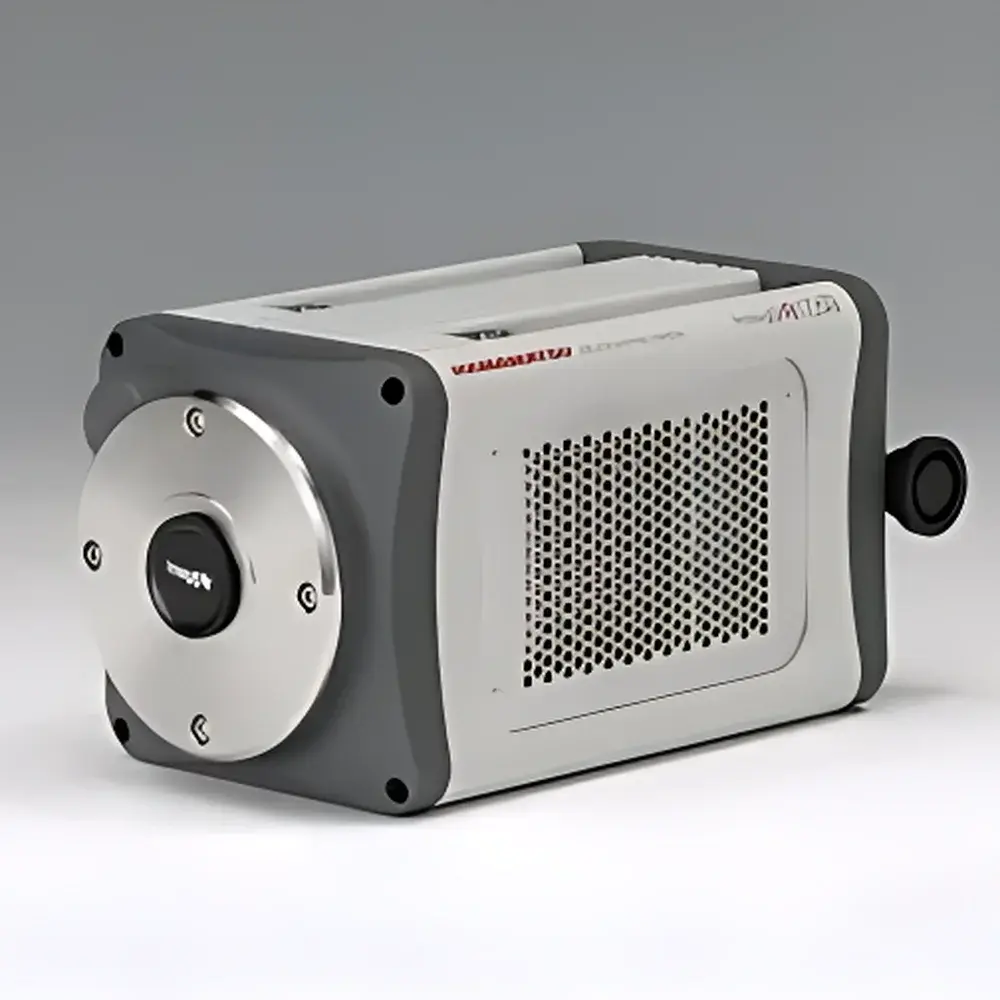
Hamamatsu ImagEM X2 Electron-Multiplying CCD Camera
| Brand | Hamamatsu |
|---|---|
| Origin | Japan |
| Manufacturer Type | Original Equipment Manufacturer (OEM) |
| Import Category | Imported Instrument |
| Model | C9100-23B |
| Pricing | Upon Request |
Overview
The Hamamatsu ImagEM X2 (Model C9100-23B) is a high-performance, vacuum-sealed, back-illuminated electron-multiplying charge-coupled device (EM-CCD) camera engineered for quantitative ultra-low-light imaging in demanding scientific applications. Based on frame-transfer architecture and optimized for photon-starved conditions—such as single-molecule fluorescence, TIRF, spinning-disk confocal, and intravital microscopy—the ImagEM X2 leverages on-chip electron multiplication to achieve sub-electron readout noise performance at high frame rates. Its 512 × 512 pixel sensor features 16 µm square pixels, delivering an active area of 8.19 mm × 8.19 mm and enabling both full-frame acquisition (up to 70.4 fps at 22 MHz pixel clock) and region-of-interest (ROI) readout at up to 1076 fps via vertical binning and corner-readout optimization. Unlike conventional CCDs, the EM-CCD architecture decouples readout noise from signal detection sensitivity by amplifying photoelectrons prior to readout—making it uniquely suited for applications where photon flux is limited and temporal resolution is critical.
Key Features
- Electron multiplication gain range: 4× to 1200× (software-calibratable and field-adjustable)
- Ultra-low readout noise: ≤1 e⁻ rms at maximum EM gain (22 MHz), 8 e⁻ rms in standard CCD mode (0.6875 MHz)
- Deep cooling capability: Stable operation at −80 °C (water-cooled) or −65 °C (forced-air cooled), with temperature stability ±0.01 °C
- Extremely low dark current: 0.0005 e⁻/pixel/s at −80 °C (water cooling); <0.005 e⁻/pixel/s at −65 °C (air cooling)
- Minimized clock-induced charge (CIC): Optimized clocking scheme suppresses spurious charge generation across all exposure durations
- Integrated mechanical shutter: Software-controllable, protects EM register from overexposure-induced degradation and reduces image lag
- Real-time on-chip image processing: Background subtraction, dead-pixel correction, recursive filtering, frame averaging, and cosmic-ray rejection
- Dual-mode operation: Seamless switching between EM-CCD (photon-counting regime) and standard CCD (high dynamic range, deep full-well capacity >370,000 e⁻)
- IEEE 1394b FireWire interface: High-bandwidth, deterministic latency data transfer compatible with real-time acquisition workflows
- Four SMA trigger I/O ports: Programmable input/output timing, adjustable trigger delay, and “trigger-ready” handshake signaling for synchronized multi-device experiments
Sample Compatibility & Compliance
The ImagEM X2 is compatible with standard C-mount optical interfaces and integrates seamlessly into inverted and upright microscopes, light-sheet systems, and custom optical benches. Its sealed vacuum housing (10⁻⁸ Torr base pressure) eliminates sensor contamination and ensures long-term calibration stability without re-evacuation. The camera supports compliance-critical workflows through precise temperature logging, EM-gain traceability, and DCAM-API–driven audit trails—enabling alignment with GLP/GMP documentation requirements when paired with validated acquisition software. While not inherently FDA 21 CFR Part 11–compliant, its hardware-level timestamping, deterministic trigger response, and firmware-controlled gain calibration support integration into regulated environments where instrument qualification protocols are implemented at the system level.
Software & Data Management
Controlled via Hamamatsu’s DCAM-API SDK (Windows/Linux), the ImagEM X2 supports third-party platforms including MetaMorph, Micro-Manager, and MATLAB through standardized driver layers. All EM-gain calibration, temperature setpoints, ROI definitions, and real-time processing parameters are stored in non-volatile memory and can be exported as human-readable XML configuration files. Gain aging compensation is implemented via periodic EM-realignment routines—each logged with timestamps and environmental metadata. Image data output is 16-bit linear, with optional “electron”-scale units enabled for absolute photon quantification. The camera provides hardware-synchronized exposure timing and supports external synchronization modes (edge-triggered, level-triggered, start-triggered, and synchronous readout) with sub-microsecond jitter—essential for time-resolved fluorescence lifetime or pump-probe experiments.
Applications
- Single-molecule localization microscopy (SMLM), including PALM and STORM
- Total internal reflection fluorescence (TIRF) imaging of membrane dynamics and vesicle trafficking
- Calcium wave propagation and intracellular ion flux monitoring in live-cell assays
- Spinning-disk confocal microscopy requiring high-speed, low-noise detection
- In vivo fluorescent blood cell tracking and microcirculation studies
- Fluorescent reporter gene expression analysis under physiological illumination levels
- Protein–protein interaction mapping via FRET or BiFC with minimal phototoxicity
- Photon-limited spectroscopy and quantum optics experiments requiring event-level sensitivity
FAQ
What is the difference between EM-CCD and standard CCD operation in the ImagEM X2?
The camera operates in two distinct modes: EM-CCD mode applies on-chip gain to amplify weak signals above readout noise floor; standard CCD mode disables multiplication for high-dynamic-range imaging with full-well capacity exceeding 370,000 electrons.
Can the ImagEM X2 be used in regulated environments such as GxP laboratories?
Yes—when integrated with validated acquisition software and documented calibration procedures, its stable thermal control, gain traceability, and deterministic triggering support IQ/OQ/PQ validation frameworks.
How does the camera mitigate clock-induced charge (CIC)?
Through optimized clock voltage sequencing and timing profiles tailored to each pixel clock rate (0.6875 MHz, 11 MHz, 22 MHz), minimizing spurious charge generation during charge transfer—particularly critical for short-exposure applications.
Is water cooling mandatory for optimal performance?
No—forced-air cooling achieves −65 °C stabilization; however, water cooling is required to reach −80 °C and sustain the lowest dark current (0.0005 e⁻/pixel/s), essential for long-exposure quantitative assays.
What is Photon Imaging Mode and when should it be used?
A proprietary acquisition mode that applies statistical thresholding and spatial filtering to preserve linearity while enhancing spatial resolution in photon-starved regimes—ideal for detecting sparse, low-contrast features below conventional SNR thresholds.





