
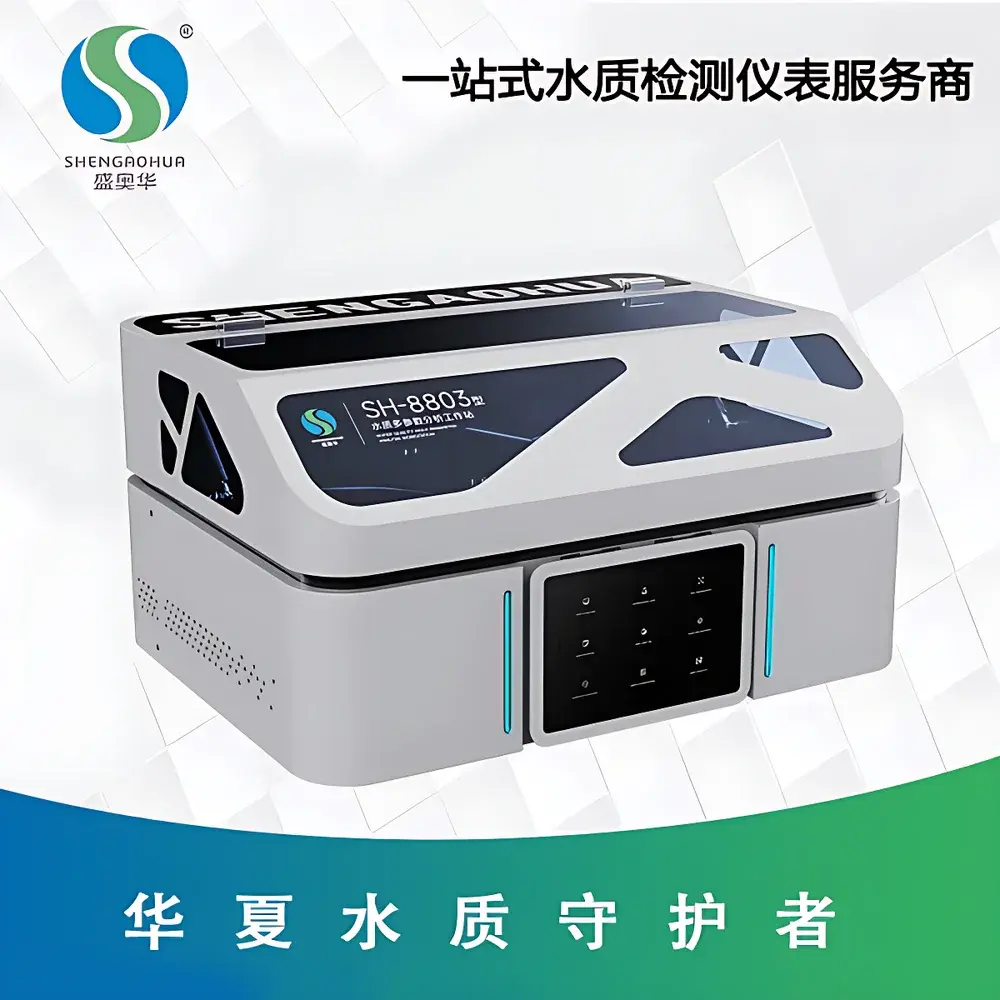
Shengaohua SH-8803 Fully Automated Multi-Parameter Water Quality Analysis Workstation
| Brand | Shengaohua |
|---|---|
| Origin | Jiangsu, China |
| Manufacturer Type | Direct Manufacturer |
| Product Category | Domestic |
| Model | SH-8803 |
| Instrument Type | Laboratory Water Quality Analyzer |
| Measured Parameters | Ammonia-N, Copper, Total Iron, Ferrous Iron (Fe²⁺), Ferric Iron (Fe³⁺), Hexavalent Chromium (Cr⁶⁺) |
| Wavelength Range | 420–540 nm |
| Measurement Accuracy | ≤5% |
| Repeatability | ≤3% |
| Optical Stability | ±0.003 Abs/10 min |
| Absorbance Range | 0.000–3.000 Abs |
| Minimum Resolution | 0.0001 Abs |
| Calibration Curves Stored | 100 |
| Data Storage Capacity | 100,000 records |
| Sample Throughput | 38 samples/batch |
| Cycle Time | 100 min/batch |
| Power Consumption | 100 W |
| Operating Temperature | 5–40 °C |
| Relative Humidity | ≤85% RH (non-condensing) |
| Dimensions (W×D×H) | 655 × 495 × 485 mm |
| Weight | 50 kg |
| Power Supply | AC 220 V, 50 Hz |
Overview
The Shengaohua SH-8803 Fully Automated Multi-Parameter Water Quality Analysis Workstation is a benchtop laboratory instrument engineered for high-throughput, standardized spectrophotometric analysis of key inorganic water quality parameters. It operates on the principle of visible-light absorbance spectroscopy—utilizing fixed-wavelength LED sources (420 nm, 440 nm, 510 nm, and 540 nm) aligned with established colorimetric methods defined in national and international standard protocols (e.g., HJ 535–2009 for ammonia-nitrogen, GB/T 7474–1987 for copper, HJ/T 345–2007 for hexavalent chromium). The system integrates sample handling, reagent dispensing, reaction incubation, optical measurement, waste disposal, and data reporting into a single unattended workflow. Its disk-based carousel architecture enables concurrent processing of up to 38 samples per batch, with full analytical cycle completion within 100 minutes—optimized for routine compliance monitoring in municipal water laboratories, environmental testing facilities, and industrial effluent QA/QC departments.
Key Features
- Fully automated liquid handling platform with integrated syringe pumps, peristaltic valves, and precision dispensing nozzles for reagents, standards, blanks, and samples.
- 12.3-inch true-color capacitive touchscreen interface running a real-time Linux-based embedded OS—supporting intuitive navigation, multi-user access control, and audit-ready operation logs.
- Preloaded calibration curves compliant with Chinese EPA and ISO-standardized methods; users may generate, validate, and archive custom calibration models using certified reference materials.
- Onboard automatic dilution capability for out-of-range samples, eliminating manual pre-dilution steps and reducing analyst intervention.
- Real-time fault diagnostics with sensor-based monitoring of reagent levels, wash solution volume, waste tank fill status, probe collision detection, and optical path integrity—triggering visual (red LED) and audible alerts upon anomaly detection.
- Uninterruptible operation with power-loss recovery: system resumes incomplete batches from last valid process step upon restoration of AC supply.
- Embedded thermal printer and dual-data export options (USB flash drive and internal database) ensure traceable, auditable reporting in accordance with GLP documentation requirements.
- Modular design with tool-free access to fluidic pathways, optical module, and sample carousel—minimizing downtime during routine maintenance or consumable replacement.
Sample Compatibility & Compliance
The SH-8803 is validated for use with clarified, filtered, or centrifuged aqueous matrices—including drinking water, surface water, groundwater, wastewater effluents, and industrial process streams. All measurement protocols adhere to nationally recognized methodologies: ammonia-nitrogen by Nesslerization (HJ 535–2009), copper by diethylthiocarbamate complexation (GB/T 7474–1987), total/ferrous/ferric iron by o-phenanthroline and thiocyanate methods (HJ/T 346–2007, HJ/T 344–2007), and hexavalent chromium by diphenylcarbazide reaction (HJ/T 345–2007). The instrument meets electromagnetic compatibility (EMC) Class B requirements per GB/T 18268.1–2010 and safety specifications under GB 4793.1–2019. While not FDA 21 CFR Part 11-certified out-of-the-box, its secure user authentication, electronic signature support, and immutable audit trail functionality enable configuration for regulated environments under internal SOPs.
Software & Data Management
The workstation’s embedded software provides role-based access control (administrator, analyst, reviewer), time-stamped method execution logs, and version-controlled curve management. All measurements are timestamped and linked to operator ID, sample ID, batch ID, and calibration history. Raw absorbance values, corrected concentrations, QC flag status (e.g., “within control limits”, “dilution applied”, “curve fit R² < 0.995”), and pass/fail determinations against predefined acceptance criteria are stored in a relational SQLite database. Data export supports CSV and PDF formats compatible with LIMS integration via USB or optional Ethernet module (not included). Firmware updates are delivered via signed firmware packages over USB, ensuring integrity verification prior to installation.
Applications
- Routine regulatory compliance testing for municipal water treatment plants (e.g., monthly ammonia-N and Cr⁶⁺ reporting under China’s GB 5749–2022).
- Industrial pretreatment monitoring for electroplating, metal finishing, and mining operations subject to discharge permit limits on Cu, Fe, and Cr⁶⁺.
- Environmental field lab deployment for rapid screening of surface water bodies during pollution incident response.
- Academic and research laboratories conducting method validation studies or inter-laboratory comparison exercises involving multi-analyte photometric assays.
- Contract testing labs requiring high sample throughput with minimal hands-on time and full digital traceability for accreditation audits (e.g., CNAS-CL01).
FAQ
What sample volume is required per test?
Typical sample consumption ranges from 1.5 mL to 3.0 mL per parameter, depending on selected dilution factor and assay protocol.
Can the SH-8803 be integrated with a Laboratory Information Management System (LIMS)?
Yes—via exported CSV files or optional RS-232/USB virtual COM port output; API-level integration requires custom middleware development.
Is cleaning solution included with the instrument?
No—users must supply deionized water and commercially available alkaline or acidic cleaning solutions compatible with PTFE and borosilicate glass fluidic components.
How often does the optical system require recalibration?
Factory calibration is stable for ≥12 months under normal operating conditions; annual verification using NIST-traceable neutral density filters is recommended.
Does the system support kinetic or timed-endpoint measurements?
No—the SH-8803 performs fixed-time endpoint absorbance readings only, consistent with standard EPA- and ISO-aligned colorimetric protocols.







