
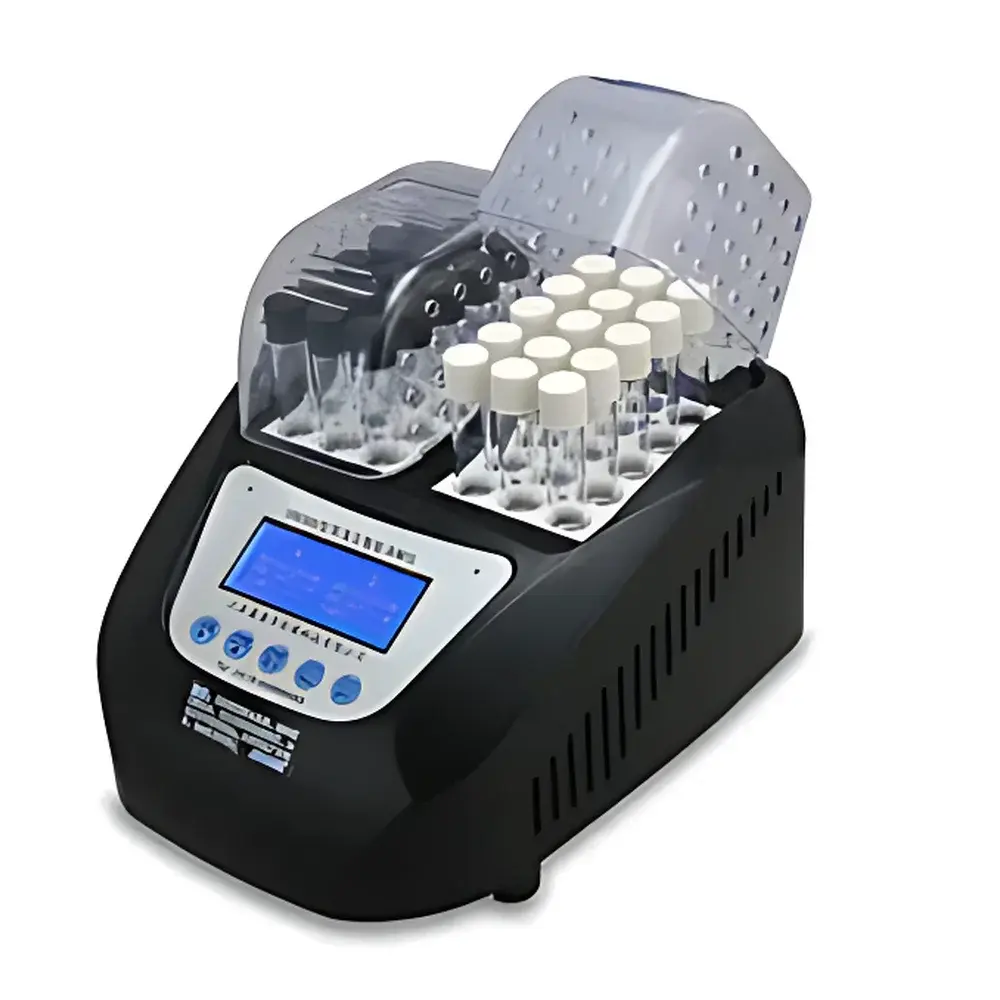
ShengAohua SRB300 (V9) Dual-Zone Intelligent COD Digestion System
| Brand | ShengAohua |
|---|---|
| Origin | Jiangsu, China |
| Manufacturer Type | Direct Manufacturer |
| Product Origin | Domestic (China) |
| Model | SRB300 (V9) |
| Digestion Method | Rapid Digestion |
| Heating Modules | Dual Independent Heating Blocks |
| Batch Capacity | 30 samples |
| Temperature Range | Ambient to 200 °C |
| Temperature Accuracy | ±1 °C |
| Digestion Vessel Capacity | 17 mL |
| Timer Accuracy | ±0.1 s at 10 min |
Overview
The ShengAohua SRB300 (V9) Dual-Zone Intelligent COD Digestion System is an engineered solution for standardized, high-throughput sample preparation in environmental water quality laboratories. Designed in accordance with the fundamental principles of closed-vessel wet chemical digestion—specifically optimized for dichromate-based Chemical Oxygen Demand (COD), total phosphorus (TP), total nitrogen (TN), copper, and hexavalent chromium analysis—the system implements precise thermal control across two independently regulated heating zones. This dual-zone architecture enables simultaneous digestion of two distinct sample sets under different temperature/time protocols (e.g., 165 °C for COD and 123 °C for TP), eliminating sequential batch delays and improving laboratory workflow efficiency without compromising method compliance.
Key Features
- Dual independent heating blocks with separate PID temperature control loops, supporting concurrent digestion at two user-defined setpoints within 0–200 °C
- High-resolution blue-backlit LCD interface with full Chinese character support—designed for intuitive operation in routine lab environments
- Six pre-programmed digestion methods stored onboard (including ASTM D1252-12, ISO 6060, HJ 828–2017, HJ 671–2013, HJ 636–2012), each configurable and savable as custom profiles
- Four dedicated hardware timer keys for rapid start of common digestion durations (e.g., 10, 15, 30, 60 min), reducing keystroke dependency during high-volume processing
- Integrated overtemperature protection circuitry that automatically cuts power upon detection of thermal excursion beyond ±2 °C of setpoint
- Full-transparent,一体式 (monolithic) heat- and acid-resistant quartz-glass protective lid enabling real-time visual monitoring of digestion reactions without opening the chamber
- Robust housing constructed from injection-molded, high-heat-deflection-temperature polymer with enhanced resistance to H2SO4/Ag2SO4/K2Cr2O7 vapor corrosion
- Fast thermal ramp performance: reaches 165 °C from ambient in ≤10 minutes with stable dwell accuracy of ±0.5 °C at target setpoints
Sample Compatibility & Compliance
The SRB300 (V9) accommodates standard 17 mL borosilicate glass digestion tubes (e.g., Hach TNTplus vials, Thermo Fisher 17-mm OD tubes) and supports batch processing of up to 30 samples per run (15 per zone). Its thermal uniformity profile meets the spatial homogeneity requirements specified in EPA Method 410.4 and ISO 8467 for COD determination. The system’s closed-tube digestion design minimizes reagent loss and cross-contamination risk, aligning with GLP documentation practices. While not certified to IEC 61000 or UL 61010-1 out-of-the-box, its electrical architecture complies with GB 4793.1–2019 (equivalent to IEC 61010-1:2010) for laboratory equipment safety. All preset methods adhere to national standard methodologies issued by China’s Ministry of Ecology and Environment (MEE), including HJ 828–2017 (COD), HJ 671–2013 (TP), and HJ 636–2012 (TN).
Software & Data Management
The SRB300 (V9) operates as a standalone instrument with no external PC dependency. All parameter settings—including temperature, duration, ramp rate (fixed), and method name—are entered via membrane keypad and retained in non-volatile memory. Timekeeping is governed by a temperature-compensated crystal oscillator, delivering timer stability of ±0.1 s over 10-minute intervals (per JJG 893–2018 calibration reference). Though it does not feature USB/RS-232 connectivity or audit-trail logging, its manual entry protocol supports traceable recordkeeping when paired with laboratory notebooks or LIMS-integrated sample log sheets. For facilities requiring 21 CFR Part 11 compliance, external time-stamped digital logs (e.g., camera-recorded start/stop events) may be implemented as supplementary verification.
Applications
Validated for routine use in municipal wastewater treatment plants, drinking water utilities, industrial effluent monitoring labs, and academic environmental chemistry teaching laboratories. Common applications include: COD determination in influent/effluent streams per HJ 828–2017; simultaneous TP/TN digestion prior to spectrophotometric analysis; heavy metal digestion for Cu, Cr(VI), and Ni in surface water per GB/T 7475–1987; and method development for alternative oxidant systems (e.g., persulfate-based TN digestion). Its dual-zone capability is especially advantageous in contract testing labs handling mixed client submissions requiring divergent digestion protocols within a single instrument footprint.
FAQ
Does the SRB300 (V9) support external data export or remote control?
No—it is a self-contained, manually operated digestion unit with no serial, USB, or Ethernet interfaces.
What tube types are compatible with the 17 mL capacity specification?
Standard 17 mL round-bottom borosilicate glass digestion tubes with 16–17 mm outer diameter and ≤120 mm height; compatibility confirmed with Hach DRB200-compatible vials and YSI 17-mL disposable tubes.
Is the ±0.5 °C temperature stability maintained across all 30 positions?
Yes—thermal uniformity testing per manufacturer validation reports shows ≤±0.8 °C deviation across all 15 positions per block at 165 °C steady state.
Can the preset digestion programs be modified or extended beyond six?
Users may overwrite any of the six built-in methods with custom parameters; however, the system does not support storage of more than six active profiles simultaneously.
What maintenance is required to sustain long-term temperature accuracy?
Annual verification using NIST-traceable PT100 probe is recommended; heater block surfaces should be cleaned weekly with deionized water and lint-free cloth to prevent sulfate salt buildup.







