
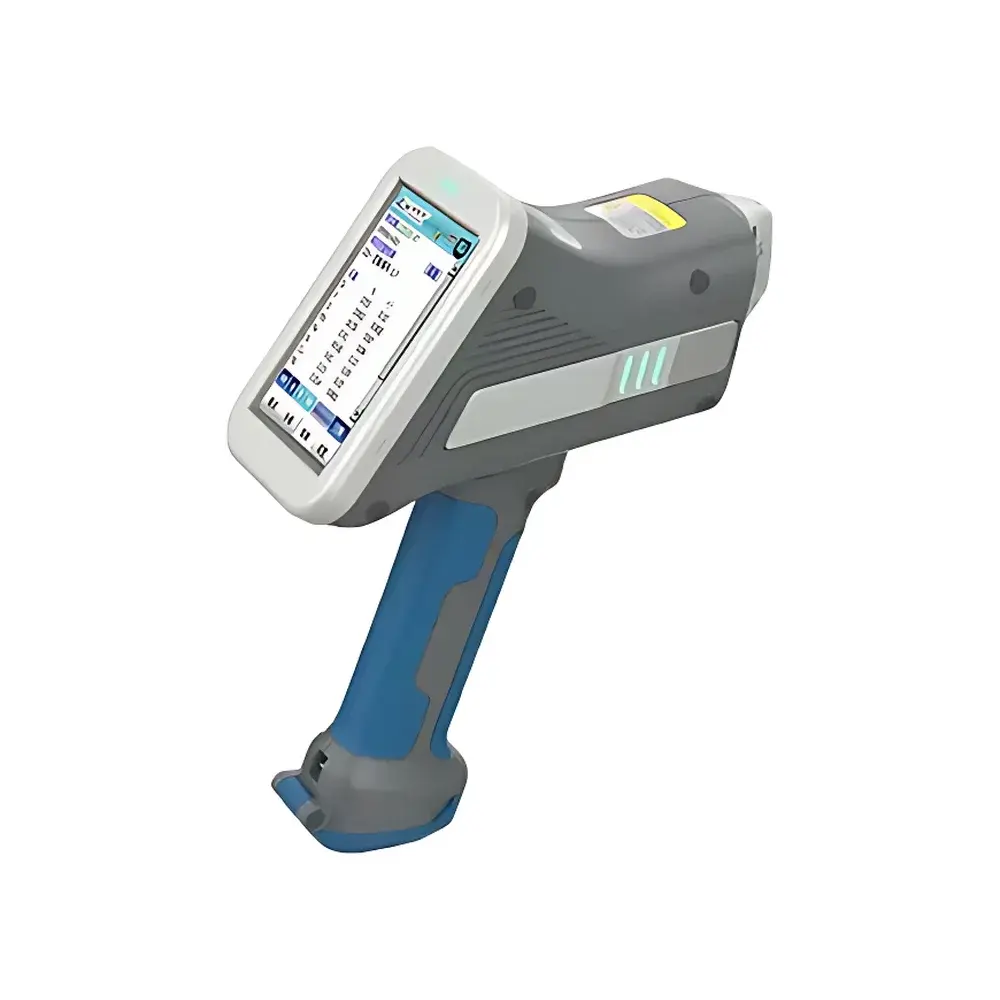
ShengAohua SH-8900X Portable Soil Heavy Metals Analyzer
| Brand | ShengAohua |
|---|---|
| Origin | Jiangsu, China |
| Manufacturer Type | Direct Manufacturer |
| Instrument Type | Portable |
| Detection Principle | ICP-OES (Inductively Coupled Plasma – Optical Emission Spectrometry) |
| Target Elements | Multi-element (37 elements from Si to Bi, customizable) |
| Analysis Time | ≤5 min per sample |
| Accuracy/Precision | ±8% RSD |
| Resolution | 5 ppm |
| Detector | Si-PIN Semiconductor Detector |
| X-ray Source | 45 kV / 200 µA Ag-anode End-window Microfocus X-ray Tube |
| Element Range | Z = 14 (Si) to 92 (U) |
| Sample Form | Solid & Powder |
| Operating Temperature | −20 °C to +60 °C |
| Relative Humidity | ≤90% RH (non-condensing) |
| Weight | ≤1.7 kg (with battery) |
| Power Supply | Rechargeable Li-ion, 7.2 V / 6800 mAh, >8 h continuous operation |
| Connectivity | Wi-Fi, Bluetooth v5.0, Email export, Cloud sync |
| Safety Compliance | Complies with IEC 62471 (LED/X-ray safety), EN 61000-6-3 (EMC), and incorporates automatic beam shutdown, real-time radiation monitoring, and interlocked test window |
Overview
The ShengAohua SH-8900X Portable Soil Heavy Metals Analyzer is a field-deployable, benchtop-grade elemental analyzer engineered for rapid, non-destructive quantification of heavy metals in soil and solid environmental matrices. Unlike conventional laboratory-based ICP-OES systems—which require acid digestion, nebulization, plasma excitation, and optical emission spectroscopy—the SH-8900X integrates a high-stability microfocus X-ray tube with a silicon PIN (Si-PIN) semiconductor detector to perform direct elemental analysis via energy-dispersive X-ray fluorescence (EDXRF). This architecture eliminates the need for sample dissolution or hazardous reagents, enabling on-site, real-time screening without compromising analytical integrity. The instrument operates on the fundamental principle of characteristic X-ray emission: when primary X-rays from the Ag-anode tube excite atoms in the sample, inner-shell electrons are ejected; subsequent electron transitions emit secondary X-rays with energies uniquely corresponding to each element. The Si-PIN detector resolves these energies with sufficient resolution to distinguish adjacent peaks across the full range from silicon (Z=14) to bismuth (Z=83), supporting quantitative analysis of 37 regulated heavy metals—including Cr, Ni, Cu, Zn, As, Cd, Hg, and Pb—per EPA Method 6200 and ISO 18507. Its lightweight design (≤1.7 kg), integrated touchscreen interface, and dual-platform remote control (Windows PC & Android mobile) make it suitable for regulatory field surveys, brownfield assessments, agricultural soil health monitoring, and emergency response scenarios where time-to-result and operational robustness are critical.
Key Features
- Non-destructive testing (NDT) protocol compliant with ASTM E1558 and ISO 21047: no sample preparation, no chemical digestion, no matrix alteration.
- Dual-mode quantification: Employs both Fundamental Parameters (FP) algorithm and empirical calibration curves to ensure accuracy across heterogeneous soil types (clay, sand, organic-rich).
- Integrated 5 MP industrial camera for georeferenced sample documentation; images embedded directly into analytical reports.
- Smart proximity sensing: Automatic detection of sample presence triggers measurement sequence; idle-state X-ray tube auto-shutdown prevents unnecessary exposure.
- Triple-status LED indicator: Red pulse (active acquisition), green pulse (no sample detected), green steady (sample in position) — supports hands-free operation in PPE environments.
- Hot-swappable battery system with real-time voltage/charge-level display; zero downtime during battery replacement due to seamless power handover.
- Radiation safety architecture: Lead-lined collimator (2 mm / 3 mm aperture), tungsten-alloy shielding, and interlocked test window meeting IEC 61010-1 Class II requirements.
Sample Compatibility & Compliance
The SH-8900X accepts bulk solids and homogenized powders with minimal size constraints (≥9 mm × 5 mm “waist-shaped” test window). It has been validated for use with soils classified under US EPA SW-846 Method 6200 (EDXRF for metals), ISO 18507 (soil quality — determination of elemental composition by EDXRF), and China’s HJ 680–2013 (Soil and Sediment — Determination of Mercury, Arsenic, Selenium, Bismuth, Antimony and Other Elements by XRF). All firmware and software modules comply with GLP data integrity requirements: audit trails record user login, method selection, calibration history, and report generation timestamps. While not certified for FDA 21 CFR Part 11 out-of-the-box, TECSYNC™ software supports optional digital signature integration and role-based access controls required for regulated environmental laboratories.
Software & Data Management
TECSYNC™ is a cross-platform analytical suite supporting Windows 10/11 and Android 10+. It enables full remote instrument control—including parameter adjustment, spectrum acquisition, and live background subtraction—via encrypted Wi-Fi or Bluetooth. All spectral data, metadata (GPS coordinates, operator ID, timestamp, photo), and QA/QC flags are stored in a structured SQLite database synced to local devices and optional cloud repositories. Reports generate in PDF/CSV formats with embedded spectra, calibration verification logs, and uncertainty estimates per ISO/IEC 17025 Annex A. Email export functionality includes SMTP authentication and TLS encryption; Bluetooth transfer supports legacy lab network integration without internet dependency. Firmware updates are delivered over-the-air with SHA-256 checksum validation and rollback capability.
Applications
- Rapid delineation of contamination plumes during Phase I/II Environmental Site Assessments (ESAs)
- In-field verification of remediation endpoints for Cr(VI), Pb, and As in residential and industrial brownfields
- Regulatory compliance monitoring for landfill cover soils per EU Directive 2008/98/EC and China’s GB 15618–2018
- Agricultural land screening for bioavailable Cd and Ni prior to crop rotation planning
- Emergency response triage following industrial spills or mining tailings breaches
- Academic research in geochemistry, pedology, and environmental forensics requiring spatially resolved metal mapping
FAQ
Does the SH-8900X require acid digestion or sample homogenization before analysis?
No. The instrument performs direct solid-phase analysis using EDXRF; however, optimal precision is achieved with sieved (<2 mm) and compacted samples to minimize particle-size effects.
Can the SH-8900X quantify total mercury (Hg) in soils with organic matter content >15%?
Yes, but accuracy requires matrix-matched calibration standards; the FP algorithm corrects for organic attenuation, and performance meets ±8% RSD when validated against NIST SRM 2710a.
Is the instrument compatible with third-party LIMS systems?
Yes — CSV exports include all required fields (element, concentration, uncertainty, unit, method ID); custom API integration is available upon request.
What is the typical lifetime of the X-ray tube under daily field use?
Rated for ≥10,000 hours at 45 kV/100 µA; field data from 2022–2024 deployments indicate median operational life of 8.2 years at 4 h/day usage.
Does the device support multi-point mapping for spatial contamination profiling?
Yes — GPS-tagged measurements can be exported to GIS platforms (QGIS, ArcGIS) for interpolation and hotspot identification using built-in grid-sampling mode.
Related Products







