
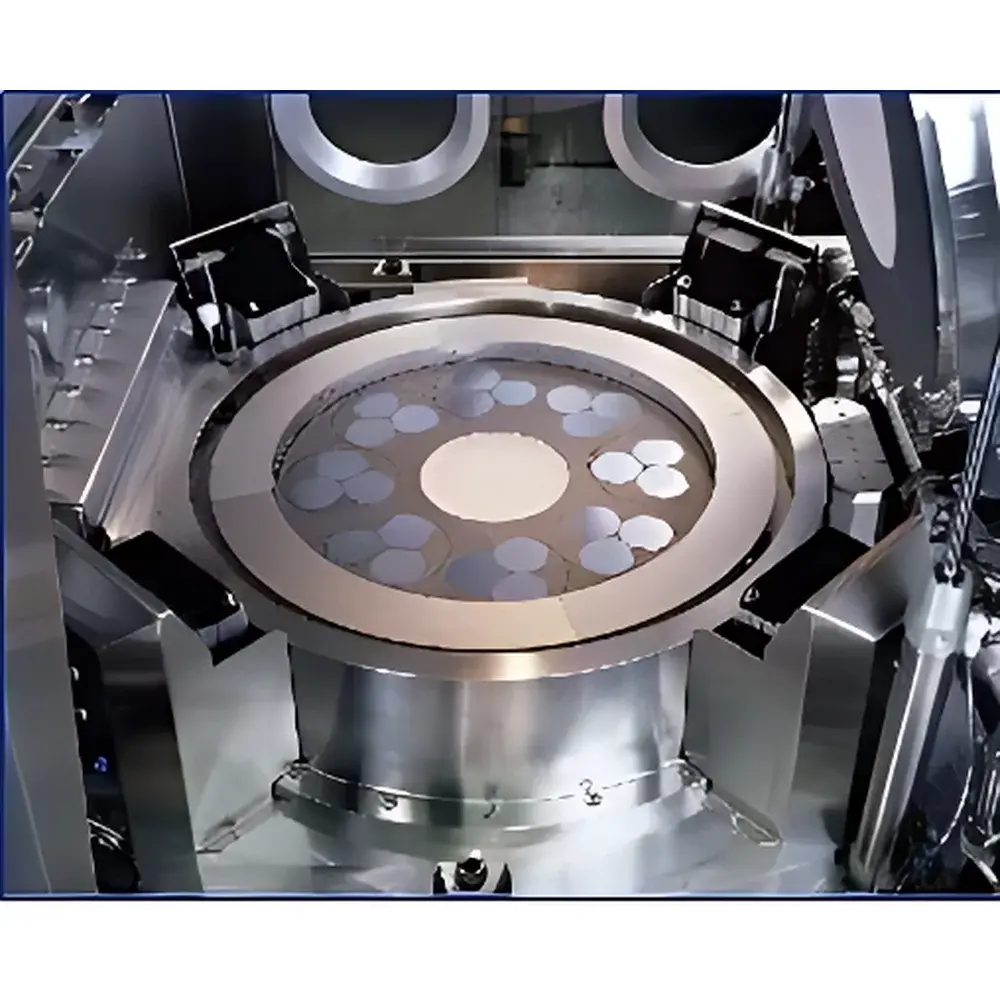
合肥科晶 MOCVD System for Epitaxial Thin-Film Growth
| Brand | Hefei Kejing |
|---|---|
| Origin | Anhui, China |
| Manufacturer Type | Authorized Distributor |
| Origin Category | Domestic (PRC) |
| Model | MOCVD |
| Pricing | Upon Request |
Overview
The Hefei Kejing MOCVD System is a precision chemical vapor deposition platform engineered for the controlled synthesis of compound semiconductor thin films via metal-organic chemical vapor deposition. It operates on the fundamental principle of thermally activated surface reactions: gaseous precursors—including Group II/III metal-organic compounds (e.g., TMGa, TMAI, DEZn) and Group IV/V hydrides (e.g., NH₃, PH₃, AsH₃)—are introduced into a heated reaction chamber under precisely regulated flow, pressure, and temperature conditions. Upon contact with a substrate held at elevated temperatures (typically 500–1100 °C), these precursors undergo catalytic decomposition and surface adsorption, enabling atomic-layer-controlled epitaxial growth of crystalline films such as GaN, AlN, InP, GaAs, ZnO, and perovskite derivatives. The system integrates quartz or graphite reaction chambers, multi-zone resistive heating elements, mass flow controllers (MFCs) with ±1% full-scale accuracy, and vacuum-tight stainless-steel gas delivery lines compliant with SEMI F57 standards.
Key Features
- Modular reactor architecture supporting horizontal or vertical cold-wall configurations with water-cooled outer jackets for thermal stability and process repeatability
- Multi-channel gas manifold with independent MFCs (up to 8 channels), each equipped with digital RS485 interface and real-time flow monitoring
- High-precision temperature control system featuring dual-sensor feedback (thermocouple + pyrometer), ±0.5 °C uniformity across 50 mm substrate zone
- Base pressure capability ≤5×10⁻⁵ Torr achieved via turbomolecular pumping station with cryo-trap for precursor condensate management
- Integrated safety interlocks including NH₃/PH₃/AsH₃ toxic gas detection (UL 2075 certified sensors), automatic purge sequencing, and emergency venting pathways
- Compliance-ready design aligned with ISO 14644-1 Class 5 cleanroom integration requirements and CE machinery directive 2006/42/EC
Sample Compatibility & Compliance
The system accommodates standard wafer formats from 2″ to 6″ diameter (Si, sapphire, SiC, and GaAs substrates), with optional custom holders for non-planar or patterned templates. All wetted materials—including quartz liners, alumina susceptors, and VCR-sealed fittings—are selected for low metallic contamination (<1×10¹⁰ atoms/cm² by TXRF post-process verification). Process documentation supports GLP/GMP traceability: every run logs timestamped temperature profiles, gas flow histories, pressure transients, and alarm events in binary-encoded .log files. Data integrity conforms to FDA 21 CFR Part 11 requirements when paired with validated third-party LIMS or ELN software.
Software & Data Management
Kejing’s proprietary MOCVD Control Suite (v3.2+) runs on Windows 10 IoT Enterprise and provides role-based access control (administrator/operator/maintainer), recipe-driven automation, and real-time parameter visualization via customizable dashboards. All operational data—including setpoints, actual values, and hardware status—are stored in encrypted SQLite databases with automatic daily backups to network-attached storage (NAS). Export functions support CSV, XML, and HDF5 formats for integration with MATLAB, Python (Pandas/NumPy), or JMP statistical analysis environments. Audit trails record user login/logout, recipe modification history, and calibration event timestamps—fully compliant with ISO/IEC 17025 clause 7.7.2.
Applications
- Growth of high-electron-mobility transistor (HEMT) heterostructures (AlGaN/GaN) for RF and power electronics
- Epitaxial deposition of light-emitting diode (LED) active layers (InGaN quantum wells on sapphire)
- Preparation of photovoltaic absorber layers (CIGS, CZTS) and buffer layers (CdS, ZnS)
- Synthesis of two-dimensional transition metal dichalcogenides (MoS₂, WS₂) via low-temperature sulfurization
- Research-scale fabrication of ferroelectric oxide thin films (PZT, BTO) for memory and sensor applications
- Process development for scalable manufacturing of perovskite solar cells (MAPbI₃, FAPbBr₃) under inert atmosphere
FAQ
What substrate heating methods are supported?
Resistive heating using silicon carbide or graphite susceptors; optional radiation heating modules available for ultra-fast ramp rates up to 100 °C/s.
Is remote operation possible?
Yes—via secure RDP or VNC over Ethernet; full control and monitoring are accessible through authenticated web interface (HTTPS/TLS 1.2).
Does the system meet UL/CSA electrical safety standards?
All power distribution units and heater controllers carry UL 508A certification; CSA C22.2 No. 142 compliance documentation provided upon request.
Can the system be upgraded for in-situ diagnostics?
Yes—integrated ports support retrofitting of reflectance anisotropy spectroscopy (RAS), laser interferometry, or quadrupole mass spectrometry (QMS) for real-time growth monitoring.
What maintenance intervals are recommended?
Quarterly MFC recalibration, biannual vacuum pump oil replacement, and annual thermocouple/pyrometer verification per ASTM E230/E1965 protocols.



