
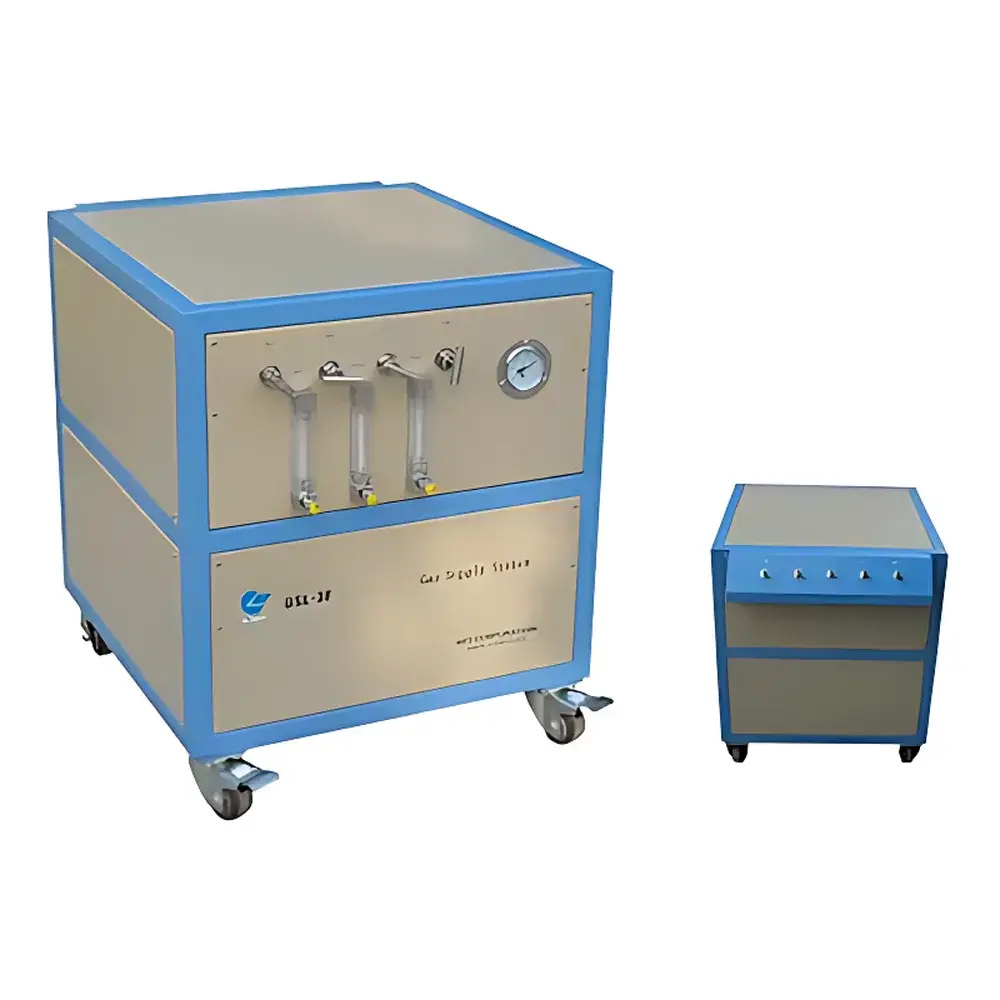
Hefei Kejing GSL-3F Multi-Channel Float-Type Gas Mixing and Delivery System
| Brand | Hefei Kejing |
|---|---|
| Origin | Anhui, China |
| Manufacturer Type | Authorized Distributor |
| Product Origin | Domestic (China) |
| Model | GSL-3F |
| Price | Upon Request |
| Gas Channels | 6 (customizable from 1–8) |
| Flow Controllers | Thermal Mass Flow Controllers (MFCs) |
| Standard Full-Scale Ranges (N₂) | 200 SCCM, 500 SCCM |
| Accuracy | ±1.5% FS |
| Linearity | ±0.5–1.5% FS |
| Repeatability | ±0.2% FS |
| Response Time (Gas) | 1–4 s |
| (Electrical) | ≤10 s |
| Operating Differential Pressure Range | 0.1–0.5 MPa |
| Maximum Inlet Pressure | 3 MPa |
| Tubing | Stainless Steel SS316, OD 6 mm × ID 4 mm |
| Pressure Gauge Range | –0.1 to +0.15 MPa, Graduation: 0.01 MPa |
| Shut-off Valves | 6 × Φ6 mm High-Pressure Manual Valves |
| Display | 4-Digit LED Digital Readout |
| Operating Ambient Temperature | 5–45 °C |
| Compatible Gases | High-Purity Inert, Reducing, and Oxidizing Gases (excluding simultaneous H₂/O₂) |
Overview
The Hefei Kejing GSL-3F Multi-Channel Float-Type Gas Mixing and Delivery System is an engineered solution for precise, safe, and reproducible gas supply in high-temperature laboratory processes—particularly within muffle furnaces, CVD reactors, and atmosphere-controlled thermal treatment systems. Unlike conventional single-gas regulators or manual rotameter-based mixers, the GSL-3F integrates calibrated thermal mass flow controllers (MFCs), high-integrity stainless-steel fluidic architecture, and redundant mechanical safety features to deliver stable, ratio-defined gas mixtures under controlled differential pressure conditions. Its core principle relies on independent volumetric flow regulation of up to six gas streams—each dynamically monitored and adjusted via digital MFC feedback loops—enabling real-time stoichiometric control essential for oxidation, reduction, inert annealing, and carbonization protocols. Designed explicitly for integration with tube furnaces and horizontal muffle systems operating up to 1200 °C, the system ensures zero air ingress during gas switching through sequential valve actuation logic and dead-volume minimization in manifold design.
Key Features
- Modular 6-channel architecture (expandable from 1 to 8 channels) supports flexible gas configuration—ideal for dual- or triple-atmosphere experiments requiring rapid, contamination-free transitions between N₂, Ar, H₂, O₂, CO, or forming gas.
- Thermal mass flow controllers certified to ±1.5% full-scale accuracy with <±0.2% repeatability ensure long-term stability across repeated thermal cycles—critical for GLP-compliant process validation.
- Dual-layer safety protocol: individual high-pressure shut-off valves (rated to 3 MPa) per channel plus strict interlock guidance prohibiting concurrent H₂/O₂ delivery, mitigating explosion risk in furnace environments.
- All wetted parts constructed from electropolished SS316 tubing (OD 6 mm / ID 4 mm) and VCR-compatible fittings eliminate particle shedding and adsorption—maintaining ≥99.999% gas purity required for thin-film deposition and semiconductor-grade sintering.
- Front-panel 4-digit LED display provides simultaneous readout of pressure (–0.1 to +0.15 MPa) and real-time flow rates (SCCM), enabling operator verification without external instrumentation.
- Quick-disconnect compression fittings (¼″ NPT & Φ6 mm) allow tool-free maintenance and leak-tight reconfiguration—reducing downtime during multi-project lab scheduling.
Sample Compatibility & Compliance
The GSL-3F is validated for use with ultra-high-purity (UHP) gases meeting ISO 8573-1 Class 1 solid particle and Class 2 moisture specifications. It complies with general requirements for laboratory gas distribution systems per ISO 10297 (gas cylinder valves) and EN ISO 2503 (gas hose assemblies). While not intrinsically rated for hazardous area installation, its mechanical interlocks and pressure-rated components align with OSHA 1910.101 and CGA P-1 safety guidelines for non-oxidizer/reducer co-location. For regulated environments—including FDA-regulated materials synthesis or ISO/IEC 17025-accredited testing labs—the system supports audit-ready documentation of flow calibration certificates (traceable to NIST standards) and optional electronic log export for 21 CFR Part 11–compliant data integrity.
Software & Data Management
The base GSL-3F operates in standalone analog/digital hybrid mode; however, optional RS-485 or Modbus RTU interface enables integration with LabVIEW, MATLAB, or custom SCADA platforms for automated recipe-driven gas sequencing. Flow setpoints, actual readings, and valve status are timestamped and exportable as CSV files—facilitating correlation with furnace temperature profiles and post-run failure analysis. All digital outputs include checksum-verified communication and configurable alarm thresholds (e.g., flow deviation >±3%, pressure drop >0.05 MPa over 30 s), supporting preventive maintenance alerts and ICH Q7-aligned equipment qualification protocols.
Applications
- Controlled-atmosphere sintering of advanced ceramics (e.g., SiC, AlN) under N₂/H₂ mixtures to suppress decomposition.
- CVD precursor carrier gas blending (Ar/H₂ or N₂/CH₄) with sub-second response for uniform film nucleation.
- Oxidation kinetics studies in metal alloys using precisely metered O₂/N₂ gradients at elevated temperatures.
- Graphene growth optimization via programmable H₂/Ar ramp sequences synchronized with furnace ramp rates.
- Post-processing annealing of battery cathode materials (e.g., NMC, LFP) under reducing atmospheres to tune oxygen vacancy concentration.
FAQ
Can the GSL-3F support simultaneous H₂ and O₂ delivery?
No. The system’s mechanical design and operational instructions explicitly prohibit concurrent H₂/O₂ supply due to explosive limits; only one oxidizing and one reducing gas may be active per configuration cycle.
Is calibration traceable to national standards?
Yes—each MFC is supplied with a factory calibration certificate traceable to NIST SRM 1680c (nitrogen flow standard); field recalibration services are available upon request.
What is the maximum allowable inlet pressure for cylinder connection?
The system accepts inlet pressures up to 15 MPa from standard gas cylinders; internal pressure regulation maintains safe differential operation within the 0.1–0.5 MPa working range.
Does the system meet requirements for GMP manufacturing environments?
While the hardware itself is not GMP-certified, its construction, documentation package, and optional electronic audit trail functionality enable qualification under Annex 15 and EU GMP Chapter 4 for ancillary gas supply in pilot-scale production.
Can additional gas channels be added post-purchase?
Yes—modular manifold design allows retrofitting of up to two additional MFC channels and associated valves without replacing the main frame or control panel.



