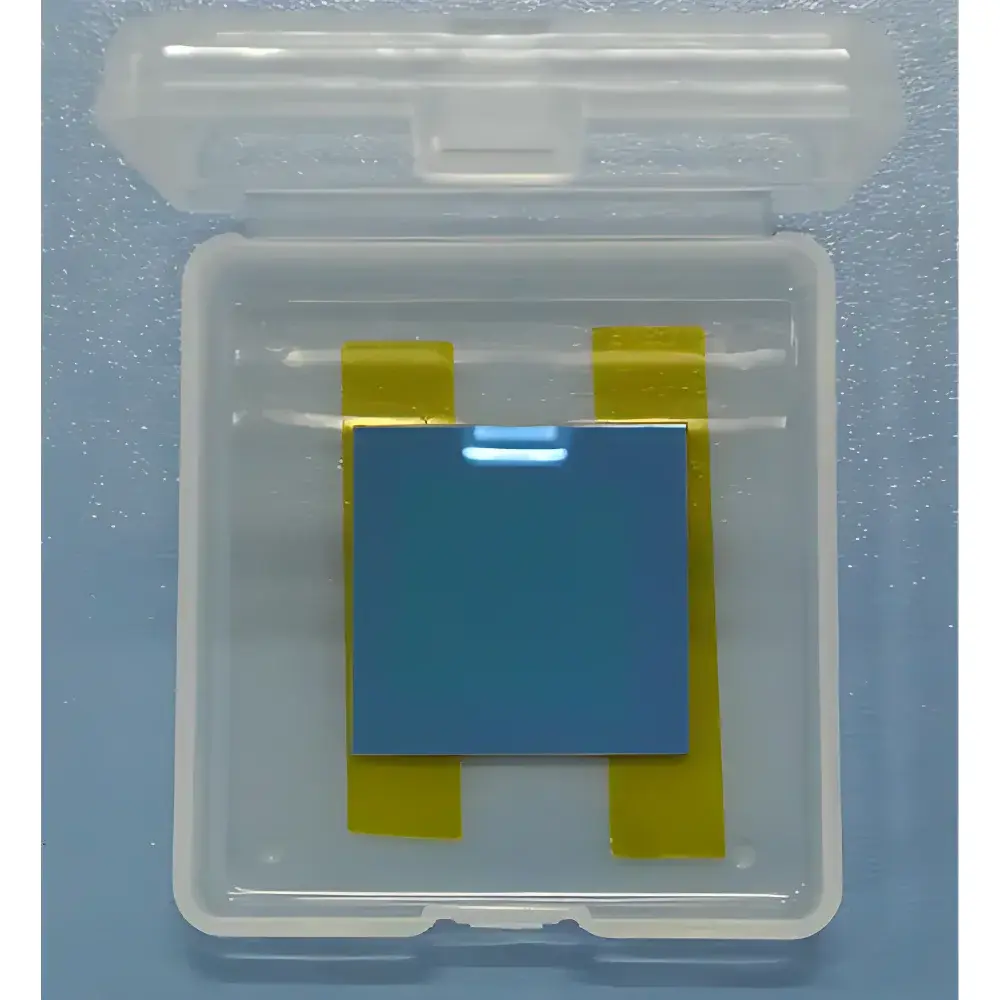
Silicon-Substrate Graphene Film (Hefei Kejing Model SGF-Series)
| Brand | Hefei Kejing |
|---|---|
| Substrate | Si (700 µm thick) with 300 nm SiO₂ layer |
| Graphene Type | CVD-grown monolayer or bilayer |
| Dimensions | 1×1 cm, 2×2 cm, 5×5 cm |
| Sheet Resistance | 300–500 Ω/□ (monolayer), 200–300 Ω/□ (bilayer) |
| Monolayer Coverage | ≥95% |
| Storage | Dry, oxygen-free environment, <30°C, use within 30 days |
| Compliance | ASTM D4496, ISO/IEC 17025-aligned handling protocols |
Overview
The Silicon-Substrate Graphene Film (SGF-Series) is a precision-engineered material platform designed for fundamental research and applied development in nanoelectronics, optoelectronics, and two-dimensional (2D) material characterization. Fabricated via low-pressure chemical vapor deposition (LPCVD) on thermally oxidized silicon wafers, each film consists of a 700 µm-thick Si substrate bearing a uniform 300 nm SiO₂ dielectric layer, onto which high-quality graphene is transferred or directly grown. The device-grade architecture enables reliable optical identification (via contrast modulation under white-light microscopy), Raman spectroscopic validation (G and 2D peak intensity ratios, FWHM of 2D band), and electrical characterization without substrate-induced interference. This configuration satisfies the stringent dimensional and interfacial requirements of gate-tunable field-effect transistor (FET) fabrication, scanning probe microscopy (SPM) calibration, and surface-enhanced Raman spectroscopy (SERS) substrate development.
Key Features
- High-fidelity monolayer and bilayer graphene films with ≥95% surface coverage, verified by optical microscopy and confocal Raman mapping
- Uniform sheet resistance across specified dimensions: 300–500 Ω/□ (monolayer), 200–300 Ω/□ (bilayer), measured using four-point probe methodology per ASTM F1529
- Thermally stable Si/SiO₂ substrate stack optimized for compatibility with standard microfabrication processes (photolithography, e-beam lithography, metal evaporation)
- Controlled surface morphology—low root-mean-square (RMS) roughness (<0.5 nm) on SiO₂ ensures minimal charge scattering and consistent carrier mobility
- Batch-consistent transfer process validated through cross-laboratory intercomparison studies aligned with ISO/IEC 17025 quality management principles
Sample Compatibility & Compliance
These graphene-on-silicon substrates are compatible with vacuum-based analytical systems including X-ray photoelectron spectroscopy (XPS), angle-resolved photoemission spectroscopy (ARPES), and low-energy electron diffraction (LEED). They meet the physical stability criteria required for integration into cleanroom-compatible workflows compliant with SEMI S2 and S8 safety standards. While not certified as GMP-grade consumables, handling and storage protocols follow GLP-aligned documentation practices—including lot-specific traceability, environmental log recording (temperature, O₂ partial pressure), and expiration tracking—to support reproducible experimental outcomes in academic and industrial R&D settings.
Software & Data Management
No proprietary software is bundled with the SGF-Series films, as they function as passive reference materials rather than active instrumentation. However, users are advised to integrate acquisition and analysis workflows using industry-standard platforms: Renishaw WiRE™ for Raman spectral quantification, Gwyddion for AFM topography processing, and MATLAB or Python (with SciPy/NumPy) for sheet resistance statistical modeling. All measurement data generated using these substrates should be archived with metadata fields including lot number, storage duration, ambient exposure time, and pre-characterization imaging/Raman spectra—enabling full audit trails per FDA 21 CFR Part 11 principles where applicable.
Applications
- Calibration and benchmarking of graphene characterization tools (e.g., Raman spectrometers, optical contrast algorithms, conductive AFM probes)
- Prototype development of transparent conductive electrodes for flexible displays and photodetectors
- Substrate for van der Waals heterostructure assembly via dry-transfer techniques
- Model system for studying charge carrier screening, phonon scattering, and interfacial thermal transport at the 2D/3D interface
- Baseline reference in interlaboratory round-robin studies evaluating graphene quality metrics (defect density, domain size, strain distribution)
FAQ
What is the recommended method for verifying monolayer coverage prior to device fabrication?
Optical contrast analysis under 50× objective with Köhler illumination, followed by point-spectrum Raman acquisition at ≥10 locations across the film area, is the minimum verification protocol. A 2D/G intensity ratio >2.0 and full-width-at-half-maximum (FWHM) of the 2D peak <35 cm⁻¹ indicate high-quality monolayer regions.
Can these substrates be annealed in UHV to remove adsorbates?
Yes—annealing at 200–300°C for 30 minutes under ≤1×10⁻⁹ mbar is permissible and commonly used to desorb water and hydrocarbons; however, temperatures exceeding 350°C may induce SiO₂ dehydroxylation and interfacial trap generation.
Is there batch-to-batch variation in sheet resistance, and how is it controlled?
Inter-batch coefficient of variation (CV) for sheet resistance is maintained below 8% through real-time plasma monitoring during CVD growth and post-transfer ellipsometry thickness verification; full QC reports are available upon request.
Do you provide wafer-level graphene films beyond 5×5 cm?
Custom orders for 4-inch and 6-inch diameter wafers are supported upon technical feasibility review and minimum order quantity agreement.
How does storage under inert gas affect long-term Raman signature stability?
Oxygen exposure induces p-doping and defect formation detectable via G-peak broadening and D/G intensity increase; maintaining O₂ <1 ppm extends spectral fidelity beyond 45 days, though electrical performance degradation begins after 30 days even under optimal conditions.
Related Products