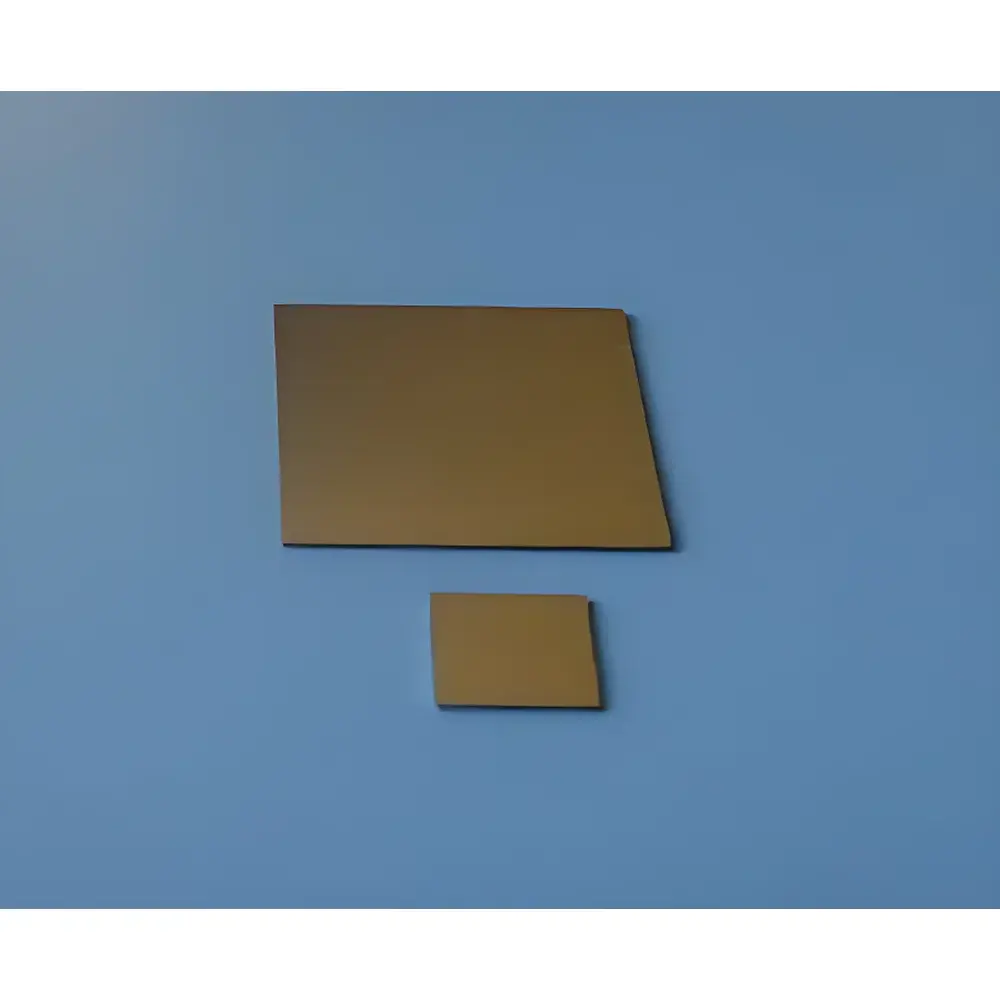
Chromium (Cr) Metal Sputtering Target Plate – Hefei Kejing High-Purity Polycrystalline Cr Sheet
| Brand | Hefei Kejing |
|---|---|
| Origin | Anhui, China |
| Model | Cr Sheet |
| Purity | >99.99% |
| Thickness | 1.0 mm |
| Dimensions (Std) | 10 × 10 × 1.0 mm |
| Surface Roughness (Ra) | < 30 Å |
| Density | 7.19 g/cm³ |
| Melting Point | 2180 K |
| Boiling Point | 2944 K |
| Atomic Mass | 58.9332 u |
| Atomic Number | 24 |
| Packaging | Vacuum-sealed in Class 100 cleanroom bag, stored in Class 1000 cleanroom environment |
Overview
The Chromium (Cr) Metal Sputtering Target Plate is a high-purity polycrystalline chromium sheet engineered for physical vapor deposition (PVD), particularly DC/RF magnetron sputtering and electron-beam evaporation applications. Fabricated from cold-rolled 2 mm thick chromium stock and precision-cut to dimensional specifications, this Cr sheet serves as a robust, stoichiometric source material for depositing uniform, adherent chromium thin films on substrates such as silicon wafers, glass, quartz, and metal foils. Its >99.99% purity ensures minimal incorporation of interstitial impurities (e.g., O, C, N) and trace metallic contaminants—critical for maintaining film resistivity, oxidation resistance, and interfacial adhesion in multilayer stack fabrication. With a body-centered cubic (BCC) crystal structure, chromium exhibits high hardness, low thermal expansion (4.9 × 10⁻⁶ K⁻¹), and exceptional corrosion resistance—properties directly retained in the deposited film when process parameters are optimized.
Key Features
- Ultra-high purity (>99.99% Cr, trace metals quantified per ICP-MS analysis)
- Precision-machined geometry: standard 10 × 10 × 1.0 mm with tight dimensional tolerance (±0.05 mm)
- Optimized surface finish: Ra < 30 Å (measured via atomic force microscopy), minimizing arcing and particle generation during sputtering
- No post-fabrication annealing applied—preserves as-rolled microstructure and dislocation density suitable for controlled grain growth during deposition
- Vacuum-compatible packaging: double-bagged in Class 100 cleanroom polyethylene, vacuum-sealed under inert atmosphere (N₂ or Ar), certified for use in ISO Class 5 (Class 100) environments
- Customizable dimensions—including thicknesses from 0.5 mm to 3.0 mm, and planar sizes up to 150 × 150 mm—subject to minimum order quantity
Sample Compatibility & Compliance
This Cr sheet is compatible with standard target bonding configurations (indium, elastomeric, or epoxy-based) for both planar and cylindrical magnetron sputter sources. It meets baseline requirements for semiconductor-grade thin-film processes under SEMI F57 and ASTM F1136 standards for metallic sputter targets. While not certified to ISO 9001 or AS9100 at the component level, all production batches undergo full traceability documentation—including raw material mill certificates, purity assay reports (ICP-OES/MS), and surface roughness validation data. The material complies with RoHS Directive 2011/65/EU and REACH Annex XIV restrictions for chromium metal (Cr(0)), excluding hexavalent Cr(VI) species. For GLP/GMP-regulated R&D environments, batch-specific CoA (Certificate of Analysis) and CoC (Certificate of Conformance) are available upon request.
Software & Data Management
As a passive consumable substrate—not an active instrument—this Cr sheet does not incorporate embedded firmware, connectivity, or proprietary software. However, its metrological characteristics are fully integrable into laboratory information management systems (LIMS) and electronic lab notebooks (ELN) via standardized metadata fields: lot number, purity grade, surface roughness value, dimensional verification report, and packaging certification. Users deploying automated sputtering platforms (e.g., Kurt J. Lesker Auto 500, Angstrom Engineering APEX) may map this Cr sheet’s lot ID to deposition recipes, enabling full process traceability aligned with FDA 21 CFR Part 11 audit-trail requirements where applicable.
Applications
- Sputter-deposited chromium adhesion layers in Ti/Cr/Au and NiCr/Cr/Au metallization stacks for MEMS and RF devices
- Hard mask fabrication for deep-UV lithography and reactive ion etching (RIE) processes
- Reference electrodes and corrosion-resistant interconnects in electrochemical sensor development
- Model system for fundamental studies of BCC transition-metal thin-film growth kinetics and strain relaxation mechanisms
- Substrate for epitaxial growth of Cr-based Heusler alloys (e.g., Co₂MnSi/Cr bilayers) in spintronics research
- Calibration reference for X-ray photoelectron spectroscopy (XPS) and Auger electron spectroscopy (AES) peak identification
FAQ
Is this Cr sheet suitable for ultra-high-vacuum (UHV) sputtering systems?
Yes—its low outgassing rate (<1 × 10⁻⁹ Torr·L/s·cm² after 24 h bakeout at 150 °C) and absence of organic binders or lubricants make it compatible with UHV chambers operating down to 1 × 10⁻¹⁰ mbar.
Can I obtain a certificate of conformance with elemental analysis data?
Yes—each shipment includes a CoC listing measured impurity levels (Fe, Ni, Cu, Si, O, C, N) per ASTM E1479, plus surface roughness validation report.
What is the recommended target bonding method for this Cr sheet?
Indium solder bonding is preferred for thermal cycling stability; for high-power DC sputtering (>5 kW), elastomeric bonding with thermally conductive silicone grease is recommended to mitigate thermal stress delamination.
Do you offer annealed Cr sheets?
Standard offerings are non-annealed. Annealed variants (recrystallized at 1200 °C under high-purity argon) are available as custom orders with lead time extension and MOQ of 5 pieces.
Are custom dimensions subject to additional testing or qualification?
Yes—non-standard geometries undergo additional flatness verification (≤5 µm deviation over 10 mm span) and edge chamfer inspection to prevent arcing; full test reports are supplied with shipment.