
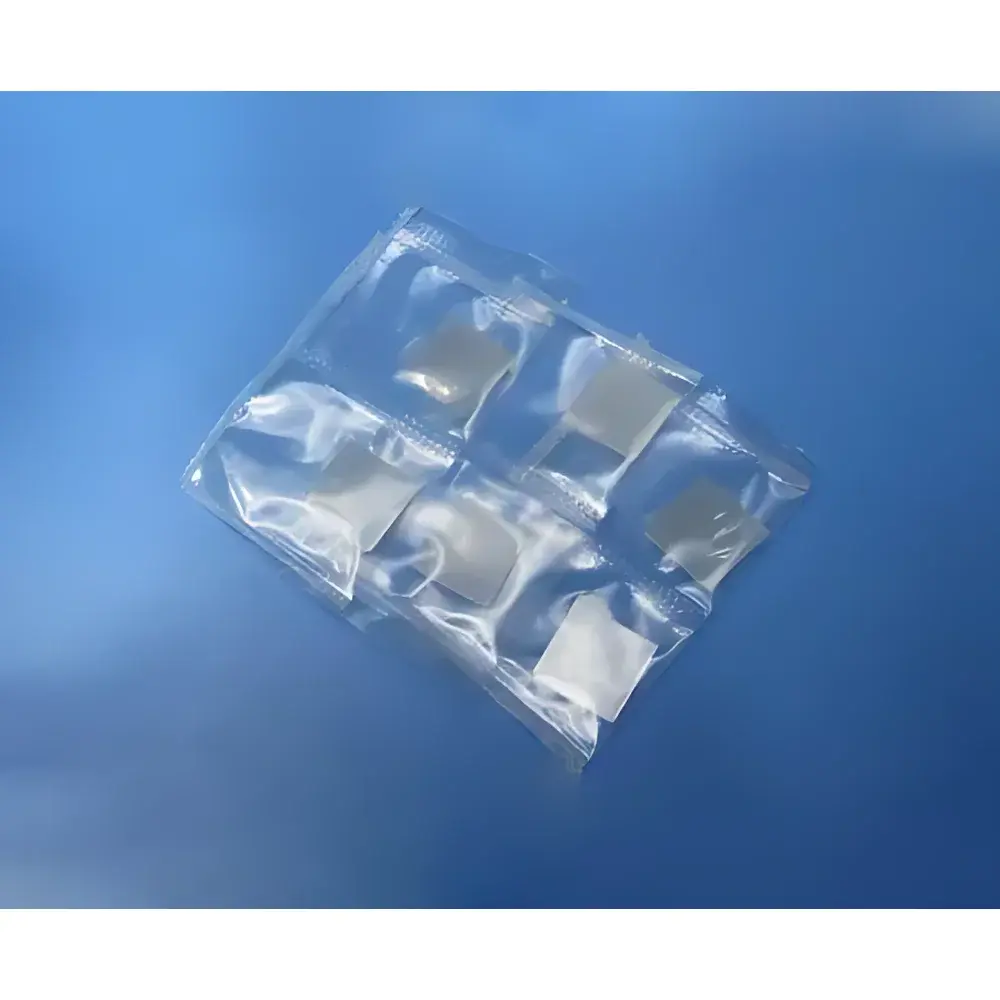
GdScO₃ (Gadolinium Scandate) Single Crystal Substrate Wafers
| Brand | Hefei Kejing |
|---|---|
| Origin | Anhui, China |
| Manufacturer Type | Authorized Distributor |
| Origin Category | Domestic |
| Model | GdScO₃ Crystal Substrate |
| Pricing | Upon Request |
| Crystal Structure | Orthorhombic (a = 5.45 Å, b = 5.75 Å, c = 7.93 Å) |
| Melting Point | 2127 °C |
| Density | 6.6 g/cm³ |
| Growth Method | Czochralski (CZ) |
| Orientation | <110> ± 0.5° |
| Dimensions | 10 × 10 × 0.5 mm³ or 10 × 5 × 0.5 mm³ |
| Surface Finish | Single-side polished |
| Surface Roughness (Ra) | < 0.5 nm |
| Packaging | Vacuum-sealed in Class 100 cleanroom bags, stored and shipped from Class 1000 cleanroom environment |
Overview
GdScO₃ (gadolinium scandate) single crystal substrates are high-purity, orthorhombic perovskite-structured oxide wafers engineered for epitaxial growth of functional thin films—particularly high-temperature superconductors, complex oxides, and ferroelectric heterostructures. With lattice parameters closely matching those of YBCO (YBa₂Cu₃O₇₋δ), LSCO (La₀.₆₇Sr₀.₃₃MnO₃), and PZT (Pb(Zr,Ti)O₃), GdScO₃ substrates minimize interfacial strain and dislocation density during pulsed laser deposition (PLD), sputtering, or molecular beam epitaxy (MBE). Its thermal expansion coefficient (≈10.2 × 10⁻⁶ K⁻¹, 300–1000 K) and chemical stability under oxidizing annealing conditions further support reproducible film nucleation and phase-pure crystallization. Unlike conventional SrTiO₃ or LaAlO₃ substrates, GdScO₃ exhibits superior dielectric mismatch tolerance and reduced oxygen vacancy formation at elevated temperatures—critical for fabricating low-leakage ferroelectric capacitors and interface-engineered oxide electronics.
Key Features
- High structural fidelity: Orthorhombic lattice with precise unit cell dimensions (a = 5.45 Å, b = 5.75 Å, c = 7.93 Å) confirmed by high-resolution X-ray diffraction (HR-XRD) and rocking curve FWHM < 0.02°
- Ultra-low surface roughness: Ra < 0.5 nm on single-side polished surface, verified by atomic force microscopy (AFM), enabling monolayer-resolved heteroepitaxy
- Tight crystallographic orientation control: -oriented wafers with angular tolerance ≤ ±0.5°, ensuring consistent domain alignment across wafer batches
- Thermally robust architecture: Melting point of 2127 °C and density of 6.6 g/cm³ support high-temperature processing up to 950 °C without warping or decomposition
- Controlled fabrication environment: Grown via Czochralski method under inert atmosphere; final packaging performed in ISO Class 6 (1000) cleanrooms and sealed in ISO Class 5 (100) cleanroom-grade vacuum bags
Sample Compatibility & Compliance
GdScO₃ substrates are routinely employed in R&D and pilot-scale thin-film deposition systems compliant with ASTM F398 (Standard Guide for Evaluation of Epitaxial Substrates) and ISO/IEC 17025-accredited materials characterization laboratories. Their compatibility extends to quartz crystal microbalance (QCM) sensor platforms requiring chemically inert, non-piezoelectric dielectric supports—especially where long-term baseline stability and minimal acoustic damping are essential. The substrate’s stoichiometric purity (>99.99% trace metal analysis) and absence of secondary phases meet stringent requirements for USP reference material qualification and GLP-compliant thin-film process development. All wafers undergo full certificate of analysis (CoA) documentation, including XRD phase verification, surface profilometry reports, and residual contamination screening (ICP-MS for Fe, Ni, Cr, Cu).
Software & Data Management
While GdScO₃ substrates themselves are passive components, their integration into automated thin-film synthesis workflows benefits from traceability protocols aligned with FDA 21 CFR Part 11 and EU Annex 11. Batch-specific lot numbers, cleanroom handling logs, and metrology records are maintained in secure LIMS (Laboratory Information Management Systems) environments. For QCM-based applications, substrate mounting geometry and acoustic coupling parameters are programmatically registered in instrument control software (e.g., QSense Analyzer Suite, SRS QCM200 firmware) to calibrate frequency shift-to-mass conversion factors using Sauerbrey and Kanazawa models. Raw surface topography data (AFM, SEM) and XRD scans are archived in vendor-neutral formats (TIFF, .xy, .csv) to ensure long-term interoperability with third-party analysis tools such as GSAS-II, ImageJ/Fiji, and MATLAB-based epitaxial strain modeling scripts.
Applications
- Epitaxial growth of REBCO (Rare-Earth Barium Copper Oxide) coated conductors for high-field magnet and fusion blanket applications
- Synthesis of strained LaNiO₃ and SrRuO₃ electrodes in resistive switching memory devices
- Template layers for ferroelectric tunnel junctions (FTJs) and multiferroic heterostructures (e.g., BiFeO₃/GdScO₃)
- Substrate platform for surface acoustic wave (SAW) sensors operating above 500 °C
- Reference standard in comparative studies of interfacial oxygen diffusion kinetics between perovskite oxides
FAQ
What is the typical off-axis angle tolerance for -oriented GdScO₃ substrates?
Standard specification is ±0.5°, measured via double-crystal X-ray diffractometry against Si (111) reference; tighter tolerances (±0.2°) are available upon request with extended lead time.
Can GdScO₃ substrates be reused after thin-film removal?
Not recommended for critical epitaxial applications; chemical mechanical polishing (CMP) may alter near-surface stoichiometry and introduce subsurface damage detectable by TEM cross-sectioning.
Is hydrogen annealing compatible with GdScO₃?
No—reducing atmospheres promote Sc³⁺ reduction and oxygen vacancy accumulation; only O₂ or air annealing up to 900 °C is advised.
Do you provide custom orientations (e.g., , ) or thicknesses?
Yes—custom cuts, double-side polish, and thicknesses from 0.3 mm to 1.0 mm are supported under NRE agreement; minimum order quantity applies.
How is surface cleanliness validated prior to shipment?
Each batch undergoes spectroscopic ellipsometry (SE) for native oxide thickness (<0.4 nm), followed by contact angle measurement (H₂O < 5°) and particle count verification (≥99.9% particles < 0.3 µm per ISO 14644-1 Class 5).
Related Products






