
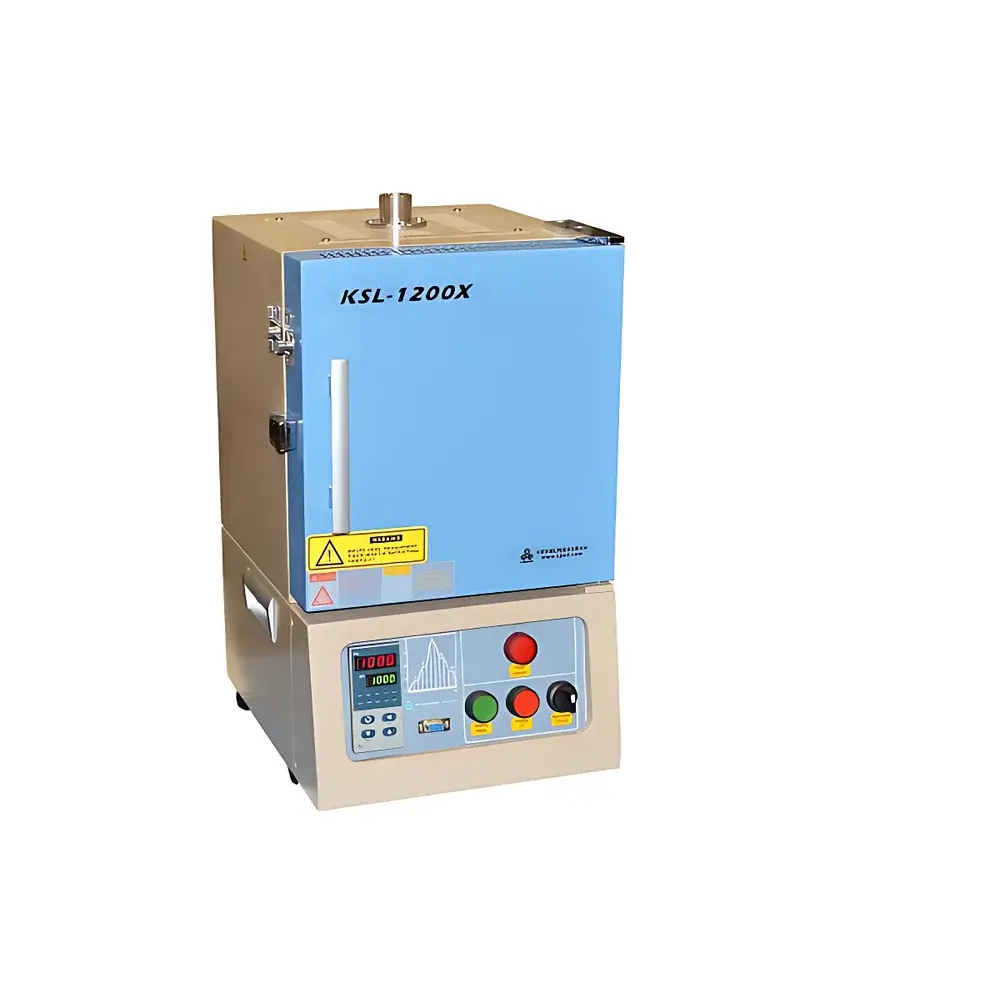
Hefei Kejing KSL-1200X-J Compact Benchtop Muffle Furnace
| Brand | Hefei Kejing |
|---|---|
| Origin | Anhui, China |
| Model | KSL-1200X-J (4.2 L) |
| Max Temperature | 1200°C |
| Temperature Uniformity | ±1°C |
| Heating Rate to Max Temp | 20°C/min |
| Rated Power | 2.5 kW |
| Internal Chamber Dimensions | 150 mm × 155 mm × 180 mm (4.2 L) |
| Heating Element | Mo-doped Fe-Cr-Al alloy with ZrO₂ coating |
| Insulation | High-purity alumina fiber + Al₂O₃ reflective coating |
| Cooling System | Dual-shell air-cooled jacket |
| Certifications | CE, UL/MET/CSA compliant (>24 V components), TÜV/CAS optional |
Overview
The Hefei Kejing KSL-1200X-J is a compact, benchtop muffle furnace engineered for precision thermal processing in research laboratories, materials science departments, and quality control environments. Designed around the fundamental principle of resistive heating within an electrically insulated, radiation-dominated chamber, it delivers stable, repeatable high-temperature operation up to 1200°C. Its muffle architecture isolates samples from direct contact with heating elements and combustion byproducts—ensuring contamination-free thermal treatment essential for sintering, ashing, calcination, annealing, and pre-treatment of ceramic, metallurgical, and battery electrode materials. The furnace’s dual-shell housing incorporates an active air-circulation interlayer, maintaining external surface temperatures below 60°C during continuous operation at maximum temperature—a critical safety feature for shared lab spaces. With a net working volume of 4.2 L and internal dimensions of 150 × 155 × 180 mm, it balances spatial efficiency with sufficient capacity for standard crucibles (e.g., Φ60 × 40 mm alumina or quartz) and small sample boats.
Key Features
- High-stability PID temperature controller with 30-segment programmable ramp-soak profiles, enabling complex thermal cycles for controlled phase transformations or multi-step heat treatments.
- Mo-doped Fe-Cr-Al heating elements coated with zirconia (ZrO₂) for enhanced oxidation resistance and extended service life under cyclic thermal stress.
- Double-layer furnace shell with forced-air interstitial cooling, minimizing radiant heat loss and ensuring operator safety and ambient thermal stability.
- High-purity alumina fiber insulation combined with a proprietary high-emissivity aluminum oxide reflective coating on the inner chamber walls—improving thermal efficiency and field uniformity (±1°C at 1200°C, measured per ASTM E220).
- K-type thermocouple integrated into the furnace wall with dual safety protection: over-temperature cutoff and thermocouple break detection.
- Side-opening door with high-temperature ceramic fiber gasket ensures rapid access, minimal heat loss during loading/unloading, and long-term sealing integrity.
Sample Compatibility & Compliance
The KSL-1200X-J accommodates standard laboratory crucibles (alumina, quartz, silicon carbide), ceramic setters, and small-volume sample boats. Its muffle design prevents cross-contamination between samples and eliminates reliance on atmospheric control—making it suitable for inert-atmosphere-compatible applications when used inside gloveboxes or with purge gas adapters (N₂, Ar). All low-voltage control circuitry (>24 V) complies with UL 61010-1, MET Laboratories’ safety standards, and CSA C22.2 No. 61010-1. The unit carries full CE marking per EU Directive 2014/35/EU (Low Voltage Directive) and 2014/30/EU (EMC Directive). Optional third-party certification—including TÜV Rheinland (Germany) or CSA Group (Canada)—is available upon request and client-funded verification.
Software & Data Management
While the KSL-1200X-J operates via a standalone front-panel controller, its analog voltage output (0–5 V or 4–20 mA) enables integration with external data acquisition systems (e.g., LabVIEW, MATLAB, or SCADA platforms) for real-time temperature logging and audit trail generation. The built-in controller supports time-stamped event logging (start/end of program, alarm triggers) and retains all 30-segment profiles even after power interruption. For GLP/GMP-aligned workflows, users may pair the furnace with validated external chart recorders or compliant DAQ hardware to satisfy 21 CFR Part 11 requirements for electronic records and signatures.
Applications
- Sintering of oxide ceramics (Al₂O₃, ZrO₂), ferrites, and solid-state electrolytes.
- Ashing of organic matrices (e.g., plant tissue, polymers, foodstuffs) prior to elemental analysis (ICP-OES, AAS).
- Calcination of metal oxide precursors (e.g., NiO, Co₃O₄, LiCoO₂) for cathode material synthesis.
- Thermal gravimetric pre-conditioning of catalysts and adsorbents.
- Heat treatment of small metal alloys and thin-film substrates under ambient or purged atmospheres.
- Calibration reference source for infrared thermometers and pyrometers (within specified emissivity ranges).
FAQ
What is the recommended continuous operating temperature?
The furnace is rated for continuous operation at ≤1100°C. Operation at 1200°C is permissible for durations up to 2 hours per cycle to avoid accelerated degradation of heating elements and insulation.
Can this furnace be used under inert gas flow?
Yes—gas inlet/outlet ports can be retrofitted to the chamber; however, the standard configuration does not include sealed gas fittings. Custom modifications require engineering review and are subject to additional lead time and validation.
Is the temperature uniformity verified across the entire chamber volume?
Per internal qualification testing per ISO/IEC 17025-accredited protocols, radial and axial uniformity at 1000°C is ±1.2°C within the central 70% of the chamber volume (i.e., ~105 × 109 × 126 mm). Full mapping reports are available upon request.
Does the controller support remote monitoring or Ethernet connectivity?
No—the standard controller is local-only. Remote interface capability requires integration via its analog output signal and external industrial controllers or data loggers.
What maintenance is required to sustain calibration and performance?
Annual verification of thermocouple accuracy using NIST-traceable reference standards is recommended. Visual inspection of heating element integrity and gasket compression should occur every 200 operational hours or quarterly—whichever comes first.



